Hello! Welcome back to our course on applying literature skills to storytelling in branding.
In our first lesson, we established the five foundational elements of any story: character, setting, plot, conflict, and theme. We briefly defined plot as "what happens" in the narrative. Today, we're going to refine that understanding by tackling a subtle but powerful distinction that is key to masterful storytelling.
Our learning outcome for this lesson is to differentiate between story and plot in narrative construction. Understanding this difference will allow you to be more deliberate in how you structure brand narratives, balancing the sequence of events with the deeper meaning and emotional drive that truly engages an audience.
The Classic Distinction: What vs. Why
While often used interchangeably in casual conversation, "story" and "plot" have distinct meanings for a writer. The most famous definition comes from the novelist E.M. Forster.
A story is a simple chronological account of events. A plot, however, organizes those events to show causality—the chain of cause and effect.
To get a firm grasp on this core idea, let's start with a clear, concise article.
Plot - Definition and Examples
The article 'Plot - Definition and Examples' from LitCharts provides an excellent starting point. It uses E.M. Forster's classic examples to clearly separate the two concepts.
Please read the subsection titled 'The Difference Between Plot and Story.' It's a short section on plot versus story that gets right to the heart of the matter.
As the article explains:
- Story: "The king died, and then the queen died." This is a sequence of events. We know what happened.
- Plot: "The king died, and then the queen died of grief." This is a causal chain. We know why it happened. The "of grief" is the crucial element that turns a simple story into a plot.
To hear this concept explained, the following video offers a great reinforcement of this idea.
What Is Plot? How Plot Diagrams Can Help You Write Your BEST Story
The video 'What Is Plot?' by The Write Practice reiterates this distinction, emphasizing that plot is driven by cause and effect, and importantly, by character choices.
Starting around 47 seconds in, watch the plot definition. Notice how the narrator stresses that plot isn't just a recitation of facts, but a series of events with purpose and causality.
So, our first working definition is:
- Story = What happened.
- Plot = How and why it happened.
A Deeper Perspective: External Action vs. Internal Journey
Another useful way to distinguish between the two is to think about the external versus the internal dimensions of a narrative. From this perspective:
- Plot is the external sequence of events that the audience sees. It's the action, the physical journey—what the characters do.
- Story is the internal journey of the characters. It's about their motivations, their emotional changes, their inner conflicts—why they do what they do.
Let's watch a clip that explains this distinction clearly.
The Difference Between Story and Plot
The video 'The Difference Between Story and Plot' by Frustrated Jacob offers this complementary view. It frames plot as the 'what' and story as the 'internal why.'
Watch the core difference in the first 1 minute and 13 seconds of the video. Pay close attention to the example: 'plot is two people shooting at each other, story is why they're shooting at each other.'
This lens is incredibly valuable for branding. The plot might be "a customer buys and uses your product," but the story is "a customer struggling with self-doubt finds confidence and achieves their goal."
The following Venn diagram is a great visual summary of how these two concepts relate.

Why This Distinction Matters for Branding
A brand message that is all plot and no story is just a dry list of facts. It's transactional and forgettable.
- Example (All Plot): "Our company was founded in 2010. We launched our signature software in 2012. Today, we serve 50,000 users." (This is a story in the "sequence of events" sense, but it lacks a plot or deeper story to make us care.)
A brand message that is all story and no plot is abstract and lacks credibility. It feels like empty promises.
- Example (All Story): "We believe in empowering creatives. Our mission is to unlock human potential through innovation." (This is a noble sentiment, but without a plot showing how they do this, it has no impact.)
The most effective brand narratives balance both. They show the "what" (plot) as a demonstration of the "why" (story). To explore this idea of balance, let's return to the "Frustrated Jacob" video.
The Difference Between Story and Plot
This segment discusses the pitfalls of narratives that are either all-plot or all-story, highlighting why a balance is crucial for engaging a broad audience.
Starting about a minute and forty-five seconds in, watch plot vs. story. Think about how this applies to marketing. A typical crime procedural is 'all plot,' while a pretentious art film might be 'all story.' Where do most brand ads fall?
Test your understanding!
Consider the outdoor apparel brand Patagonia. Their famous "Don't Buy This Jacket" ad campaign from 2011 is a classic piece of brand storytelling.
Can you differentiate the plot from the story in that campaign?
- Plot: A company places an ad telling people not to buy its product, while also outlining how to make their products last longer and how to recycle them.
- Story: A brand grapples with its own paradox: it makes consumer goods but is deeply concerned about consumerism's impact on the planet. It's a story about corporate responsibility, environmental consciousness, and challenging the status quo. The internal motivation is a commitment to sustainability that overrides the conventional drive for sales.
The plot (the ad itself) is interesting, but the story (the 'why' behind it) is what makes it powerful and memorable.
Weaving Plot and Story Together
The magic happens when the external plot and the internal story are woven together so tightly that one cannot exist without the other. The character's actions (plot) should reveal their internal state (story), and their internal motivations (story) should drive their actions (plot).
The video below analyzes the opening sequence of the James Bond film Casino Royale. It's a masterclass in how an action-packed chase scene (plot) is used to establish the hero's internal flaws and core conflict (story) for the rest of the film.
The Difference Between Story and Plot
Let's watch a final clip from 'The Difference Between Story and Plot' for an in-depth analysis of how these elements work together.
About eight minutes into the video, watch the chase analysis. As you watch, observe how Bond's physical actions in the chase (the plot) reveal his ego, recklessness, and drive to win at all costs (the story).
Translating to Branding: Narrative vs. Story
In your work, you'll encounter a similar distinction in branding-specific terminology: Brand Narrative vs. Brand Story. We can map this industry language onto the literary concepts we've just discussed.
- Brand Narrative is the big-picture strategic framework. It's the overarching set of values, beliefs, and messages that define your brand's identity and purpose. It is the deep Story—the "why" your brand exists.
- Brand Stories are the specific pieces of content—the ads, the founder's bio, the customer testimonials—that bring that narrative to life. They are the Plots that demonstrate the narrative in action.
This chart provides a clear comparison.
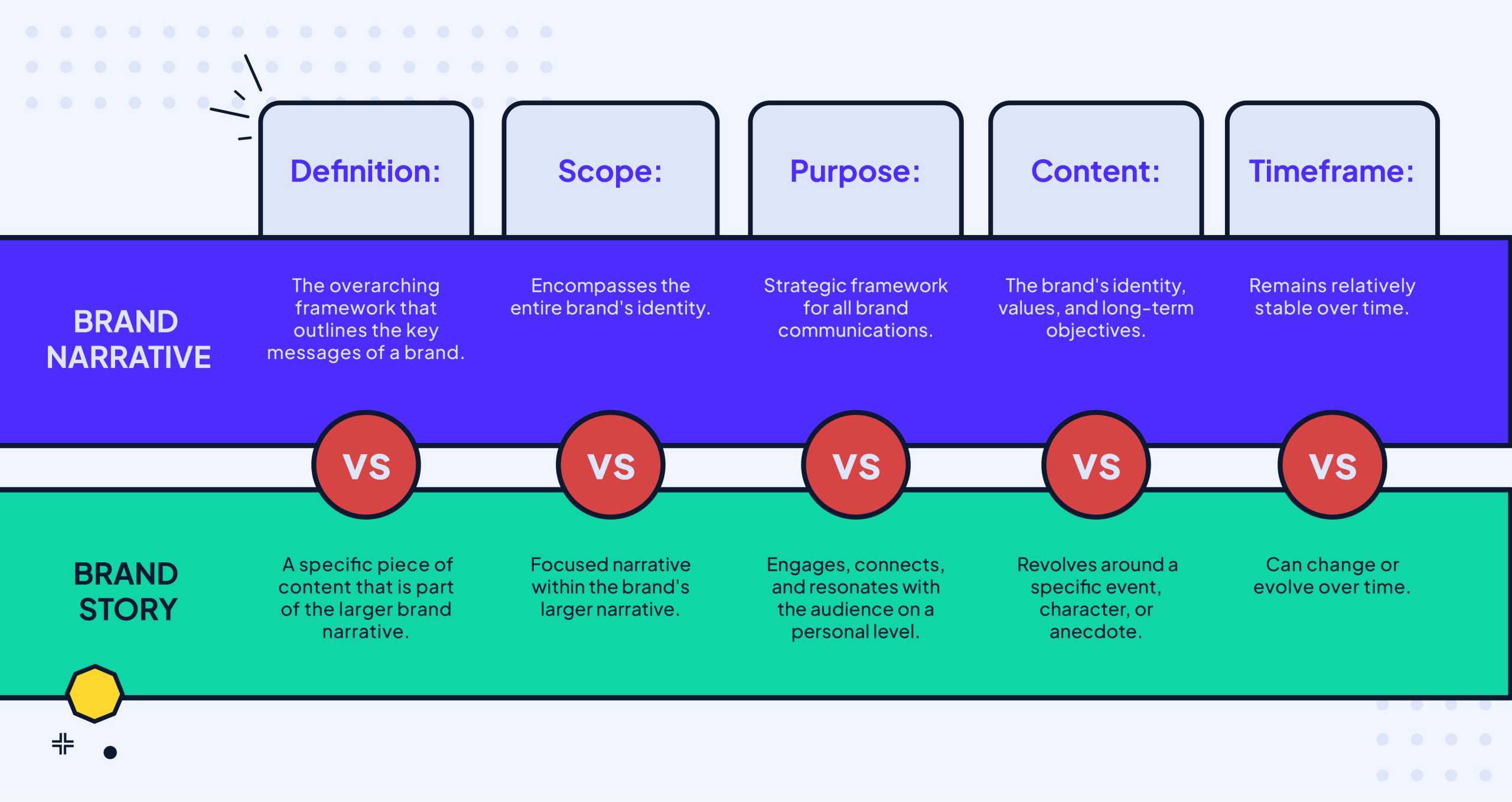
Thinking this way is a powerful tool for a brand strategist. You first define your core Brand Narrative (your 'Story'), and then you develop a series of Brand Stories (your 'Plots') to prove that narrative to your audience.
Conclusion
Today we've moved beyond a simple definition of plot to understand its relationship with the broader concept of story. This nuanced understanding is what separates adequate storytelling from truly compelling narrative work.
Here are your key takeaways:
- Story vs. Plot (Causality): A story is a sequence of events ("and then..."), while a plot connects those events with causality ("because of...").
- Story vs. Plot (Internal/External): Plot is the external action that happens, while story is the internal journey and motivation of the characters.
- Balance is Key: Effective narratives, especially in branding, require a balance. All plot is dry and transactional; all story is abstract and lacks impact.
- Application in Branding: The core Brand Narrative (the 'why') is brought to life through specific Brand Stories (the 'what' and 'how'), which function as plots demonstrating the narrative.
In our next lesson, we'll build directly on this foundation. Now that we know a plot is a sequence of causally-linked events, our next question is: how should we arrange those events for maximum impact? We will answer that by exploring the concept of the narrative arc and its role in engaging an audience.