Hello! Welcome back to our course on applying literature skills to brand storytelling.
In our last lesson, we distinguished between plot (the causal sequence of events) and story (the deeper 'why' and internal journey). We concluded that great brand narratives use specific plots (brand stories) to demonstrate their overarching story (brand narrative). This naturally leads to our next question: how do we structure these plots for the greatest impact?
Today, we will explore the answer to that question. Our learning outcome is to explain the concept of a narrative arc and its role in engaging an audience. The narrative arc is the deliberate shaping of a plot to create a powerful emotional journey for your audience. For you as a brand strategist, understanding this is like a designer understanding composition—it’s the fundamental structure that makes the final work compelling.
The Power of the Arc: Why Structure Creates Engagement
At its heart, a story is about change. A narrative arc is the structure that gives this change meaning and emotional weight. It's the journey from one state to another, full of tension and release. A well-structured story doesn't just present facts; it makes the audience feel something.
To understand why this is so effective, let's explore the psychology behind it.
The Art of the Narrative Arc: Why Marketers Must Learn to ...
The article 'The Art of the Narrative Arc' from the American Marketing Association provides a fantastic explanation for why structured stories are so powerful. It uses a great analogy and touches on the neuroscience of engagement.
Please read the section titled 'Why Stories Matter and How They Work.' As you read, pay close attention to the rollercoaster analogy and the explanation of how conflict and empathy activate memory and emotion in the brain.
As the article explains, a narrative arc creates engagement through a cycle of tension and release. The rising action builds anticipation, and the climax provides a satisfying payoff. This emotional journey does two crucial things:
- It bypasses skepticism: A well-told story feels more like an experience than a sales pitch.
- It creates memorable emotional responses: By engaging our emotions through empathy and conflict, the story's message becomes deeply embedded in our memory. Remember Jerome Bruner's finding: facts are 22 times more memorable when wrapped in a story.
Modeling the Arc: Freytag's Pyramid
Writers have been using narrative arcs for centuries. One of the most famous models was developed in the 19th century by novelist Gustav Freytag. His model, known as Freytag's Pyramid, breaks the narrative arc into five distinct stages.
To walk through these stages, let's watch a short video that explains them clearly.
Perfecting Your Plot: How to Structure a Narrative
The video 'Perfecting Your Plot: How to Structure a Narrative' by ServiceScape Literary provides a clear, step-by-step guide to the five stages of Freytag's Pyramid.
Please watch from 02:24 to 05:39. This segment introduces Freytag's Pyramid and then explains each of its five parts: Exposition, Rising Action, Climax, Falling Action, and Resolution.
To summarize, Freytag's five stages are:
- Exposition: The beginning, where the setting and characters are introduced, establishing the "normal" world.
- Rising Action: A series of events and conflicts that build tension and move the story toward its peak.
- Climax: The turning point of the story—the moment of highest tension where the protagonist faces their main challenge.
- Falling Action: The immediate aftermath of the climax, where the tension begins to dissipate and the consequences unfold.
- Resolution (or Dénouement): The end of the story, where the conflict is resolved, and a new sense of normalcy is established.
A Simpler, More Practical Model: The Three-Act Structure
While Freytag's Pyramid is a detailed and useful model, many modern storytellers—especially in film and marketing—use a simplified version called the Three-Act Structure. It condenses the five stages into a more flexible framework that's perfect for crafting brand stories.
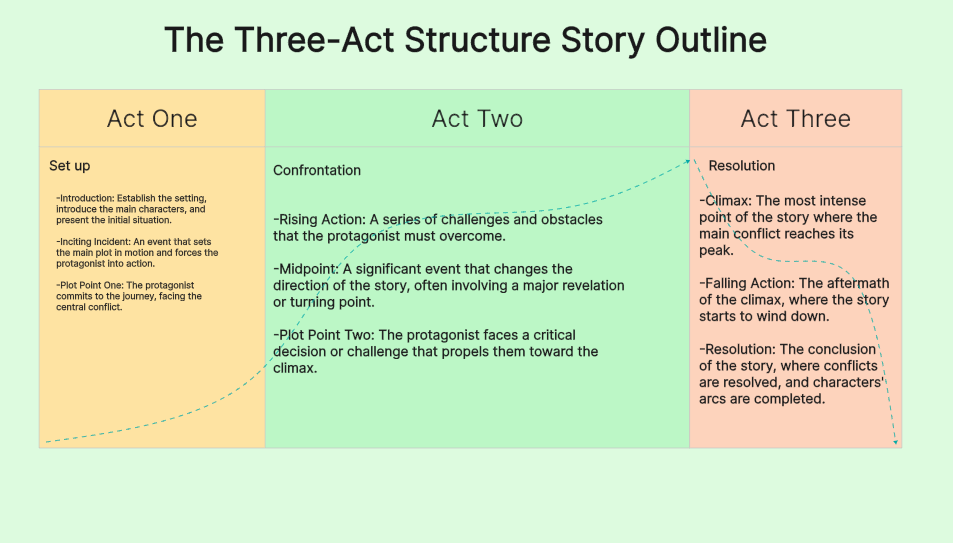
The three acts are:
- Act I: The Setup. This act introduces the main character (your customer), their world, and the problem or conflict they face. This is where you establish the initial situation.
- Act II: The Confrontation. This is the longest act, where the character attempts to solve their problem. They face obstacles, challenges escalate (rising action), and everything comes to a head in the climax, the main turning point.
- Act III: The Resolution. Following the climax, the tension falls, the problem is resolved, and we see the character in their new, transformed reality.
The Essential Ingredients: Stakes and Transformation
A narrative arc isn't just a mechanical sequence of events. For it to truly engage an audience, it must have two critical ingredients: stakes and transformation.
- Stakes: The audience must understand what the character stands to gain or lose. What's at risk? High stakes create suspense and make us care about the outcome.
- Transformation: The character must change in some meaningful way by the end of the story. This change is the point of the narrative and what makes it feel impactful.
Let's watch a segment that explains why these two elements are non-negotiable for any good story.
Marketing Storytelling: How to Craft Stories That Sell And Build Your Brand
In his video 'Marketing Storytelling,' Adam Erhart breaks down the famous 'Hero's Journey' framework. After going through all 12 steps, he boils it down to the two most important takeaways for any storyteller.
Watch from 10:47 to 11:43. Pay close attention to his two core principles: 'no stakes, no story' and 'no transformation, no impact.'
Applying the Narrative Arc to Branding
This is where theory meets practice for your work. In brand storytelling, the customer is the hero of the story. The narrative arc maps their journey from a state of frustration or need to a state of success and satisfaction. Your brand doesn't play the hero; it plays the crucial role of the guide or mentor who helps the hero succeed.
The three-act structure provides a perfect framework for this:
Marketing Storytelling: How to Craft Stories That Sell And Build Your Brand
Let's return to Adam Erhart's video. He perfectly simplifies the entire Hero's Journey into the three-act structure and explains how to apply it directly to your customer's story.
Watch from 11:43 to 13:36. Notice how he maps the Beginning, Middle, and End directly onto the customer's journey: their initial problem, how the brand guides them to a solution, and their ultimate transformation.
Let's break this down:
- Act I (The Beginning/The Problem): You start by painting a relatable picture of your customer's "ordinary world." What is the problem they face? What is their pain point or frustration? This is the conflict that ignites the story.
- Act II (The Middle/The Solution): Your customer decides to take action and meets a guide—your brand. Your brand provides them with a plan (your product or service) to overcome their problem. This is the journey of confrontation and overcoming obstacles.
- Act III (The End/The Success): With your help, the customer resolves their problem. Their life is transformed for the better. You end by showing this new reality—the success and satisfaction they now enjoy.
Test your understanding!
Think about Apple's classic "1984" Super Bowl ad, which introduced the Macintosh computer. How does it follow a three-act structure?
Show answer
- Act I (The Setup): We see a dystopian world of grey, conforming drones being lectured by a "Big Brother" figure on a giant screen. This is the "problem" world—a world of conformity and control, representing the dominance of IBM in the computer market at the time.
- Act II (The Confrontation): A lone woman, depicted in color and athletic gear, runs through the crowd, pursued by guards. She carries a large sledgehammer. Her run is the rising action, and the climax is the moment she hurls the sledgehammer at the screen, causing it to explode.
- Act III (The Resolution): The drones are bathed in light and look on in awe, freed from the screen's influence. A voiceover announces: "On January 24th, Apple Computer will introduce Macintosh. And you'll see why 1984 won't be like 1984." The transformation is from a world of conformity to one of freedom and individuality, enabled by Apple.
Conclusion
Today, we've defined the narrative arc and explored its fundamental role in creating stories that captivate an audience. By structuring a plot to create an emotional journey of tension and release, you can make any message more engaging and memorable.
Here are your key takeaways:
- A narrative arc is the structural and emotional shape of a story, guiding the audience through rising tension, a climax, and a resolution.
- It engages audiences by creating suspense and empathy, which activates emotional and memory circuits in the brain.
- The Three-Act Structure (Setup, Confrontation, Resolution) is a practical framework for building narrative arcs, especially in branding.
- For an arc to be effective, it must contain clear stakes (what's at risk) and result in a meaningful transformation for the character.
- In brand storytelling, the customer is the hero, and the narrative arc maps their journey from a problem to a successful transformation, with the brand acting as their guide.
In our next lesson, we will take an even closer look at the Three-Act Structure. We'll break down exactly what needs to happen in the beginning (setup), middle (confrontation), and end (resolution) of a brand narrative to ensure your story is clear, compelling, and effective.