Hello! Welcome to the first lesson of our new module, "Beyond Linearity: Advanced Narrative Structures."
In our previous lessons, we focused on the Hero's Journey, culminating in you drafting a compelling brand story centered on customer transformation. You learned how to position the customer as the hero and the brand as the mentor, guiding them from a problem to a successful resolution.
Today, we delve into a different but equally powerful framework: the five-act structure, also known as Freytag's Pyramid. Your learning goal for this lesson is to describe the five-act structure and its dramatic effect. This model, born from classical and Shakespearean drama, offers a sophisticated way to build and release tension, creating a powerful emotional arc for your audience. For your goal of applying literary skills to branding, understanding this structure is like adding another master tool to your storyteller's toolkit.
1. From Aristotle to Freytag: The Origin of Dramatic Arcs
Before we dive into the five acts, it's helpful to understand where this idea came from. The concept of a story having a distinct beginning, middle, and end is as old as Aristotle. However, it was a 19th-century German novelist, Gustav Freytag, who formalized this into a five-part structure after analyzing the plays of Shakespeare and ancient Greek dramatists.
Freytag's Pyramid: Unveiling the Core of Dramatic Storytelling
To get a clear picture of this history and the structure itself, let's start with a brief article from Autocrit titled 'Freytag’s Pyramid: Unveiling the Core of Dramatic Storytelling.'
Please read the first section, 'Origin and Evolution of Freytag’s Technique.' Focus on how Freytag built upon Aristotle's ideas to create his five-part framework.
As the article explains, Freytag's goal was to map the flow of dramatic tension. He visualized this flow as a pyramid, with the action rising to a peak and then falling to a conclusion.
Here is a visual representation of the structure:

2. The Five Acts: A Step-by-Step Breakdown
Freytag's Pyramid divides a story into five distinct parts, each with a specific function in managing the narrative's tension and emotional impact.
Let's explore each stage in detail.
Freytag's Pyramid: Unveiling the Core of Dramatic Storytelling
The Autocrit article provides an excellent breakdown of each stage, complete with modern examples.
Please read the sections 'The 5 Stages of Freytag’s Pyramid' and 'Elements of Freytag’s Pyramid in Classic and Modern Narratives.' As you read, pay attention to the purpose of each stage and how it contributes to the overall dramatic effect. The examples from Harry Potter and The Great Gatsby will be particularly useful.
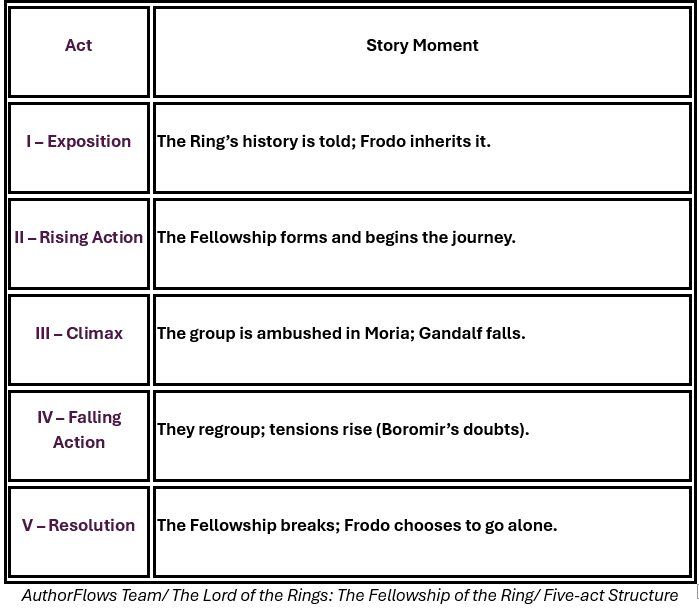
Based on your reading, let's summarize the dramatic function of each act:
- Exposition: This is the setup. It introduces the main characters, the setting, and the normal state of affairs. Its dramatic purpose is to establish a baseline and introduce an inciting incident—an event that disrupts the status quo and launches the story.
- Rising Action: A series of events that build from the inciting incident. Each event increases the conflict and raises the stakes. The dramatic effect is to build suspense and audience investment. We lean in, wanting to know what will happen next.
- Climax: The turning point of the story. This is the moment of peak tension, the confrontation where the protagonist faces their greatest challenge. Dramatically, it's the story's explosive center, after which nothing can be the same.
- Falling Action: The events that occur after the climax. The tension begins to de-escalate as the consequences of the climax unfold. This stage shows the immediate results of the turning point and starts tying up loose ends.
- Resolution (or Dénouement): The conclusion of the story. The central conflict is resolved, and a new sense of normalcy is established. For the audience, this provides a sense of closure and satisfaction. As the article notes, in classic tragedies, this stage was often a "Catastrophe."
This table provides another clear example using a well-known story:
3. Seeing the Pyramid in Action: A Christmas Carol
To truly understand the dramatic effect of the five-act structure, there's no better example than Charles Dickens's A Christmas Carol. Its five "staves" map beautifully onto the five acts, providing a masterclass in character transformation.
How A Christmas Carol Perfectly Demonstrates Five-Act Structure
The video 'How A Christmas Carol Perfectly Demonstrates Five-Act Structure' by Lessons from the Screenplay provides a brilliant, in-depth analysis. Watch how each act methodically breaks down and rebuilds its protagonist, Ebenezer Scrooge.
Watch the entire video (around 13 minutes). As you watch, notice how each new ghost marks the beginning of a new act, and focus on the specific goal of that act: Act 1: How is Scrooge's flaw established? Act 2 (Rising Action): How is he confronted with his past? Act 3 (Rising Action continues): What does he learn about the present consequences of his actions? Act 4 (Climax/Crisis): What ultimate future forces him to choose to change? Act 5 (Falling Action & Resolution): How does he prove his transformation?
The video's analysis shows the power of this structure. It doesn't just tell a story; it engineers an emotional journey for both the character and the audience, making Scrooge's final redemption feel earned and profoundly satisfying.
4. Freytag's Pyramid in Brand Storytelling
So, how does a 19th-century dramatic theory apply to 21st-century branding? Surprisingly well. This structure is perfect for telling stories about problems and solutions, which is the heart of much of marketing.
Compelling Brand Stories That Drive Success
The article 'Compelling Brand Stories That Drive Success' from Branded Agency offers a clear guide on adapting Freytag's Pyramid for branding.
Please read the section 'Crafting Your Brand Story: The Freytag's Pyramid Approach' (including all five sub-points). Focus on how each dramatic stage is translated into a branding context, using the examples of TOMS, Airbnb, Tesla, etc.
Here’s a summary of the brand story translation:
- Exposition: Introduce the customer's world and the problem they face. This is your brand's "why."
- Rising Action: Detail the customer's struggles and the challenges they encounter. Build empathy and show the urgency of the problem.
- Climax: The "aha!" moment. Introduce your brand's product or service as the unique, definitive solution to the problem.
- Falling Action: Show the positive impact. Use testimonials, case studies, or data to demonstrate how the solution works in the real world.
- Resolution: The new reality. Paint a picture of the customer's transformed life and end with a clear call to action, inviting others to join this success story.
Test your understanding!
Think about Apple's famous "1984" Super Bowl ad. Can you map its simple narrative onto Freytag's Pyramid? What happens at the Climax?
Show answer
- Exposition: A dystopian, gray world where identical people march in unison, listening to a "Big Brother" figure on a giant screen.
- Rising Action: A lone, colorful heroine runs from guards, carrying a large sledgehammer. The tension builds as she approaches the screen.
- Climax: She swings the sledgehammer and shatters the screen, silencing the "Big Brother" figure. This is the peak of the action and the turning point.
- Falling Action: A wave of light and air washes over the stunned audience.
- Resolution: The on-screen text appears: "On January 24th, Apple Computer will introduce Macintosh. And you'll see why 1984 won't be like '1984'." This presents the new reality and the product as the hero.
Conclusion
In this lesson, you've added a foundational literary structure to your branding arsenal. While the Hero's Journey is excellent for framing transformative customer journeys, Freytag's Pyramid provides a powerful blueprint for building and releasing dramatic tension, making it ideal for problem-solution narratives.
Key Takeaways:
- Freytag's Pyramid is a five-act structure (Exposition, Rising Action, Climax, Falling Action, Resolution) that maps the rise and fall of dramatic tension.
- Its dramatic effect comes from systematically building suspense to a powerful turning point (the climax) and then guiding the audience to a satisfying conclusion.
- In branding, this structure can frame a customer's problem as the rising action, the brand's solution as the climax, and the successful outcome as the falling action and resolution.
Preview of the Next Lesson:
So far, we have focused on linear narratives that move chronologically from A to B. But what happens when you break that line? In our next lesson, we will explore non-linear techniques, starting with how flashbacks can be used to reveal brand history or character backstory, adding layers of depth and intrigue to your storytelling.