Hello! Welcome back.
In our last lesson, we constructed the Yang-Mills Lagrangian, which describes the dynamics of non-Abelian gauge fields. We discovered that, unlike photons, these gauge bosons (like gluons) interact with themselves, a direct consequence of the non-Abelian group structure.
Today, we will apply this powerful framework to the real world by formulating the theory of the strong nuclear force: Quantum Chromodynamics (QCD). Our goal is to introduce the concept of "color charge" carried by quarks and then assemble the complete Lagrangian for QCD based on an SU(3) gauge symmetry. This will unify the matter fields (quarks) and the force-carrying fields (gluons) into a single, coherent theory.
The Need for Color Charge
Before we dive into the mathematics, let's address a fundamental question: why do we need to introduce a new type of charge for the strong force? The answer comes from a puzzle in particle physics related to the Pauli Exclusion Principle.
Consider the baryon. Experiments show it is a spin-3/2 particle composed of three "up" quarks (). To get a total spin of 3/2, the spins of all three quarks must be aligned (e.g., all spin-up). This means we have three identical fermions (up quarks) in the same spatial and spin state, which appears to be a direct violation of the Pauli Exclusion Principle.
The resolution, proposed in the 1960s, is to postulate that quarks possess an additional, hidden quantum number. This new degree of freedom, whimsically named color, allows the three quarks to be distinguished from one another. If each "up" quark in the has a different color, the total wavefunction can be made anti-symmetric as required, and the Pauli principle is saved.
The following video provides an excellent, detailed explanation of this reasoning.
The Strong Nuclear Force as a Gauge Theory, Part 1: Quarks
This video from Richard Behiel's series on the Strong Force provides a clear, intuitive argument for the existence of color charge, using the Delta baryon as the key example.
Watch the segment from 15:05 to 26:53. The presenter does a great job of explaining why the existence of particles like the Delta++ forces us to conclude that quarks must have an additional internal degree of freedom.
This new quantum number, color, is the "charge" of the strong interaction, just as electric charge is the charge of electromagnetism. Experiments have established that there are three colors (and three corresponding anti-colors). The theory describing the interaction of these colors is thus based on the gauge group SU(3).
The Mathematical Framework of QCD
Now that we understand the need for color, let's build the mathematical structure of QCD.
1. Quarks as Color Triplets
We represent the three color states with labels, conventionally "red" (), "green" (), and "blue" (). A quark of a specific flavor (like "up" or "down") is not described by a single Dirac spinor , but by a column vector of three Dirac spinors, one for each color:
Here, is the flavor index (e.g., ). This object, , is a field that transforms in the fundamental representation of the SU(3) color group. This means under a local SU(3) gauge transformation, it transforms as:
where is a position-dependent unitary matrix with determinant 1.
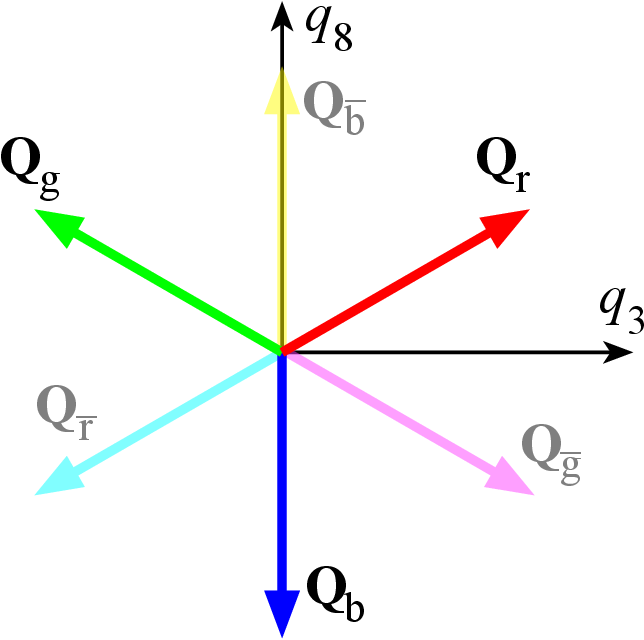
The image below shows how the three color states (and three anti-color states) are represented as vectors in the two-dimensional space defined by the diagonal generators of SU(3).
2. The QCD Lagrangian
We can now construct the full Lagrangian for QCD by following the gauge principle, just as we did for a general SU(N) theory.
Step 1: Start with free, colored quarks.
The Lagrangian for free, non-interacting quarks of all flavors and colors is simply a sum of Dirac Lagrangians:
This Lagrangian is invariant under global SU(3) transformations (where is a constant matrix), but not local ones.
Step 2: Enforce local gauge invariance.
To make the Lagrangian invariant under local SU(3) transformations, we must replace the ordinary derivative with the covariant derivative :
Here, is the strong coupling constant, and is the Lie-algebra valued gauge potential for SU(3). It's a matrix built from the eight gluon fields and the eight generators of SU(3), the Gell-Mann matrices :
The eight fields are the gluon fields, the force carriers of the strong interaction.
Step 3: Add the dynamics for the gluons.
The gluons themselves have dynamics, described by the Yang-Mills Lagrangian we derived last lesson, specialized to SU(3):
where the field strength tensor includes the gluon self-interaction term:
The are the structure constants of SU(3).
Step 4: Combine everything.
The complete classical Lagrangian of Quantum Chromodynamics is the sum of the gauge-invariant quark Lagrangian and the Yang-Mills Lagrangian for the gluons:
Expanding the covariant derivative term, we can write it as:
This elegant expression contains all the dynamics of the strong force at the fundamental level:
- The quark kinetic and mass terms.
- The interaction between quarks and gluons (the term).
- The propagation and self-interaction of gluons (the term).
The following document provides a concise and clear summary of this construction.
For a clear, written summary of the construction we just discussed, please read the following section from a CERN lecture on QCD.
Read Section 1.1, "The QCD Lagrangian" (pages 66-67). This section compactly lays out all the components we've discussed: the SU(3)c symmetry, the quark fields with color and flavor indices, the covariant derivative, the non-abelian field strength, and the final combined Lagrangian in equations (6) and (7).
The next video provides a step-by-step walkthrough of deriving the general SU(N) gauge theory, which directly maps to our construction of QCD for N=3.
Deriving Yang-Mills Theory And Quantum Chromodynamics (QCD) | Quantum Field Theory
This video from Dietterich Labs follows a very similar logic to our course, using the derivation of QED as a template to build a general SU(N) gauge theory (Yang-Mills theory). This process is exactly what yields QCD when N=3.
Watch the video from 06:51 to 20:15. This extended segment covers the entire derivation: starting with the global SU(N) Dirac Lagrangian, introducing the covariant derivative and gauge fields for local symmetry, finding the field strength tensor, constructing the Yang-Mills term, and finally combining them to get the full QCD Lagrangian. This will be a great review and consolidation of everything we've learned in the last few lessons.
Test your understanding!
Let's look closely at the quark-gluon interaction term in the QCD Lagrangian: .
If we write out the color indices explicitly, letting be a column vector with components (where or ), this term becomes:
What does this expression tell you about how a gluon interacts with a quark? Specifically, what does a gluon do to a quark's color?
Show answer
The interaction is governed by the matrix elements . A gluon of type a couples a quark of color k to a quark of color j. Since the Gell-Mann matrices () are generally not diagonal, the interaction causes a quark to change its color.
For example, a quark can absorb or emit a gluon and transition from a "red" state to a "green" state. This means that unlike the photon in QED, which just couples to electric charge without changing it, the gluons themselves carry color and actively participate in changing the color states of the quarks they interact with. This is a fundamental feature of the strong interaction.
Conclusion
In this lesson, we have successfully formulated the theory of Quantum Chromodynamics by applying the principles of local gauge invariance to the SU(3) color group.
Key Takeaways:
- The experimental evidence for particles like the necessitates a new quantum number for quarks, called color.
- Quarks come in three colors and are described by fields in the fundamental representation of the SU(3) gauge group.
- The force carriers are the eight gluons , which are the gauge bosons of SU(3).
- The complete QCD Lagrangian combines the gauge-invariant Dirac Lagrangian for quarks with the Yang-Mills Lagrangian for gluons:
- This Lagrangian encapsulates the full classical dynamics of the strong force, including quark propagation, quark-gluon interactions, and gluon self-interactions.
Preview of the Next Lesson:
We have now written down the classical Lagrangian for QCD. However, as you know from your study of QED, writing the Lagrangian is only the first step. To actually perform calculations, we must quantize the theory. Quantizing a non-Abelian gauge theory like QCD presents new challenges not seen in QED. In the next lesson, we will begin this process by discussing the Faddeev-Popov procedure and the introduction of unphysical "ghost" fields, which are essential for a consistent quantization of the theory.