In our previous lesson, you learned to distinguish between a highly structured Data Warehouse and a flexible, raw Data Lake. We established that a data lake's core feature is its ability to store massive amounts of unstructured and semi-structured data using a "schema-on-read" approach. Today, we'll build on that concept to answer the crucial question: What is this actually used for?
This lesson focuses on the common use cases for a data lake, specifically highlighting scenarios where its ability to handle raw data is not just a feature, but a critical asset. As a software architect, you are accustomed to designing systems for specific requirements; the data lake excels in situations where the requirements—and the questions you need to ask of your data—are not yet fully defined.
From Data Reservoir to Insight Engine
The primary value of a data lake comes from its ability to fuel applications that go beyond traditional business reporting. While a data warehouse is perfect for answering known questions ("How many units did we sell last quarter?"), a data lake is designed for exploration and discovery, helping you answer questions you haven't even thought of yet.
This is because it ingests data in its native format. This raw data is a goldmine for data scientists and machine learning engineers. The following diagram illustrates this flow perfectly. Various forms of data are pooled into the lake, which then serves as the foundation for a wide range of advanced analytical applications.
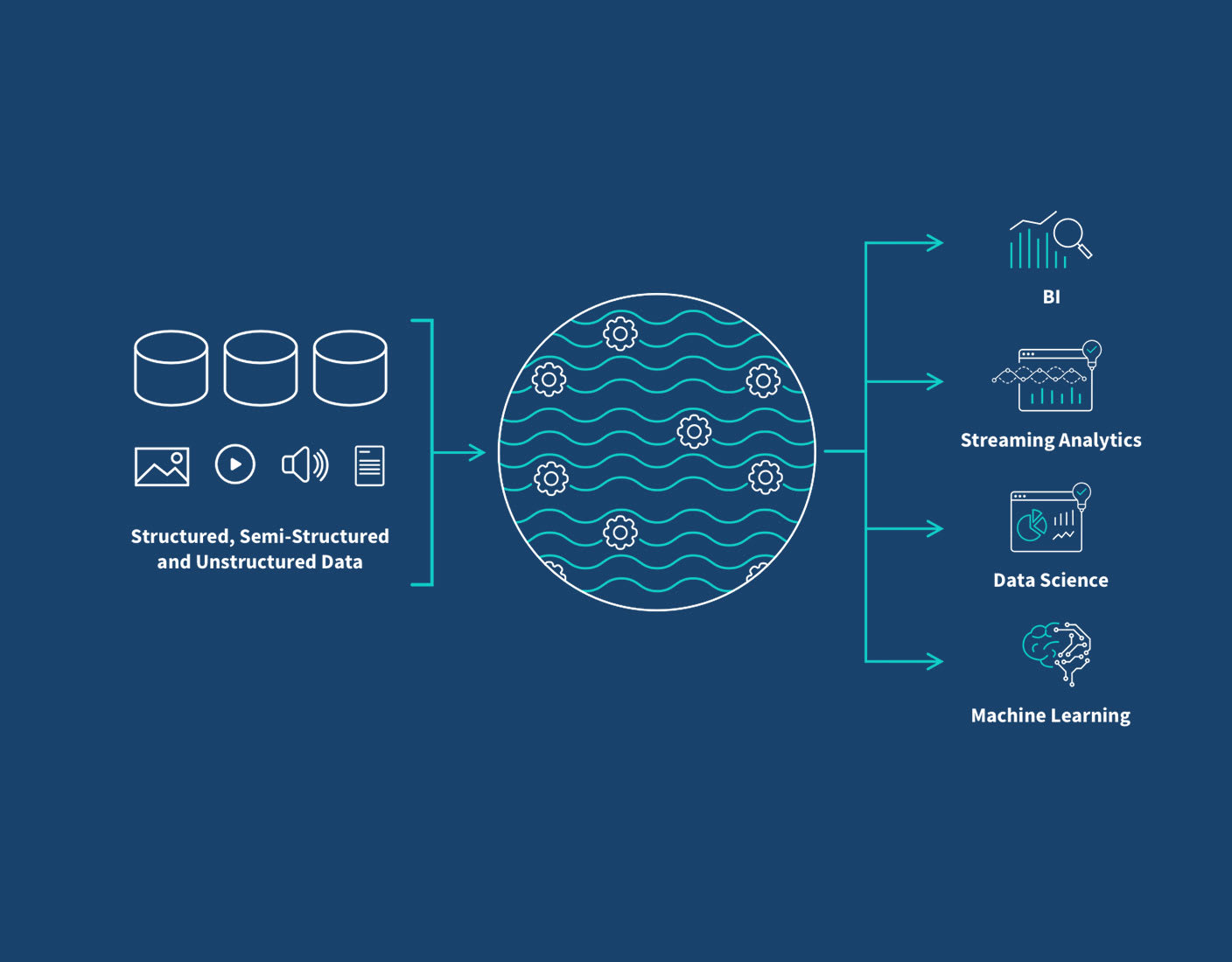
Key Use Cases for Raw Data
The flexibility of the data lake makes it ideal for several modern data challenges. The most prominent use cases are driven by the need to analyze complex, diverse, and rapidly changing datasets.
-
Machine Learning (ML) and Artificial Intelligence (AI): This is arguably the most significant driver for data lake adoption. ML models, especially in deep learning, perform better with more data. Data lakes provide a vast repository of raw data (text, images, logs, audio) that data scientists can use to train, test, and validate predictive models without the constraints of a predefined schema.
-
Real-Time Analytics and IoT: Consider the data generated by Internet of Things (IoT) devices, social media feeds, or website clickstreams. This data is high-volume, high-velocity, and often semi-structured (like JSON logs). A data lake can ingest these streams in real-time, enabling immediate analysis for things like operational monitoring, anomaly detection, or tracking user engagement as it happens.
-
Advanced Customer Analytics (360-Degree View): Businesses aim to understand their customers from every angle. A data lake allows an organization to consolidate all customer-related data—structured (from a CRM), semi-structured (web logs), and unstructured (support emails, social media mentions)—into a single repository. This unified view enables sophisticated analysis of customer behavior, journey mapping, and sentiment analysis.
A Real-World Example: Netflix
To make this concrete, let's look at how one of the world's largest data-driven companies uses its data lake. The following article provides a concise case study on Netflix, which is a textbook example of leveraging raw data for a core business function.
Modern Data Architecture: Data Lake vs. Data Warehouse vs. Lakehouse
This article offers excellent, tangible examples of data lake use cases. We'll focus on a couple of key sections.
First, read the two bullet points under the heading "Real-World Example". This will give you a quick, high-level summary of applications in media and healthcare. Next, scroll down to the "Real-World Case Studies" section and read the case study titled "Netflix: Mastering Data Lakes for Personalization". Pay attention to the types of data they ingest and why a data lake is the right architecture for their goal of personalization.
As the Netflix example shows, the ability to dump 1.5 petabytes of raw viewing logs, device metrics, and A/B test results into a single place is what allows their data scientists to build the recommendation engine that is central to their product. This would be nearly impossible to achieve with a traditional data warehouse, which would require structuring and cleaning this data before it could even be stored.
Other industries follow similar patterns:
- In finance, data lakes are used for real-time fraud detection by analyzing streams of transaction data, user location, and device information simultaneously.
- In retail, they power dynamic pricing engines and analyze in-store customer movement via sensor data.
Key Takeaways
You've now seen not just what a data lake is, but why it's a critical component in the modern data stack.
- A data lake's primary value lies in its ability to store raw, unstructured data, making it the ideal platform for use cases where questions are not known in advance.
- The most common and powerful applications are in Machine Learning/AI, real-time streaming analytics (IoT), and creating a 360-degree customer view.
- Companies like Netflix use data lakes to power core business functions like content recommendation by analyzing massive volumes of raw user interaction data.
In our next and final lesson, we will move from these general concepts to a specific, powerful technology: Snowflake. You'll learn about its unique architecture and see how it seeks to combine the power and flexibility of a data lake with the simplicity and performance of a data warehouse.