Welcome to the first day of your conceptual tour through the world of modern data platforms. Your goal is to get a high-level understanding of Data Lakes and Snowflake, and today we'll build the foundation for that by exploring the "Data Lake" concept.
Given your background as a software architect with experience in databases and cloud infrastructure, you're already familiar with the challenges of storing and managing data. Today's lesson will focus specifically on two major paradigms for large-scale data storage: the traditional Data Warehouse and the more modern Data Lake. By the end of our 10 minutes, you will be able to explain what a data lake is and how it fundamentally differs from a data warehouse.
The Traditional Approach: The Data Warehouse
Let's start with the more established concept: the Data Warehouse. You can think of it as a highly organized central library for a company's data. Its primary purpose is to power business intelligence (BI), reporting, and analytics.
The defining characteristic of a data warehouse is its process. Data from various sources (like transactional databases, CRM systems, etc.) isn't just dumped in. It first goes through a process called ETL (Extract, Transform, Load). The data is:
- Extracted from its source.
- Transformed into a clean, consistent, and structured format. This means cleaning up errors, standardizing values, and fitting it into a predefined model or schema.
- Loaded into the warehouse.
This "schema-on-write" approach ensures that the data is reliable and optimized for fast queries, making it ideal for business analysts who need to ask specific, predictable questions. However, it's also rigid; the schema must be defined upfront, and it handles structured data best.
The following short video provides an excellent overview of both databases, which you're familiar with, and data warehouses.
Database vs Data Warehouse vs Data Lake | What is the Difference?
This clip from the "Alex The Analyst" YouTube channel clearly explains what a data warehouse is and contrasts it with a standard database.
Watch the section that defines a data warehouse, paying attention to the concepts of OLAP (Online Analytical Processing) and the ETL process. The video then offers a quick comparison between a database and a data warehouse, which will help solidify the concept.
The Modern Paradigm: The Data Lake
Now, let's turn to the Data Lake. If a data warehouse is a curated library, a data lake is a massive, unfiltered reservoir. It's designed to store vast quantities of data in its raw, original format—structured, semi-structured, and unstructured data all live together. Think log files, social media feeds, images, videos, and sensor data.
The key difference is the data processing model. A data lake uses a "schema-on-read" approach. Data is loaded into the lake first without any transformation. A structure (schema) is only applied when the data is pulled out for a specific analysis. This is often described as ELT (Extract, Load, Transform).
This flexibility makes data lakes ideal for use cases where the questions aren't known in advance, such as:
- Data science exploration
- Machine learning model training
- Artificial intelligence applications
Data scientists and data engineers are the primary users, as they have the skills to work with raw, messy data and discover new insights.
To see this explained, let's return to the same video.
Database vs Data Warehouse vs Data Lake | What is the Difference?
This next segment introduces the Data Lake concept.
Please watch the clip that explains what a data lake is. Notice the emphasis on storing any type of data in its raw form and its primary use cases, like machine learning.
Data Lake vs. Data Warehouse: At a Glance
To summarize the core distinctions, the key is not just what they store, but how and for whom.
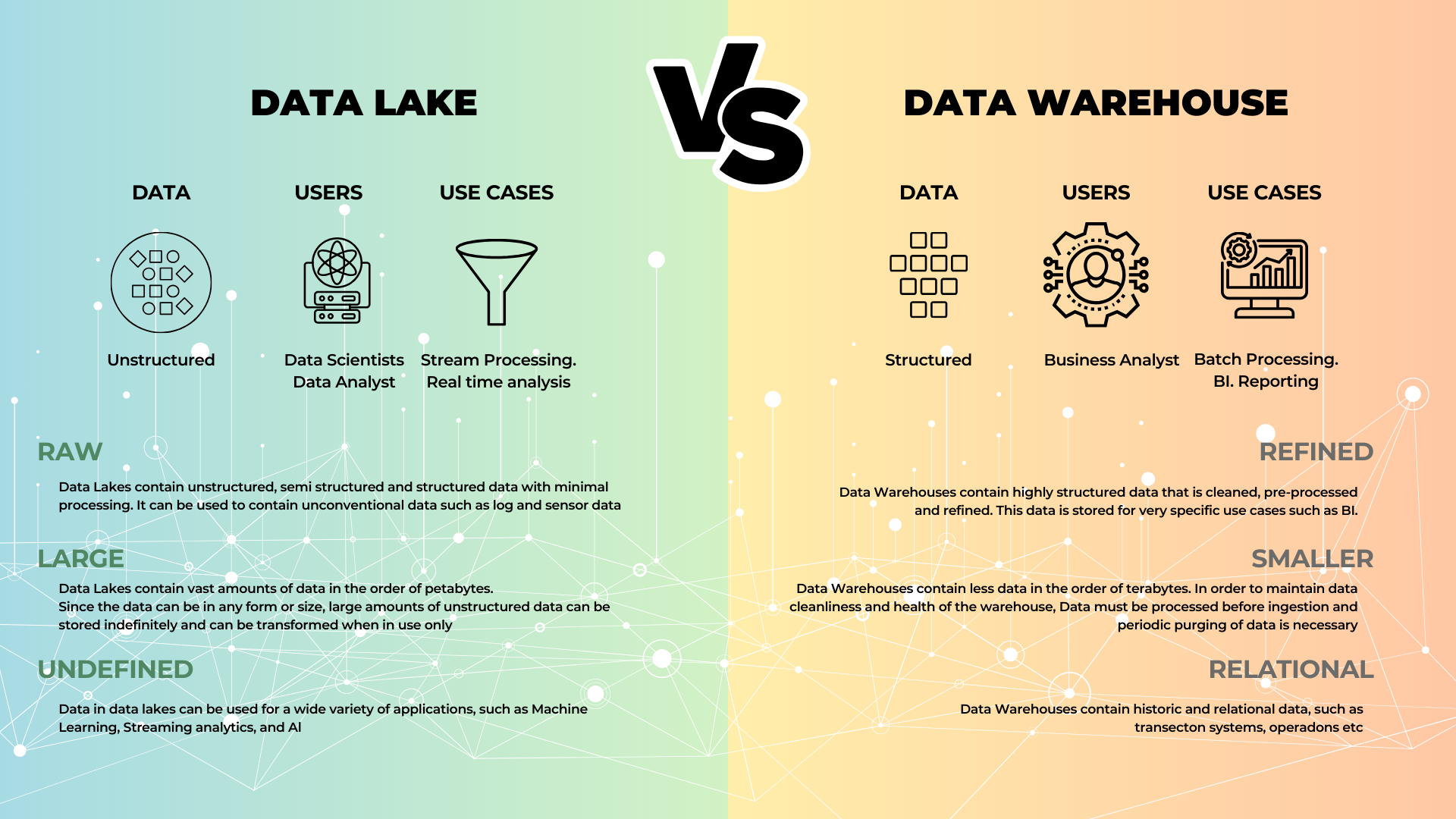
For a more detailed breakdown, the following article from Splunk offers a concise comparison.
Data Lake vs. Data Warehouse: Definitions, Key ...
This article section clearly lays out the primary points of comparison between the two systems.
Please read the section titled The 6 main differences. Focus your attention on the points discussing Data structure & schema, Users, and Purpose/use case, as these are the most critical distinctions.
Key Takeaways
You've now covered the essential concepts for today. Let's recap:
- Data Warehouse: Stores structured, processed data for a predefined purpose (like BI reporting). It uses a schema-on-write (ETL) model, making it organized but rigid.
- Data Lake: Stores raw, unstructured data with no predefined purpose. It uses a schema-on-read (ELT) model, making it flexible and scalable, ideal for data science and AI.
The core trade-off is between the structured reliability of a warehouse and the raw flexibility of a lake.
In our next lesson, we will introduce Snowflake. You'll discover its unique architecture and see how it cleverly navigates the landscape between the structured world of data warehouses and the flexible nature of data lakes.