Welcome back. In our last lesson, we compared the Ayurvedic rationale for managing Medoroga (Pathya-Apathya) with modern dietary approaches for obesity, bridging the qualitative science of Gunas with the quantitative science of metabolic hormones.
Today, we transition our focus from metabolic disorders to the heart of digestive health: Agni. This lesson marks the beginning of our module on functional digestive disorders. Our learning outcome is to analyze the relationship between Agni types and modern digestive enzyme physiology. For an integrative practitioner, this ability to translate the functional concept of Agni into the language of modern physiology is fundamental for diagnosis, patient education, and effective treatment.
1. The Ayurvedic Framework: The Hierarchy of Transformative Power
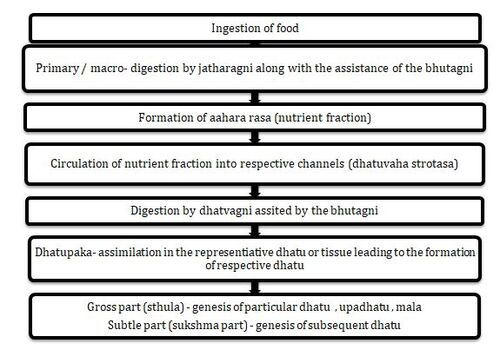
From your BAMS studies, you have a solid understanding of Agni as the biological fire governing all transformation in the body. It is not a single entity but a complex, hierarchical system. To refresh and structure this concept for our analysis, let's look at its main classifications.
- Jatharagni: The principal digestive fire located in the Koshtha (GI tract), primarily in the Grahani (duodenum). It is responsible for the initial breakdown of ingested food.
- Bhutagni: The five "elemental" fires, largely associated with the liver, which process the digested nutrients at a more subtle level, making them suitable for assimilation by the body's tissues.
- Dhatvagni: The seven tissue-specific fires, each residing in one of the Dhatus (tissues). They govern the metabolic processes unique to each tissue, ensuring its proper formation and nourishment.
This sequence represents a cascade of digestion and metabolism, from the gross to the subtle.
Beyond this structural hierarchy, Ayurveda also describes four functional states of Jatharagni, which reflect its efficiency and are determined by the influence of the Doshas:
- Samagni (Balanced): Normal, efficient digestion. Occurs when Doshas are in equilibrium.
- Tikshnagni (Sharp/Hyperactive): Overly intense digestion, often associated with Pitta dominance.
- Mandagni (Slow/Dull): Weak, sluggish digestion, characteristic of Kapha dominance.
- Vishamagni (Irregular): Erratic, unpredictable digestion, caused by Vata dominance.
Understanding this framework is the first step. The next is to map it onto the landscape of modern physiology.
2. The Modern View: A Symphony of Enzymes
Modern physiology describes digestion as a highly organized process of chemical breakdown orchestrated by specific proteins called enzymes, along with other secretions like acids and bile.
Let's look at a map of these key players.

From this, we can summarize the digestive journey:
- Mouth: Digestion begins with salivary amylase breaking down carbohydrates.
- Stomach: The highly acidic environment (due to hydrochloric acid, HCl) denatures proteins, allowing the enzyme pepsin to begin protein digestion.
- Small Intestine: This is the primary site of chemical digestion and absorption. The pancreas releases a potent cocktail of enzymes—pancreatic amylase (for carbs), trypsin (for proteins), and lipase (for fats)—into the duodenum. The acidic chyme from the stomach is neutralized by bicarbonate, creating the alkaline environment these enzymes require. Bile from the liver emulsifies fats, preparing them for digestion by lipase.
Now, let's build the bridge between these two worlds.
3. Correlating Agni and Enzymes: From Function to Physiology
The relationship between Agni and enzymes is not one-to-one. Agni is a broader, functional concept representing the entire capacity for transformation, while enzymes are the specific biochemical tools that carry out this transformation.
To explore this correlation in depth, the following video provides an excellent academic perspective.
Webinar on Concept of Agni with special reference to gastrointestinal physiology and Prakriti
In this webinar from the National Institute of Ayurveda, the speaker delves into the concept of Agni and its correlation with modern gastrointestinal physiology.
Please watch the segment from 32:19 to 44:37. The speaker provides a detailed correlation between the Ayurvedic concept of Agni and the modern understanding of digestive secretions, absorption, and the metabolism of carbohydrates, proteins, and lipids. This will form the basis for our analysis.
Building on the insights from the video and other scholarly work, we can establish the following key correlations.
Jatharagni ↔️ Overall GI Digestive Power
Jatharagni is best understood as the net digestive capacity of the upper gastrointestinal tract. It is the combined, synergistic action of:
- Gastric secretions: Hydrochloric acid (HCl) and pepsin.
- Pancreatic secretions: Amylase, lipase, trypsin, chymotrypsin, and bicarbonate.
- Bile: For fat emulsification.
- Intestinal brush border enzymes: Lactase, sucrase, etc.
The four functional states of Jatharagni can be correlated with the quantitative and qualitative status of these secretions:
- Samagni: A state of eubiosis and optimal secretion, corresponding to a normal Basal Metabolic Rate (BMR) and efficient digestion.
- Tikshnagni: Can be correlated with hypersecretion, particularly of gastric acid (hyperchlorhydria), leading to rapid digestion and symptoms of hypermetabolism.
- Mandagni: Can be correlated with hyposecretion, such as hypochlorhydria or exocrine pancreatic insufficiency (EPI), leading to sluggish digestion, bloating, and hypometabolism.
- Vishamagni: Correlates with dysregulated or erratic secretion of enzymes and uncoordinated GI motility, often seen in functional disorders like Irritable Bowel Syndrome (IBS).
Bhutagni ↔️ Hepatic Biotransformation
Once nutrients are absorbed from the intestine, they travel via the portal vein to the liver. The liver is the body's primary metabolic hub. The function of the five Bhutagnis—transforming the digested food into a form usable by the body's tissues—correlates strongly with hepatic metabolism. This includes:
- Detoxification (Phase I and Phase II biotransformation).
- Metabolism of carbohydrates: Glycogenesis, glycogenolysis, gluconeogenesis.
- Metabolism of proteins: Synthesis of plasma proteins, deamination of amino acids.
- Metabolism of lipids: Synthesis of cholesterol and bile salts.
Essentially, Bhutagni represents the liver's enzymatic machinery that "purifies" and "prepares" the absorbed nutrients for the rest of the body.
Dhatvagni ↔️ Tissue-Specific Cellular Metabolism
Finally, the function of the seven Dhatvagnis corresponds to tissue-specific cellular metabolism. Each tissue has unique enzymatic pathways that allow it to take up the nutrients prepared by the liver and use them for its specific functions—energy production, repair, and synthesis of structural or functional components. For example:
- Mamsa Dhatvagni (muscle tissue fire) correlates with the cellular enzymes responsible for muscle protein synthesis.
- Asthi Dhatvagni (bone tissue fire) correlates with the enzymatic activity of osteoblasts in bone formation and mineralisation.
- Rasa Dhatvagni (plasma/lymph tissue fire) can be linked to aspects of glucose metabolism and the formation of blood components.
The following resources provide excellent tables and summaries that crystallize these correlations.
Comprehensive review of Agni physiology: Ayurvedic ...
This review article, 'Comprehensive review of Agni physiology', contains a clear and concise table that directly maps Ayurvedic Agni concepts to their modern physiological counterparts.
Please review the section titled 'Modern Correlations of Agni Physiology'. Focus on the table within this section. It explicitly connects Jatharagni, Bhutagni, Dhatvagni, and the four Agni states to terms like gastric digestion, hepatic metabolism, BMR, and hyper/hypometabolism. This is a key summary for our lesson.
CORRELATION OF FOOD DIGESTION PROCESS
The article 'CORRELATION OF FOOD DIGESTION PROCESS' offers a step-by-step comparison and concludes with a very direct set of correlations.
Read the 'CONCLUSION' section. It provides a straightforward summary: 'The Jathragni can be correlated with Gastric juice. Panchbhutagni can be correlated with Pancratic juice and Bile salts. Saptdhatwagni can be correlated with the Intestinal juice.' While the correlation of Bhutagni and Dhatvagni can be more nuanced (as we discussed with liver and cellular metabolism), this provides a practical, GI-centric view.
Test your understanding!
A 45-year-old patient presents with chronic bloating, a feeling of heaviness after meals, undigested food in their stool, and mild fatigue. Based on today's lesson, how would you describe their condition using both Ayurvedic and modern physiological terminology, and what specific modern dysfunction might you suspect?
Show answer
-
Ayurvedic Terminology: The patient's symptoms are classic signs of Mandagni (sluggish digestive fire), likely with a predominance of Kapha Dosha. This impaired Jatharagni is leading to the formation of Ama (improperly digested food) and poor nourishment of the Dhatus, causing fatigue.
-
Modern Physiological Correlation: The state of Mandagni corresponds to a hypometabolic state in the GI tract. The symptoms suggest a deficiency in the secretion or action of key digestive enzymes.
-
Suspected Modern Dysfunction: The specific symptoms point towards possible exocrine pancreatic insufficiency (EPI), where the pancreas does not produce enough digestive enzymes (lipase, amylase, protease) to break down food effectively. Another possibility could be hypochlorhydria (low stomach acid), which would impair protein digestion and could have downstream effects on pancreatic enzyme release.
Conclusion
Today we have built a robust bridge between the Ayurvedic concept of Agni and modern digestive physiology. This integrative understanding moves beyond simple one-to-one translations and appreciates the depth of both systems.
Key Takeaways:
- Agni is a holistic, functional concept representing the body's entire transformative power, organized in a hierarchy from the gut to the cells.
- Jatharagni correlates with the combined digestive power of the upper GI tract's enzymes and secretions (gastric, pancreatic, biliary).
- The four states of Jatharagni (Sama, Tikshna, Manda, Vishamagni) can be understood as states of balanced, hyper-, hypo-, or dysregulated enzymatic function.
- Bhutagni aligns with the metabolic and biotransformation functions of the liver.
- Dhatvagni corresponds to the specific enzymatic pathways within each tissue that govern cellular metabolism.
Grasping these relationships empowers you to use modern diagnostic insights to refine your Ayurvedic assessment of Agni and to explain complex Ayurvedic principles to your patients in a clear, relatable way.
Preview of the Next Lesson:
When Agni is impaired, the result is the formation of Ama—metabolic toxins. In our next lesson, we will correlate the Ama concept with gut dysbiosis and systemic inflammatory markers, taking our analysis of digestive pathology one step further.