Hello! Welcome to our next lesson.
In our previous session, we established a strong analytical framework for understanding Inflammatory Bowel Disease (IBD) through the Ayurvedic concepts of Grahani, Atisara, and Pravahika. We correlated the clinical presentations of Ulcerative Colitis and Crohn's Disease with Pittaja and Sannipataja pathogenesis, respectively, rooting the disease process in Agnimandya and severe Dosha vitiation.
Today, we transition from pathogenesis (Samprapti) to treatment (Chikitsa). Our goal is to evaluate key anti-inflammatory Dravyas (e.g., Kutaja, Bilva, Musta) with supporting modern pharmacological evidence. By the end of this lesson, you will be able to analyze how these classical medicines work, not just through the lens of Rasa Panchaka, but also through modern scientific mechanisms like antimicrobial action, mucosal healing, and immunomodulation.
1. The Therapeutic Principle: Grahi Karma
Before we examine the individual herbs, it's crucial to understand their primary shared action in the context of inflammatory and diarrheal gut disorders: the Grahi Karma. As a BAMS graduate, you are familiar with this term, but let's refine its meaning in this specific context.
A Grahi (absorbent) Dravya has a unique tripartite action:
- Deepana: It stimulates a weakened Agni.
- Pachana: It helps digest and metabolize residual toxins (Ama).
- Shoshana: It absorbs excess fluid from the intestines.
This makes Grahi action fundamentally different from and superior to Stambhana (styptic/astringent) action for conditions like Grahani and IBD. While a Stambhana drug simply stops fluid loss (often by constricting channels), a Grahi drug addresses the root cause by correcting Agni and clearing Ama, while also providing symptomatic relief. This restorative approach is central to managing IBD in Ayurveda. The three herbs we are focusing on—Kutaja, Bilva, and Musta—are exemplary Grahi Dravyas.
2. Evaluating the Anti-Inflammatory Dravyas
Let's now evaluate our three selected herbs, integrating classical wisdom with modern evidence. The image below shows two of the plants we will discuss.
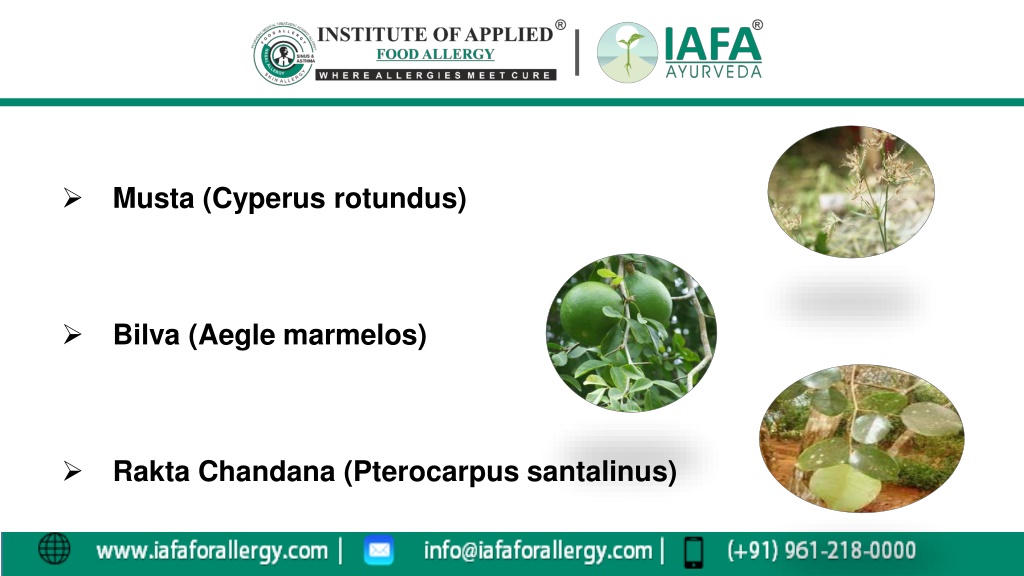
To gain a comprehensive understanding, we will draw from two key review articles that brilliantly synthesize Ayurvedic knowledge and modern research.
A Review of Grahi Dravyas and Grahani: An Ayurvedic and Integrative Medical Review
To build our evaluation, we'll use two resources. The first paper, 'A Review of Grahi Dravyas,' provides excellent integrated profiles. The second, 'Grahani: An Ayurvedic and Integrative Medical Review,' offers specific pharmacological insights from modern studies. Please read the specified sections to gather the necessary evidence.
From the paper 'A Review of Grahi Dravyas...' (resource ID LINK), please read the section 'Pharmacopoeia of Prominent Grahi Dravyas', focusing on the detailed descriptions for Kutaja, Musta, and Bilva. Pay attention to the Ayurvedic Profile, Phytochemistry, and Modern Pharmacology for each.
Grahani: An Ayurvedic and Integrative Medical Review
Now, let's look at the second resource for specific clinical and pre-clinical evidence.
From the paper 'Grahani: An Ayurvedic and Integrative Medical Review...' (resource ID LINK), please read section 6.2, 'Pharmacological Insights into Key Herbs (Kutaja, Bilva, Musta)'. This section contains crucial information about studies demonstrating their efficacy in IBD-like conditions.
Now that you have reviewed the source material, let's synthesize and evaluate this information for each herb.
A. Kutaja (Holarrhena antidysenterica): The Potent Antimicrobial Astringent
-
Ayurvedic Evaluation:
- Rasa Panchaka: Tikta (bitter), Kashaya (astringent) Rasa; Laghu, Ruksha Guna; Sheeta Veerya; Katu Vipaka.
- Karma: Primarily Grahi and Stambhana.
- Analysis: Its Tikta and Kashaya tastes, combined with Sheeta Veerya, make it an outstanding Pitta-Shamaka (Pitta-pacifying) drug. This directly counteracts the Vidagdha Pitta (corrosive Pitta) that drives the inflammation and ulceration in Pittaja Grahani (UC). While its Sheeta Veerya is typical of a Stambhana agent, it is classified as a premier Grahi due to its efficacy in conditions with Ama and infection, an action attributed to its Prabhava (specific, inexplicable action). It is the drug of choice for Pravahika (dysentery) and Raktatisara (bloody diarrhea).
-
Modern Pharmacological Support:
- Phytochemistry: The primary active constituents are steroidal alkaloids, especially conessine.
- Anti-inflammatory Mechanism: Kutaja's primary mechanism is antimicrobial. Conessine has potent amoebicidal and antibacterial effects against pathogens like Entamoeba histolytica and Shigella. By eliminating these microbial triggers, it removes a major source of inflammation.
- Evidence: Its astringent and anti-diarrheal properties are well-documented. As noted in the LINK resource, clinical studies have validated its use in ulcerative colitis, showing a significant reduction in bowel frequency and rectal bleeding.
B. Bilva (Aegle marmelos): The Mucosal Protector and Healer
-
Ayurvedic Evaluation:
- Rasa Panchaka: (unripe fruit) Kashaya, Tikta Rasa; Laghu, Ruksha Guna; Ushna Veerya; Katu Vipaka.
- Karma: Deepana, Pachana, and Grahi.
- Analysis: The Ushna Veerya makes Bilva a powerful digestive stimulant, ideal for chronic conditions rooted in deep-seated Mandagni. It is specifically indicated for chronic Grahani and Atisara, where the gut lining is weak and damaged. Its function is not just to stop diarrhea but to restore the integrity of the Grahani itself.
-
Modern Pharmacological Support:
- Phytochemistry: Contains coumarins (like marmelosin), alkaloids, and tannins.
- Anti-inflammatory Mechanism: Bilva's standout mechanism is mucosal protection. Research shows it increases the thickness of the adherent mucus gel layer, enhances the production of protective glycoproteins, and promotes the repair of the gut lining. This is a direct physical barrier against inflammatory agents.
- Evidence: The study on a mouse model of ulcerative colitis (mentioned in LINK) is compelling. It showed that Bilva was able to reduce the disease activity index and lower levels of the pro-inflammatory cytokine TNF-α, a key target for modern IBD drugs.
C. Musta (Cyperus rotundus): The Broad-Spectrum Immunomodulator
-
Ayurvedic Evaluation:
- Rasa Panchaka: Katu (pungent), Tikta, Kashaya Rasa; Laghu, Ruksha Guna; Sheeta Veerya; Katu Vipaka.
- Karma: It is celebrated as a classic Deepana, Pachana, and Grahi agent.
- Analysis: Musta's combination of tastes makes it Tridoshic in action, but its Sheeta Veerya gives it a strong anti-inflammatory (Pitta-Shamaka) edge. It is one of the most versatile herbs for digestive disorders, addressing both the symptoms (Atisara) and the root cause (Agnimandya).
-
Modern Pharmacological Support:
- Phytochemistry: Rich in a volatile oil containing sesquiterpenes (e.g., α-cyperone).
- Anti-inflammatory Mechanism: Musta demonstrates the most direct and sophisticated immunomodulatory action. It works by downregulating the gene expression of key pro-inflammatory cytokines, including Interleukin-4 (IL-4), IL-6, IL-12, and Interferon-gamma (IFN-γ), as highlighted in the LINK resource. This targets the very core of the inflammatory cascade in the gut.
- Evidence: Its anti-diarrheal, antispasmodic, and anti-inflammatory effects are well-supported. Its ability to modulate the immune response makes it a scientifically validated choice for chronic inflammatory conditions like IBD.
Test your understanding!
A patient with a diagnosis of ulcerative colitis (Pittaja Grahani) presents with frequent, bloody stools (Raktatisara) and signs of an active gut infection. Another patient with long-standing Crohn's-like symptoms (Sannipataja Grahani) has less bleeding but significant mucosal damage, malabsorption, and a highly reactive immune system.
Based on their primary mechanisms of action, which herb—Kutaja, Bilva, or Musta—would you prioritize for each patient? Justify your choice by linking the herb's primary Ayurvedic Karma and modern pharmacological mechanism to the patient's specific presentation.
Show answer
-
Patient 1 (UC with infection): The priority herb here would be Kutaja.
- Justification: The presentation is dominated by active bleeding and infection (Pravahika/Raktatisara). Kutaja's potent antimicrobial action (via conessine) directly targets the infectious trigger. Its strong Stambhana (astringent) quality helps control the bleeding. This aligns perfectly with its classical indication for such conditions.
-
Patient 2 (Crohn's with mucosal damage): While a combination would be ideal, Bilva and Musta offer the most targeted benefits.
- Justification: For the mucosal damage and malabsorption, Bilva is the priority. Its unique ability to heal the gut lining and increase the protective mucus layer directly addresses the structural damage (Grahani dysfunction). For the underlying immune hyperactivity, Musta is key. Its proven ability to downregulate a wide range of pro-inflammatory cytokines targets the core immunopathology of the disease. A combination would therefore provide both structural repair and immune system regulation.
Conclusion
In this lesson, we have moved beyond simple descriptions of herbs to a deep evaluation of their therapeutic actions. We have seen how the classical wisdom behind Dravyas like Kutaja, Bilva, and Musta is being powerfully validated by modern science.
Key Takeaways:
- Grahi Karma (Deepana-Pachana-Shoshana) is the holistic therapeutic principle for managing inflammatory diarrheal disorders, addressing both symptoms and root causes.
- Kutaja excels as an antimicrobial astringent, making it ideal for infective and bleeding-dominant phases of IBD.
- Bilva functions as a supreme mucosal healer, restoring the gut's physical integrity and reducing inflammation by lowering TNF-α.
- Musta acts as a sophisticated immunomodulator, directly targeting the inflammatory cascade by downregulating key cytokines.
- The synergistic use of these herbs, often found in classical formulations, provides a multi-target approach that simultaneously fights infection, reduces inflammation, heals the gut lining, and restores digestion.
Preview of the Next Lesson:
We have focused on managing inflammation and diarrhea, which are often prominent in the lower GI tract. In our next lesson, we will shift our focus to the upper GI tract to address a different kind of pathology. We will select appropriate Ropana (healing) drugs and formulate their application for peptic ulcer disease (Parinama Shula), continuing our journey of bridging classical Chikitsa with modern evidence.