Welcome back. In our previous lesson, we analyzed Amlapitta and its correlation with GERD, establishing a clear link between Dosha imbalance and a common upper GI disorder. We differentiated between functional issues and those involving more significant pathology.
Today, we delve deeper into inflammatory pathologies of the gut. Our focus is to analyze inflammatory bowel disease (IBD) through the lens of Grahani and Atisara Samprapti. While we have previously associated Grahani Roga with functional disorders like IBS, you will see that its classical descriptions are comprehensive enough to encompass the severe structural damage seen in IBD. This lesson will equip you to deconstruct the complex pathogenesis of IBD using core Ayurvedic principles.
1. Situating IBD in the Ayurvedic Framework
First, let's get a brief overview of IBD and its initial correlation with Ayurvedic concepts. IBD is an umbrella term for two major conditions characterized by chronic inflammation of the gastrointestinal tract: Ulcerative Colitis (UC) and Crohn's Disease (CD).
Ulcerative Colitis & IBD (Inflammatory Bowel Disease) - Complete Information with FAQs
This video from Planet Ayurveda provides a concise introduction to IBD from both a modern and an Ayurvedic perspective. It will help set the stage for our analysis.
Please watch from 00:26 to 03:21. Pay attention to the distinction between Ulcerative Colitis and IBD, the mention of autoimmunity, and the introduction of 'virudhahar vihar' and 'aamras' as primary Ayurvedic causative factors.
As the video highlighted, the modern view identifies IBD as an autoimmune disorder, where the body's own immune system attacks the intestines. Ayurveda traces its origin to metabolic dysfunction (Agnimandya) and the formation of toxins (Ama).
To analyze IBD, we must understand it not as a single Ayurvedic disease, but as a severe pathological state described across several related conditions:
- Grahani Roga: As you know, this refers to the dysfunction of the small intestine, the seat of Agni. While its milder forms correlate with IBS, its severe inflammatory presentations align with IBD.
- Atisara: Literally "diarrhea," this disease category becomes highly relevant in IBD. Specifically, Raktatisara (bloody diarrhea) is a direct clinical correlate for the active, bleeding phase of Ulcerative Colitis.
- Pravahika: Often translated as dysentery, this condition is characterized by tenesmus and the passage of small quantities of stool with mucus and/or blood. This closely mirrors the urgency and rectal symptoms of UC.
The resource from Adyant Ayurveda provides a quick reference for these concepts.
Ayurvedic Treatment for Inflammatory Bowel Disease (IBD)
This webpage provides clear, concise definitions of the key Ayurvedic conditions that we use to understand IBD.
Quickly review the sections 'Ayurvedic Perspective: IBD as Grahani, Pravahika, and Raktatisara', 'What is Grahani?', and 'Related Conditions'. This will reinforce the definitions we will be working with.
2. Deconstructing the Samprapti (Pathogenesis) of IBD
The core of our analysis lies in understanding the Samprapti. How does the body progress from simple indigestion to a state of chronic, destructive inflammation? The process begins, as with most digestive disorders, with Agni.
To explore this in detail, we will turn to a comprehensive review paper.
Grahani: An Ayurvedic and Integrative Medical Review ... - ijrpr
The paper 'Grahani: An Ayurvedic and Integrative Medical Review' offers a superb, in-depth explanation of the pathogenesis, starting from the root causes.
Please read section 3.0, 'Pathophysiology of Grahani Roga,' focusing on 'Nidana (Etiological Factors)' and 'Samprapti (Pathogenesis)'. Note the sequence: Nidana -> Dosha Vitiation -> Mandagni -> Ama formation -> Damage to the Grahani.
Based on your reading, let's outline the pathogenic cascade.
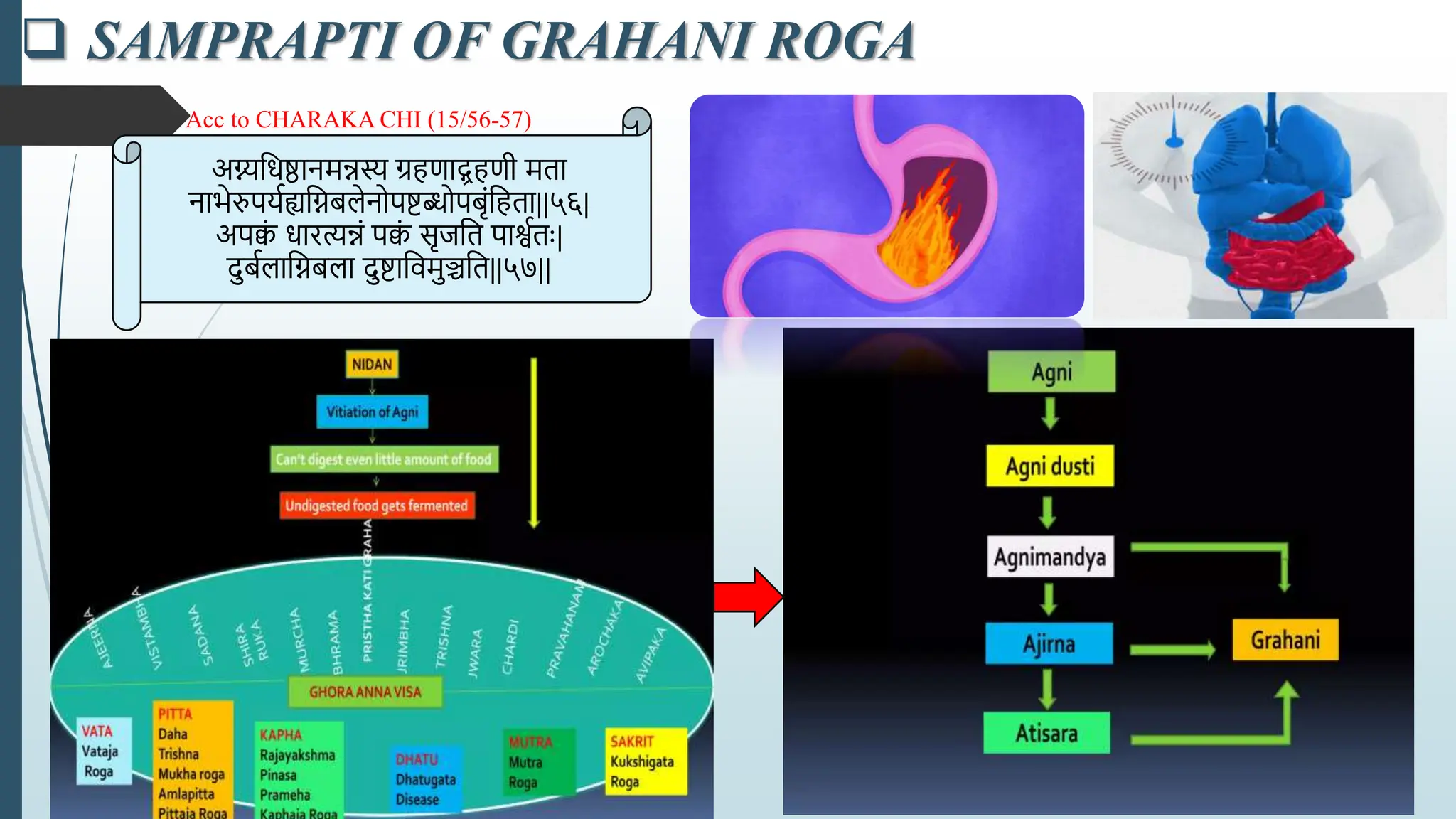
The Pathogenic Cascade:
- Nidana Sevana (Exposure to Causative Factors): The process is initiated by dietary indiscretions (Aharaja), unhealthy lifestyle habits (Viharaja), and psychological stress (Manasika). These are the same triggers we see in functional disorders.
- Agni Dushti (Impairment of Digestive Fire): These factors vitiate the Doshas, which in turn attack and weaken Jatharagni, leading to Mandagni (hypofunction of Agni).
- Ama Nirmana (Formation of Toxins): With a weakened Agni, food is not digested properly, leading to the formation of Ama—a sticky, toxic metabolic waste.
- Srotorodha (Channel Obstruction): Ama clogs the body's channels, further vitiating the Doshas and creating a vicious cycle that further weakens Agni.
The Leap to Inflammatory Disease (IBD):
Up to this point, the pathology is similar to functional Grahani (IBS). The critical difference in IBD is the severity and nature of the Dosha vitiation, particularly of Pitta.
- In IBD, there is an extreme aggravation of Pachaka Pitta. It moves beyond simple hyperacidity (Amlata) and acquires intensely corrosive, "putrefied" characteristics (Vidagdha state).
- This Vidagdha Pitta, often propelled by vitiated Vata and mixed with Ama, directly attacks the intestinal mucosa (Pittadhara Kala).
- This attack leads to the cardinal signs of inflammation:
- Shotha (Inflammation/Edema)
- Daha (Burning sensation)
- Paka (Suppuration/Ulceration)
- Rakta Srava (Bleeding)
This process explains the transition from a functional impairment to the structural damage—ulcers, bleeding, and chronic inflammation—that defines IBD.
3. Correlating IBD Types with Dosha Dominance
The genius of the Ayurvedic system lies in its ability to differentiate clinical presentations based on Dosha dominance. This allows for a precise correlation with the two main types of IBD.
Let's return to the review paper, which draws these correlations with remarkable clarity.
Grahani: An Ayurvedic and Integrative Medical Review ... - ijrpr
This next section of the same paper is crucial. It directly correlates the Dosha-based classifications of Grahani Roga with both IBS and IBD, providing the core analysis for our lesson.
Read section 4.0, 'Clinical Classification and Correlation with Modern Disorders,' particularly subsections 4.1 ('Dosha-Based Classification') and 4.3 ('Correlation with Inflammatory Bowel Disease'). Pay close attention to the descriptions of Pittaja and Sannipataja Grahani.
Synthesizing this information, we can establish a clear analytical framework:
Ulcerative Colitis (UC) → Pittaja Grahani / Raktatisara
UC is characterized by continuous, superficial inflammation, primarily in the colon (Pakwashaya). Its clinical picture aligns almost perfectly with severe Pittaja Grahani presenting as Raktatisara.
- Dominant Dosha: Pitta.
- Key Symptoms:
- Daha (Burning sensation, both abdominal and anal)
- Rakta-Pravahana (Passage of blood in stool)
- Drava Mala (Liquid stools)
- Jwara (Feverish feeling)
- Trishna (Excessive thirst)
- Pathology: The corrosive Vidagdha Pitta causes mucosal inflammation and ulceration, leading to bleeding, which is the hallmark of Raktatisara.
Crohn's Disease (CD) → Sannipataja Grahani
Crohn's Disease is more complex. It can affect any part of the GI tract, involves deeper, transmural (full-thickness) inflammation, and has a "skip lesion" pattern. This complex, variable, and deep-seated pathology is best understood as Sannipataja Grahani, where all three Doshas are involved.
- Dominant Dosha: Tridoshaja (Vata, Pitta, and Kapha).
- Pathology Breakdown:
- Vata contributes the erratic nature (skip lesions), deep, cutting pain (Parikartika), and severe systemic effects like weight loss (Karshya) due to its drying and catabolic nature.
- Pitta contributes the inflammation, ulceration, and fever.
- Kapha contributes to the formation of mucus, swelling (Shotha), and potentially the development of strictures (channel narrowing).
- The involvement of all three Doshas makes the condition chronic, relapsing (Muhur Baddha, Muhur Drava), and difficult to treat (Krichra Sadhya).
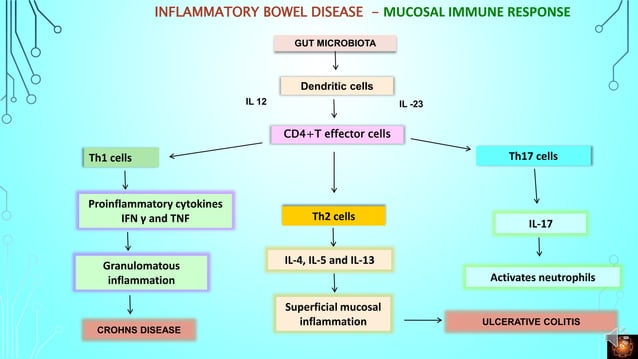
The modern understanding of IBD involves a complex interplay of immune cells. The flowchart below shows how different T-helper cell responses (Th1, Th2, Th17) are thought to contribute differently to Crohn's and Ulcerative Colitis. From an integrative perspective, this can be seen as the micro-level cellular expression of the macro-level Dosha imbalances that Ayurveda describes.
Test your understanding!
A 30-year-old patient presents with a 5-year history of digestive issues. The primary complaints are frequent, liquid stools (10-12 times/day) always containing bright red blood and mucus, accompanied by a constant burning sensation in the lower abdomen and a feeling of urgency. There is no significant weight loss, but the patient feels weak and irritable. Another 35-year-old patient reports intermittent diarrhea, severe cramping pain that comes and goes, significant weight loss over the last two years, and periods of low-grade fever. There is occasional blood in the stool.
Based on the Dosha-dominant presentations, which patient's symptoms are more suggestive of a pathology akin to Ulcerative Colitis (Pittaja Grahani), and which are more aligned with Crohn's Disease (Sannipataja Grahani)? Justify your answer.
Show answer
-
Patient 1 (30-year-old): This presentation is highly suggestive of Ulcerative Colitis / Pittaja Grahani. The key indicators are the dominance of Pitta symptoms: constant burning (Daha), profuse bleeding (Raktatisara), liquid stools (Drava Guna), and irritability (Pitta affecting the mind). The pathology appears concentrated in the colon, reflecting the typical presentation of UC.
-
Patient 2 (35-year-old): This presentation is more aligned with Crohn's Disease / Sannipataja Grahani. The mixed Doshic picture is evident: severe cramping pain (Vata), significant weight loss (Vata-induced Dhatu Kshaya), intermittent diarrhea (erratic nature of Vata), and fever (Pitta). The complexity and systemic impact point towards a Sannipataja condition.
Conclusion
Today, we have analyzed Inflammatory Bowel Disease through the sophisticated lens of Ayurvedic pathology. You have seen that ancient concepts, when correctly applied, provide a robust framework for understanding even complex modern diseases.
Key Takeaways:
- IBD is not a single entity in Ayurveda but is understood as a severe pathological state involving Grahani Roga, Raktatisara, and Pravahika.
- The pathogenesis (Samprapti) begins with Agnimandya and Ama formation but escalates to IBD due to severe vitiation of the Doshas, especially a corrosive, Vidagdha state of Pitta.
- Ulcerative Colitis correlates strongly with a Pitta-dominant pathology, primarily manifesting as Pittaja Grahani or Raktatisara.
- Crohn's Disease, with its complex, variable, and systemic nature, is best understood as a Sannipataja (Tridoshic) condition.
Preview of the Next Lesson:
Having established a deep understanding of the Samprapti of IBD, our next logical step is to explore its treatment (Chikitsa). In the next lesson, we will evaluate key anti-inflammatory Dravyas (e.g., Kutaja, Bilva, Musta) with supporting modern pharmacological evidence, bridging classical herbal wisdom with contemporary scientific research.