Hello! Welcome to the final lesson of this module on advanced integrative practice.
In our last session, we focused on the practical application of our knowledge by designing a safe, comprehensive treatment plan for a complex patient. We learned how to systematically assess, screen for risks, and create a multi-modal intervention. Today, we elevate that thinking from the immediate clinical case to the future of medicine.
This lesson addresses the learning outcome: Propose a conceptual framework for integrating Prakriti assessment into modern precision medicine. We will build a bridge between Ayurveda's ancient concept of individual constitution (Prakriti) and the cutting-edge field of precision medicine. For your goal of building an evidence-based integrative practice, understanding this bridge is not just an academic exercise—it is about envisioning the future of personalized healthcare.
The Convergence of Ancient Wisdom and Modern Science
Modern medicine is undergoing a revolution. The one-size-fits-all model is giving way to precision medicine, an approach that tailors treatment and prevention to the individual characteristics of each patient. This is often driven by genomics, metabolomics, and other 'omics' technologies. At the same time, the concept of P4 Medicine—Predictive, Preventive, Personalized, and Participatory—has become a guiding principle.
Interestingly, these "modern" ideas resonate deeply with the core philosophy of Ayurveda, which has always been inherently personalized. The concept of Prakriti—an individual's unique and stable psycho-physiological constitution—is the original blueprint for personalized health.
The exciting challenge, and the focus of our lesson, is to create a scientifically valid framework that connects these two worlds.
Ayurgenomics: The Bridge Between Prakriti and Genes
The field that formally attempts to build this bridge is called Ayurgenomics. It uses the tools of modern genomics to explore the molecular basis of Ayurvedic concepts, especially Prakriti.
To understand the foundations of this field and how it connects to precision medicine, let's start with a foundational reading.
Ayurgenomics-based frameworks in precision and ...
The following article, 'Ayurgenomics-based frameworks in precision and integrative medicine,' provides a superb overview of this emerging field. It explains how Ayurgenomics creates a shared language between Ayurveda and modern science.
Please read the 'Abstract', the 'Impact statement', and the 'Introduction' sections. As you read, focus on how the author connects the principles of P4/precision medicine with the Ayurvedic concept of individuality. Note the definition and goals of Ayurgenomics.
As you've just read, Ayurgenomics is not just about finding "a gene for Pitta." It is a much more sophisticated endeavor to:
- Discover molecular correlates for Prakriti types.
- Understand the biological basis for inter-individual differences in health and disease susceptibility.
- Provide a scientific rationale for personalized Ayurvedic interventions.
- Create an "ontological link" or a shared vocabulary between the two systems.
The Ayurgenomics Research Process
So, how does this work in practice? The process generally follows a clear, multi-step approach that combines classical Ayurvedic assessment with modern laboratory techniques.
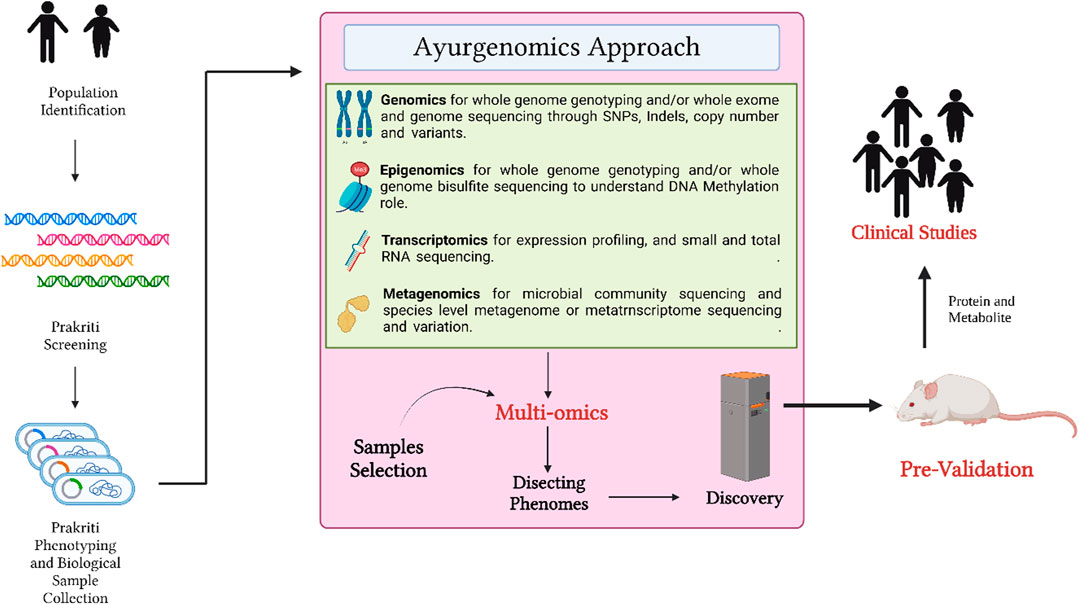
The key steps illustrated above are:
- Phenotyping: Researchers first identify a large population and use standardized questionnaires and clinical assessments to classify individuals into distinct Prakriti types. To get the clearest signal, studies often focus on "extreme" or predominant Vata, Pitta, and Kapha types.
- 'Omics' Analysis: Biological samples (like blood or saliva) are collected from these distinct groups. These samples are then analyzed using a variety of high-throughput technologies:
- Genomics: To identify genetic variations (like Single Nucleotide Polymorphisms or SNPs) that are more common in one Prakriti group versus another.
- Transcriptomics: To measure gene expression levels and see which genes are more or less active in each group.
- Epigenomics: To study modifications to DNA (like methylation) that affect gene expression without changing the DNA sequence itself. This is highly relevant to how lifestyle (Vihara) and diet (Ahara) influence health.
- Metagenomics: To analyze the gut microbiome, which is known to differ between Prakriti types and has a profound impact on metabolism and immunity.
- Discovery and Validation: By comparing the 'omics' data across the Prakriti groups, scientists can identify patterns and molecular signatures. For example, studies have consistently found that:
- Pitta types show higher baseline expression of genes related to inflammation, metabolism, and immunity.
- Vata types are associated with genes involved in cell signaling, transport, and DNA repair.
- Kapha types are linked with genes controlling cell adhesion, fluid balance, and lipid metabolism.
This approach provides objective, molecular evidence that corroborates the classical descriptions of the Doshas.
Integrating Genomics, Epigenomics and Traditional Wisdom
This second paper, 'Integrating Genomics, Epigenomics and Traditional Wisdom,' offers a concise summary of the practical components of this integrative framework.
Please read the 'Aim and Objectives,' 'Practical Framework Development,' and 'Epigenetics' sections. This will reinforce the key technologies used (SNP analysis, GWAS) and introduce the crucial role of epigenetics in linking lifestyle to gene expression.
A Conceptual Framework for Clinical Integration
Now, we arrive at our core task: proposing a conceptual framework to integrate Prakriti assessment into modern precision medicine. Based on the evidence from Ayurgenomics, we can construct a multi-level framework that translates this research into clinical practice.
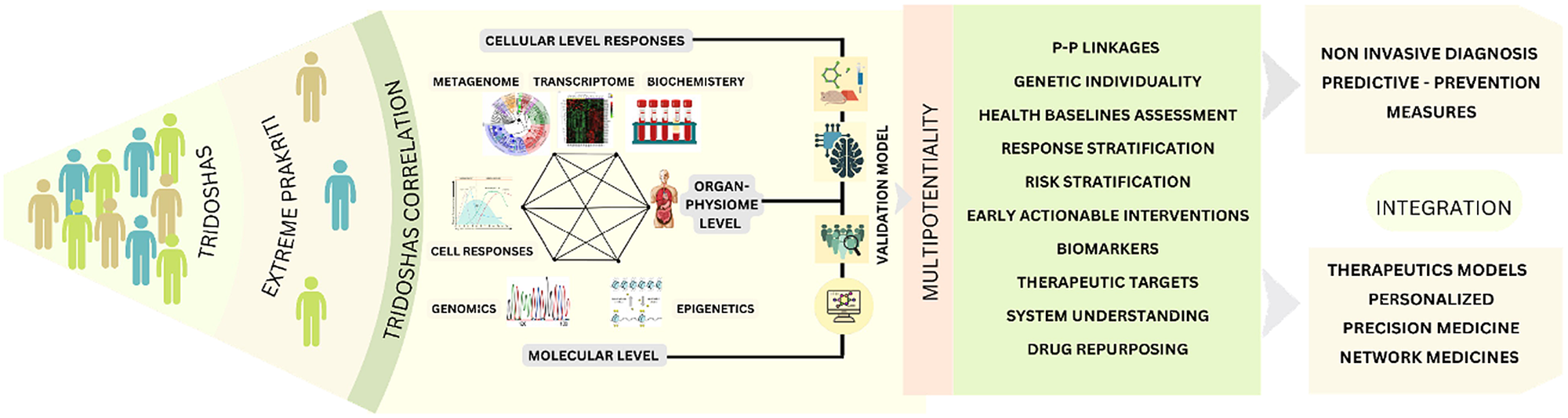
Here is a proposed four-level framework for integration:
Level 1: Prakriti-based Risk Stratification
- Concept: Use Prakriti assessment as a first-line, non-invasive, and cost-effective tool to stratify the healthy population into different risk groups.
- Application: Since your interest is in metabolic disorders, a clinician could use this to identify individuals with a predominant Kapha Prakriti. Knowing their established correlation with obesity, insulin resistance, and dyslipidemia, these individuals can be flagged for:
- More frequent screening for metabolic syndrome markers.
- Proactive, targeted counseling on diet and exercise long before any disease manifests.
- This aligns directly with the "Predictive" and "Preventive" arms of P4 medicine.
Level 2: Prakriti-informed Pharmacogenomics
- Concept: Combine Prakriti assessment with modern pharmacogenomic data to predict an individual's response to medications.
- Application: Research has shown that genes responsible for drug metabolism (like the CYP450 family) have different variants and expression levels across Prakriti types. A Pitta individual, often characterized as a "fast metabolizer," may clear a drug more quickly, requiring a different dosage than a Kapha individual. Integrating Prakriti could provide an additional layer of data to help clinicians choose the right drug and dose, minimizing adverse effects and maximizing efficacy.
Level 3: Deep Personalization of Lifestyle Interventions
- Concept: Move beyond generic health advice to deeply personalized Ahara (diet) and Vihara (lifestyle) recommendations based on an individual's unique Prakriti-genomic profile.
- Application: A modern genetic test might tell someone they have a predisposition to inflammation. Ayurgenomics can refine this by explaining why. If the person is a Pitta type, the inflammation is likely due to an overactive metabolic and immune response. The intervention would be a Pitta-shamana diet and lifestyle (e.g., cooling foods, avoiding excessive heat and intensity). This is far more specific and actionable than just "eat an anti-inflammatory diet." It connects the molecular finding to a holistic, time-tested system of management.
Level 4: Enhancing Clinical Research and Drug Discovery
- Concept: Use Prakriti to design more intelligent and efficient clinical trials. A major challenge in research is patient heterogeneity—what works for one person doesn't work for another.
- Application: Instead of testing an anti-diabetic drug on a random group of patients, researchers could stratify the trial by Prakriti. They might hypothesize that a drug targeting insulin resistance would be most effective in the Kapha subgroup, while a drug protecting against neuropathy might be more relevant for the Vata subgroup. This reduces statistical noise and can reveal strong effects that would otherwise be missed, accelerating the validation of both modern and Ayurvedic therapies.
To see how all these applications tie together, let's read the final sections of the primary research paper.
Ayurgenomics-based frameworks in precision and ...
These sections summarize the translational opportunities and future vision for Ayurgenomics.
Please read the sections 'Ayurgenomics applications in integrative medicine settings' and 'Concluding remarks'. Pay attention to how the author synthesizes the research findings into practical applications, such as risk stratification, pharmacogenomics, and creating interoperable technology platforms.
Test your understanding!
A 35-year-old software engineer is identified as having a predominant Vata Prakriti. He has no current disease but complains of anxiety, irregular sleep, and dry skin. A basic genomic scan reveals he has several SNPs associated with a slightly increased risk for neurodegenerative conditions later in life.
Using the four-level framework, how could you integrate his Prakriti and genomic information to provide a truly personalized, preventive health plan?
Show answer
Here's how the framework could be applied:
-
Risk Stratification: His Vata Prakriti inherently points towards a predisposition to disorders of the nervous system (Vata governs movement and the nervous system). This aligns perfectly with the genomic finding, reinforcing the concern and raising its priority. He is stratified into a high-risk group for neurological and age-related cognitive issues.
-
Personalized Lifestyle Interventions (Ahara/Vihara): This is the most immediate and powerful application.
- Instead of generic advice like "manage stress," you can prescribe specific Vata-shamana (Vata-pacifying) techniques: grounding activities, maintaining a regular daily routine (Dinacharya), practicing calming pranayama, and self-massage with warming oils (Abhyanga) to counter dryness and calm the nervous system.
- His diet would be tailored to be warming, nourishing, and unctuous to balance the cold, light, and dry qualities of Vata.
- This provides a targeted, holistic plan to address his current symptoms (anxiety, sleep) and mitigate his future risk simultaneously.
-
Prakriti-informed Pharmacogenomics: While he isn't taking medications now, this information would be valuable for the future. If he later requires medication for anxiety or sleep, his Vata constitution might suggest a sensitivity to certain drugs, guiding a "start low, go slow" approach.
-
Enhancing Research: He would be an ideal candidate for a prospective cohort study looking at the effectiveness of Medhya Rasayanas (nootropic/neuroprotective herbs like Brahmi or Ashwagandha) in preventing cognitive decline in a Vata-dominant, genetically at-risk population.
Conclusion
Today, we have constructed a conceptual bridge between Ayurveda and modern precision medicine. We have moved beyond seeing Prakriti as a mere philosophical concept and reframed it as a testable, biological framework for understanding human individuality.
Key Takeaways:
- Ayurgenomics provides the scientific language and tools to explore the molecular basis of Prakriti.
- Research has already identified distinct genomic, transcriptomic, and metagenomic signatures associated with the predominant Vata, Pitta, and Kapha types.
- A practical framework for integration involves using Prakriti assessment for risk stratification, pharmacogenomics, personalized lifestyle interventions, and improved clinical research design.
- This integration doesn't replace modern science with Ayurveda, or vice-versa. It creates a powerful synergy, where the holistic wisdom of Prakriti provides context for molecular data, leading to more effective and truly personalized healthcare.
Preview of Your Next Module:
This lesson concludes our module on advanced integrative practice. We have built a solid foundation in personalization and safety. Now, you are ready to apply these principles to your specific areas of clinical interest.
Your next module is "Clinical Focus: Metabolic Disorders I - Prameha and Diabetes." In the first lesson, we will begin by correlating the classical classifications of Prameha with modern understandings of diabetes and metabolic syndrome. This will be the perfect opportunity to apply the concepts of Dosha, Dushya, and even Prakriti-based predispositions to a major clinical condition.