Hello! Welcome to our next lesson in the module on metabolic disorders.
In our last session, we evaluated key Lekhana and Medohara Dravyas like Guggulu, Shilajatu, and Triphala, focusing on how they dismantle the pathology of obesity. We noted that a common thread in their action is the modulation of Agni, the body's metabolic fire.
Today, we will broaden our perspective to address the learning outcome: Compare the Agni-Deepana-Pachana approach with modern metabolic enhancement strategies.
This lesson will serve as a crucial conceptual bridge, connecting the foundational Ayurvedic strategy for treating metabolic and digestive issues with the language and mechanisms of modern physiology. Mastering this comparison is key to your goal of practicing evidence-based Ayurveda and effectively communicating its principles.
1. The Ayurvedic Approach: Correcting Agni with Deepana and Pachana
At the heart of Ayurvedic metabolism is Agni. As you know from your BAMS studies, Agni is the biological fire that governs all transformation in the body. A disturbance in Agni is considered the root cause of most diseases (Rogāḥ Sarvepi Mandāgnau).
To build a solid foundation for our comparison, let's start with a comprehensive review that correlates the Ayurvedic concept of Agni with modern physiology.
Comprehensive review of Agni physiology: Ayurvedic ...
The paper 'Comprehensive review of Agni physiology' provides an excellent overview of the types of Agni and introduces the therapeutic principles of Deepana and Pachana.
Please read the section titled 'Conceptual study' (pages 36-37). Focus on the descriptions of the three main types of Agni (Jatharagni, Bhutagni, Dhatvagni) and the brief mention of the clinical strategies of Deepana and Pachana near the end of the section.
As the paper details, the Ayurvedic model of metabolism is hierarchical:
- Jatharagni: The primary digestive fire in the GI tract, responsible for the initial breakdown of food. Its function is a prerequisite for all subsequent metabolism.
- Bhutagni: The five elemental fires, believed to function primarily in the liver, which transform the digested food into biological elements that the body can assimilate.
- Dhatvagni: The seven tissue-specific fires that govern the metabolism within each Dhatu (Rasa, Rakta, Mamsa, Meda, etc.), ensuring proper tissue formation and function.
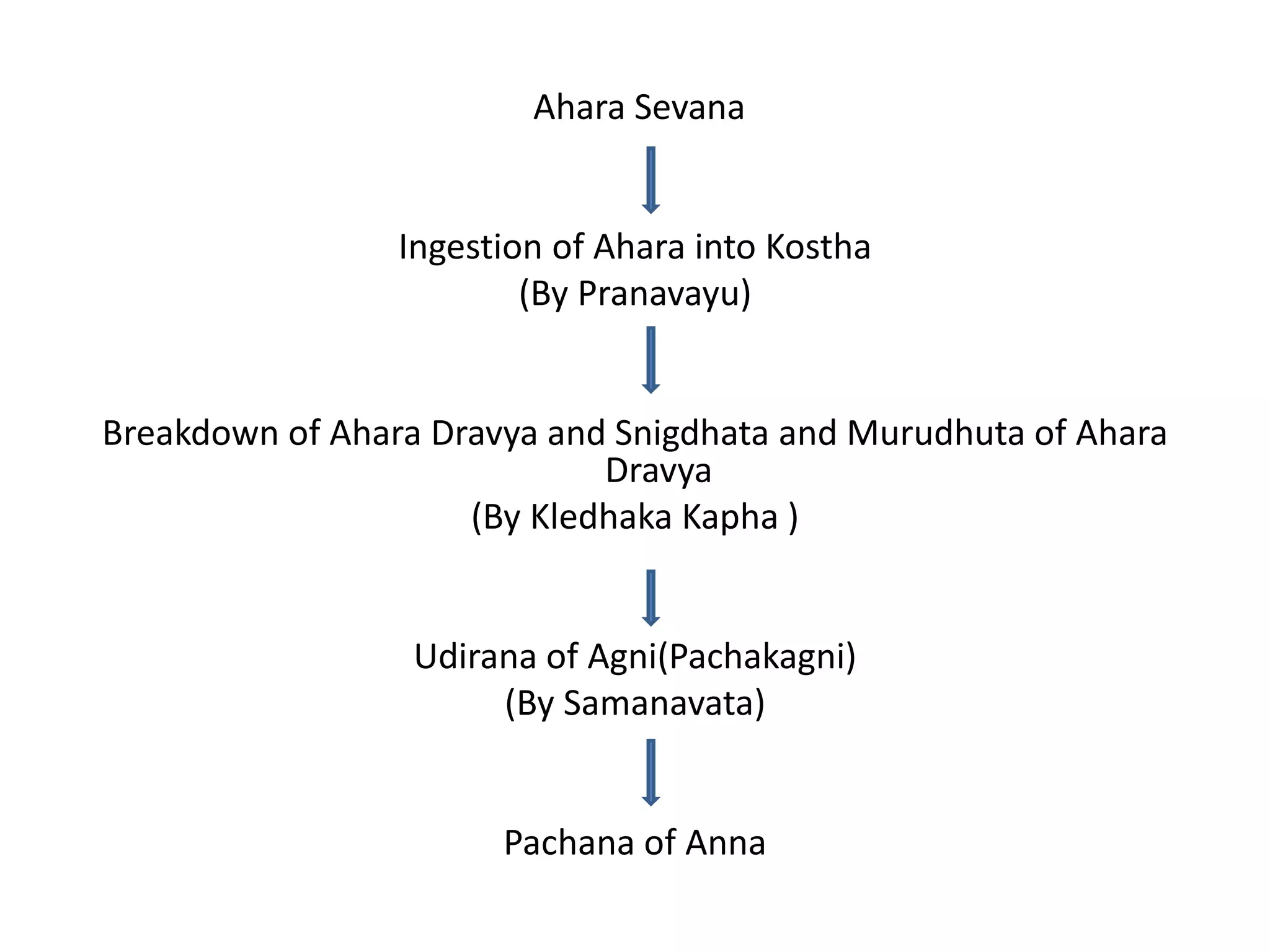
When this multi-layered Agni becomes impaired (Agnimandya), it leads to the formation of Ama—incompletely metabolized, toxic substances that obstruct channels (Srotas) and initiate disease.
The primary strategy to counter this is through Deepana and Pachana therapies:
- Deepana (Stimulation/Kindling): This action stimulates or 'kindles' Agni, particularly Jatharagni. Deepana Dravyas increase digestive capacity and appetite but do not necessarily 'digest' pre-existing Ama. Think of them as adding fuel to a low fire. Example: Fennel (Foeniculum vulgare).
- Pachana (Digestion/Cooking): This action 'digests' or metabolizes accumulated Ama, clearing it from the system. Pachana Dravyas help break down toxic metabolites but may not directly increase the strength of Agni. Think of them as agents that break down wet logs so the fire can burn them. Example: Nagarmotha (Cyperus rotundus).
- Deepana-Pachana: Many herbs possess both actions. They simultaneously strengthen the metabolic fire and clear away the metabolic waste that dampens it. This combined approach is the most common and effective strategy for metabolic disorders. A classic example is Trikatu (ginger, black pepper, long pepper).
2. Modern Metabolic Enhancement Strategies
Now, let's look at the same goal—improving metabolism—through the lens of modern physiology. The focus here is on increasing energy expenditure and optimizing biochemical pathways.
The same review paper provides a concise summary of the key modern concepts.
Comprehensive review of Agni physiology: Ayurvedic ...
Let's return to the 'Comprehensive review of Agni physiology' to understand the modern perspective on metabolism.
Please read the section 'Modern Review' (pages 37-38). Focus on the concepts of cellular metabolism (catabolism/anabolism), key metabolic hormones, thermogenesis, and Basal Metabolic Rate (BMR).
From a modern viewpoint, "enhancing metabolism" involves several interconnected strategies:
- Increasing Basal Metabolic Rate (BMR): This is the rate of energy expenditure at rest. A higher BMR means the body burns more calories to maintain basic functions. It is influenced by factors like muscle mass, age, and hormonal status.
- Promoting Thermogenesis: This is the process of heat production. It includes the energy used to digest food (Thermic Effect of Food - TEF) and non-shivering thermogenesis, where specialized tissues like brown adipose tissue (BAT) burn fat to generate heat.
- Hormonal Regulation: Modulating key metabolic hormones is crucial. This includes ensuring proper function of thyroid hormones (which set the BMR), improving insulin sensitivity (for efficient glucose utilization), and balancing appetite hormones like leptin and ghrelin.
- Enhancing Mitochondrial Function: Mitochondria are the "powerhouses" of the cell, where nutrients are converted into ATP (energy). Improving mitochondrial efficiency and density means the body can process fuel more effectively.
- Modulating Gut Microbiota: The trillions of bacteria in our gut play a vital role in extracting energy from food, synthesizing vitamins, and regulating inflammation. A healthy microbiome is essential for a healthy metabolism.
3. Bridging the Concepts: A Comparative Analysis
This is where your integrated understanding comes into play. The Ayurvedic and modern approaches are not two separate systems but rather two different languages describing the same fundamental reality of human metabolism.
A second review article offers a very clear and concise thematic integration of these concepts.
“CONCEPT OF AGNI IN AYURVEDA AND ITS ROLE ... - IJAMH
The paper 'CONCEPT OF AGNI IN AYURVEDA AND ITS ROLE...' provides an excellent summary that directly maps Ayurvedic terms to modern biomedical concepts.
Please read section '9. Thematic Integration' within the 'DISCUSSION' part of the paper (page 4). This short section provides a powerful, direct correlation between the two frameworks.
Let's use this framework to build a detailed comparison:
| Ayurvedic Concept | Modern Physiological Correlate | Therapeutic Implication |
|---|---|---|
| Jatharagni | Digestive System Function: Secretion of HCl, pancreatic enzymes, bile, and the metabolic activity of the gut microbiota. | Deepana action aims to optimize this entire process. For example, pungent herbs stimulate enzymatic secretions. |
| Bhutagni | Hepatic Biotransformation: The liver's role in processing absorbed nutrients (e.g., gluconeogenesis, detoxification). | A healthy liver is essential for converting food into bio-available forms, aligning with the Bhutagni function. |
| Dhatvagni | Tissue-Specific & Mitochondrial Metabolism: Cellular respiration within each tissue type to produce ATP. | Impaired Medo-Dhatvagni (in obesity) correlates with poor mitochondrial function and insulin resistance in fat cells. |
| Ama | Metabolic Endotoxins & Inflammation: Accumulation of metabolic waste, advanced glycation end products (AGEs), and endotoxins (like LPS from gut bacteria), leading to low-grade systemic inflammation. | Pachana action corresponds to reducing this toxic load, improving gut barrier function, and resolving inflammation. |
| Agni Deepana | Increasing BMR & Thermogenesis: Stimulating thyroid function, activating brown adipose tissue (BAT), and increasing the thermic effect of food. | Herbs with Ushna Veerya (hot potency) often have thermogenic effects, thereby increasing overall energy expenditure. |
Essentially, the Agni-Deepana-Pachana approach is a comprehensive strategy that simultaneously:
- Optimizes digestion and absorption (correcting Jatharagni).
- Reduces metabolic waste and inflammation (Ama Pachana).
- Boosts cellular energy production (enhancing Dhatvagni).
This multifaceted approach stands in contrast to many modern single-target drugs (e.g., a drug that only blocks fat absorption). It addresses the metabolic dysfunction from its root in the gut to its expression in the cells.
Test your understanding!
A 40-year-old patient presents with symptoms of Medoroga (obesity), including a 15kg weight gain over two years, constant bloating, fatigue, a thick white coating on the tongue, and a feeling of bodily heaviness.
How would you describe the therapeutic goals for this patient using both Ayurvedic and modern terminology, based on today's lesson?
Show answer
The goal is to re-establish metabolic balance by addressing both the digestive and systemic issues.
-
Ayurvedic Goals:
- Agni Deepana: To kindle the weak Jatharagni and Medo-Dhatvagni.
- Ama Pachana: To digest and eliminate the accumulated Ama that is causing the tongue coating, heaviness, and bloating.
- Srotoshodhana: To clear the channels obstructed by Ama and excess Meda.
-
Modern Physiological Goals:
- Improve Gut Function: Modulate the gut microbiota and improve digestive enzyme efficiency to reduce bloating and endotoxin production.
- Reduce Systemic Inflammation: Clear the metabolic byproducts that are causing the low-grade inflammation manifesting as fatigue and heaviness.
- Increase Basal Metabolic Rate (BMR): Enhance overall energy expenditure to promote weight loss.
- Improve Insulin Sensitivity & Mitochondrial Function: Correct the metabolism at the cellular level within the adipose tissue.
Conclusion
In this lesson, we have successfully bridged the gap between a core Ayurvedic therapeutic strategy and modern metabolic science. This comparative understanding is not just an academic exercise; it is the foundation for a truly integrative clinical practice.
Key Takeaways:
- The Agni-Deepana-Pachana approach is a holistic Ayurvedic strategy to correct metabolic dysfunction by stimulating digestive fire (Deepana) and clearing metabolic waste (Pachana).
- This approach finds strong parallels in modern metabolic enhancement strategies, which include increasing BMR and thermogenesis, improving mitochondrial function, modulating the gut microbiome, and reducing systemic inflammation.
- Jatharagni corresponds to GI function, Dhatvagni to cellular metabolism, and Ama to metabolic endotoxins and inflammation. Understanding these correlations allows you to explain Ayurvedic interventions in a scientifically plausible framework.
This conceptual work sets the stage perfectly for our next lesson, where we will move from theory to application. We will begin to interpret clinical studies on anti-obesity and lipid-lowering Ayurvedic interventions, using this integrated knowledge to critically appraise the available scientific evidence.