Introduction
In our last lesson, we took the first major hypothesis for the boudoir competition—the 'body type' advantage—and operationalized it by identifying a comprehensive set of evidence fingerprints for its four-step causal mechanism. This transformed a general idea into a testable research plan, defining exactly what we would need to find in the empirical record to confirm or disconfirm each link in the causal chain.
Today, we shift our focus to the second primary hypothesis (H2), which posits that the contestant won due to the powerful contrast between her provocative attire and her known modest persona. Our goal in this lesson is to decompose this high-level hypothesis into a fine-grained, step-by-step causal chain. We will construct the theoretical "story" of how this contrast effect could have unfolded, from the moment judges and the audience formed an expectation about the contestant to the final amplification of her scores. This decomposition is the essential first step before we can, in a future lesson, identify the evidence fingerprints for this mechanism.
The Psychology of Contrast: Expectancy Violations Theory
The core of H2 isn't just the lingerie itself; it's the surprise it created. To analyze this effect with rigor, we can draw on a well-established framework from communication studies: Expectancy Violations Theory (EVT). This theory explains how people react when someone's behavior deviates from what is expected.
To get a quick overview of this powerful concept, please start by watching this short video.
Expectancy Violation Theory (Explained in 3 Minutes)
This video from Helpful Professor Explains! provides a concise, 3-minute introduction to Expectancy Violation Theory. It will give you the foundational concepts before we explore them in more detail.
Watch the video in its entirety. Pay close attention to how it explains that the reaction to a "violation" depends on two factors: the likability of the person and whether the unexpected behavior is perceived as positive or negative.
As the video explains, when someone breaks a social script, it forces us to pay attention and evaluate the situation. This is precisely what our hypothesis suggests happened in the competition. To build our mechanism, we need to understand the components of EVT more formally.
Expectancy violations theory - Wikipedia
This Wikipedia article offers a detailed breakdown of EVT, its components, and its predictive power. It will provide the theoretical scaffolding for us to construct our causal chain.
Please read the following sections: The introduction to understand the core premise. The section on "Expectancy," which explains how expectations are formed based on communicator characteristics and social context. The section on "Communicator reward valence," which discusses how the attributes of the person violating the expectation (the "violator") influence our reaction. The section on "Violation valence," focusing on how the violation itself is judged as positive or negative. The brief section on "Arousal," explaining how violations capture our attention. Finally, review the six major propositions of EVT, as they summarize the theory's logic.
The principles of EVT give us a precise language to describe the 'attire/persona contrast' effect. The contestant's "shy persona" creates an expectancy. Her "provocative attire" is the violation. This violation triggers arousal (heightened attention). The audience and judges then assess the violation valence (is this good or bad?) based partly on the communicator reward valence (do we like/value this person?). In the context of a boudoir competition, a physically appealing contestant making a bold, confident choice is likely to be seen as a high-reward communicator, leading to a positive evaluation of the violation.
This effect is a classic example of how context shapes perception. Consider the famous Ebbinghaus illusion.
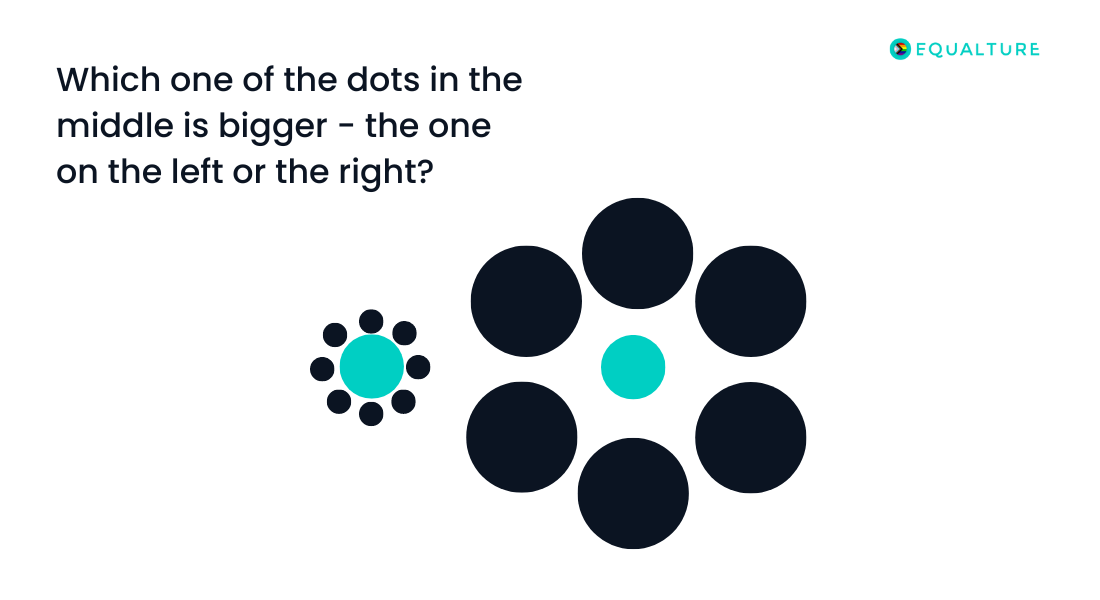
In our case, the "provocative lingerie" is the central dot. The "shy persona" is the ring of small dots, making the lingerie appear even more bold and impactful by contrast. A different contestant, already known for being an exhibitionist, wearing the same outfit would create a much weaker effect, akin to the dot surrounded by large circles.
The Causal Chain for the 'Contrast' Hypothesis (H2)
Using EVT as our guide, we can now decompose H2 into a five-step causal mechanism. This process of creating a "causal story," as discussed in the Christian Aid paper on process tracing, provides a clear, testable sequence of events.
Step 1: Establishment of Expectancy
- Mechanism Part: Before her performance, the judges and audience form a predictive expectancy of the contestant as being shy, modest, or unassuming. This expectancy is based on "communicator characteristics" known prior to her main appearance, such as her official bio, pre-competition interviews, off-stage demeanor, or even word-of-mouth reputation.
- EVT Link: This establishes the baseline against which a violation can occur. It's the "pre-interactional expectation" defined by the theory.
Step 2: The Expectancy Violation
- Mechanism Part: The contestant appears on stage wearing highly provocative and bold lingerie. Given your background in lingerie design, you know that this choice is not neutral; it is a deliberate act of presentation. This visual presentation acts as a sharp and unambiguous violation of the established 'shy' expectancy.
- EVT Link: This is the core "violation" event. The starker the difference between the expectancy (shy) and the behavior (bold), the stronger the violation.
Step 3: Arousal and Attention Shift
- Mechanism Part: The dissonance between the expected persona and the observed presentation creates cognitive arousal in the judges and audience. This is a moment of surprise that compels them to shift their attention, focusing it more intensely on her than on other, more predictable contestants. Her performance becomes highly salient.
- EVT Link: As proposition #2 of EVT states, "Violations of these expectations cause arousal and distraction, further leading the receiver to shift his or her attention to the other."
Step 4: Positive Violation Valence Assessment
- Mechanism Part: The judges and audience evaluate this violation positively. This positive assessment is driven by a combination of factors:
- High Communicator Reward: The contestant is physically attractive and a legitimate contender, making her a "high-reward" communicator. We are more inclined to interpret unexpected behavior from high-reward individuals favorably.
- Contextual Appropriateness: While violating her personal script, the provocative attire is highly appropriate and even desirable within the context of a boudoir lingerie competition.
- Compelling Narrative: The violation creates an appealing story of "hidden depths," "bold transformation," or "unleashed confidence." This narrative is more engaging than simple consistency.
- EVT Link: This step combines the concepts of "communicator reward valence" and "violation valence." The violation is assigned a positive value.
Step 5: Amplified Judgment and Scoring
- Mechanism Part: The strong positive emotional and cognitive response generated by the surprising contrast is then mapped onto the formal judging criteria. This "contrast bonus" results in inflated scores on subjective categories such as 'Stage Presence,' 'Confidence,' 'Overall Impression,' or 'X-Factor.' The impact is greater than what the lingerie or the physique alone would have garnered; it is an interactive effect. This amplified score is what ultimately pushes her aggregate total into the winning position.
- EVT Link: This follows from proposition #6: "Positive violations produce more favorable outcomes than behavior that matches expectations." The violation didn't just meet expectations; it favorably exceeded them, leading to a superior outcome.
Conclusion
In this lesson, we have moved beyond the simple statement of H2—that the attire/persona contrast caused the win—and constructed a detailed, five-step causal mechanism that explains how it might have worked. By grounding our analysis in Expectancy Violations Theory, we have built a structured and theoretically sound "causal story."
The key takeaways from our work today are:
- The Power of Theory: Social science theories like EVT provide powerful scaffolds for building and articulating causal mechanisms, lending rigor to our analysis.
- The Contrast Mechanism: We decomposed H2 into a five-step chain: (1) An expectation of shyness is set, (2) this expectation is violated by bold attire, (3) the violation causes arousal and a shift in attention, (4) this violation is evaluated positively due to the contestant's high reward value and the compelling narrative, and (5) this positive evaluation translates into amplified scores.
- Interaction is Key: The mechanism highlights that the causal power comes not from the persona or the attire in isolation, but from their dynamic interaction.
With this detailed mechanism in hand, we are now prepared for the next critical phase of the investigation. In our next lesson, we will mirror the process we undertook for H1 and identify the specific, observable "evidence fingerprints" for each of these five steps, making our 'contrast' hypothesis fully testable.