Introduction
In our previous lesson, we meticulously constructed a five-step causal mechanism for our second hypothesis (H2), which argues that the boudoir contestant's victory was driven by the powerful contrast between her provocative attire and her known modest persona. Drawing on Expectancy Violations Theory, we mapped a logical path from the establishment of an initial 'shy' expectation to the final, amplified judgment that secured her win.
Today, we take the critical next step from theoretical modeling to empirical investigation. Our goal is to operationalize this five-step mechanism by identifying the specific, observable "evidence fingerprints" we would need to find to validate each link in the causal chain. As a statistician familiar with moving from abstract models to measurable data, you'll recognize this process as the core of any rigorous causal analysis. We are defining the data points that will allow us to test our theory against reality.
From Causal Story to Testable Evidence
A causal mechanism, no matter how theoretically sound, is only a hypothesis until it is tested against evidence. The process of testing involves "operationalizing" the theory—translating each conceptual step into a set of expected empirical traces. In single-case analysis, these traces are often called "evidence fingerprints," the unique marks that the causal process should have left behind.
To structure this search, it's useful to think about the probative value of evidence. We can borrow a framework from program evaluation methodology that distinguishes between two key types of evidence.
[PDF] Process-Tracing Methods in Program Evaluation
This guide from the World Bank's Independent Evaluation Group provides a clear framework for operationalizing a theory of change, which is analogous to our causal mechanism. It introduces a practical way to think about the strength of different pieces of evidence.
Please read the following parts of Chapter 2, "Tracing a Process Theory of Change Empirically": Begin with the introduction to the chapter, focusing on the section "Operationalization of Expected Observables," which defines the core task. Next, read the section that introduces the Bayesian logic of updating confidence and defines "need-to-find" and "love-to-find" evidence. Carefully review Box 2.1, which gives concrete examples of these two evidence types. Finally, look at Figure 2.1 and the surrounding text, which visualizes how these two dimensions create different levels of evidentiary power.
As the guide explains:
- Need-to-find evidence is like a hoop test. It's evidence we must find for the hypothesis to remain plausible. Its absence is highly disconfirmatory.
- Love-to-find evidence is like a smoking gun. It's evidence that is very unlikely to exist if our hypothesis is wrong. Finding it provides strong confirmation.
With this framework, let's identify the evidence fingerprints for each of the five steps in our 'contrast' mechanism.
Evidence Fingerprints for the 'Contrast' Mechanism (H2)
Step 1: Establishment of Expectancy (Shy Persona)
The mechanism begins with judges and the audience forming a predictive expectancy of the contestant as shy or modest.
-
Evidence We Need to Find:
- Documentary Traces: Her official contestant biography or introductory materials must contain language describing her as "quiet," "reserved," "from a traditional background," or similar descriptors. If her bio described her as a "daring exhibitionist," this step, and the entire hypothesis, would fail its first hoop test.
- Behavioral Traces: Pre-performance video footage should show her exhibiting a reserved demeanor (e.g., quiet posture, minimal interaction, soft-spokenness) relative to other contestants.
-
Evidence We'd Love to Find:
- Interview Accounts (Post-Hoc): In post-competition interviews, a judge or audience member explicitly states, "Based on her bio and how she was backstage, I was expecting a very timid performance." This is a 'love-to-find' trace because it directly confirms the psychological state of the evaluator.
Step 2: The Expectancy Violation (Provocative Attire)
The contestant appears in bold lingerie that sharply and unambiguously violates the established 'shy' expectancy. Your expertise in lingerie design is particularly relevant here for assessing the objective nature of the attire.
-
Evidence We Need to Find:
- Artifact Analysis: The lingerie itself must be objectively classifiable as 'provocative' or 'bold' based on its design characteristics (e.g., material transparency, cut, coverage, styling). It cannot be a standard, conservative piece.
- Comparative Analysis: The contestant's attire should be demonstrably bolder than that of other contestants who might share a similar 'modest' persona, and at least on par with the boldest outfits in the competition.
-
Evidence We'd Love to Find:
- "Smoking Gun" Interview (Contestant): The contestant admits her strategic intent, stating something like: "I knew everyone saw me as the quiet one. I chose that piece specifically to shatter that expectation."
- Explicit Judge Commentary: A judge's scorecard note or deliberation comment reads: "Outfit choice was a complete shock given her profile."
Step 3: Arousal and Attention Shift
The violation creates cognitive arousal, compelling judges and the audience to focus their attention intensely on her.
-
Evidence We Need to Find:
- Audience Reaction: Audio/video of the event should show a discernible shift in audience reaction the moment she is revealed—a sudden increase in volume (gasps, cheers), a hush of surprise, or other indicators of captured attention.
- Media Salience: Post-competition media coverage and online discussion should disproportionately focus on her 'moment' or the 'surprise' of her performance compared to other contestants.
-
Evidence We'd Love to Find:
- Direct Observation of Judges: Video footage shows judges physically reacting at the moment of her appearance—leaning forward, looking at each other in surprise, taking notes more furiously.
- Digital Trace Analysis: A spike in social media searches or mentions of her name that coincides exactly with the timing of her performance on stage.
Step 4: Positive Violation Valence Assessment
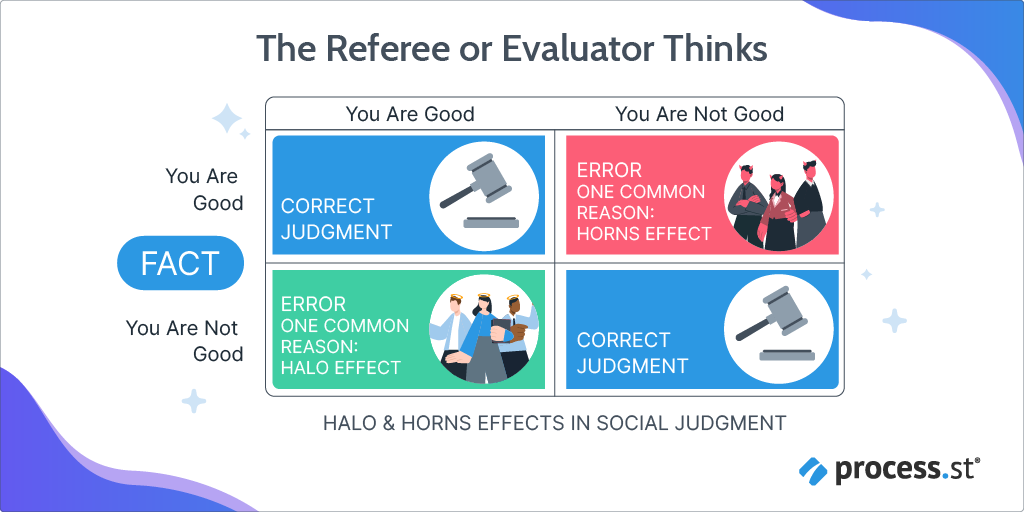
The surprise is evaluated positively, interpreted as confidence, boldness, or a compelling transformation rather than something negative like tackiness. This is where a cognitive bias, like a 'halo effect', can emerge. The surprising positive action (the violation) casts a halo over the overall perception of the contestant.
-
Evidence We Need to Find:
- Absence of Negative Commentary: A search of judge notes, media reviews, and audience comments should reveal a lack of significant negative evaluations of her choice (e.g., "tacky," "desperate," "inappropriate"). The absence of a 'horns effect' is a necessary condition here.
- Positive Adjectives in a Subjective Context: Judge scorecards and written feedback should use positive, high-arousal words like "confident," "daring," "captivating," "powerful," or "brave" in subjective categories like 'Stage Presence' or 'Overall Impression'.
-
Evidence We'd Love to Find:
- Direct "Narrative" Comments: A judge states in deliberations or an interview, "What sold it for me was the story she told. The transformation from the shy person we read about to the powerhouse on stage was incredible." This directly confirms the positive framing of the violation.
- Evidence of Egocentric Comparison: The Dunning & Hayes paper on social judgment suggests that people often use themselves or other norms as a baseline for evaluation. A judge might say, "For her to do that took more courage than for the others." This statement reveals a comparative judgment where the violation's value is amplified by the specific 'shy' baseline of the contestant. The paper you will read next discusses how to find evidence of such comparisons.
[PDF] Evidence for Egocentric Comparison in Social Judgment
This classic paper by Dunning and Hayes explores how people use their own behaviors and expectations as anchors when judging others, often resulting in contrast effects. This provides a deep psychological underpinning for our mechanism and suggests specific types of evidence to look for.
To grasp the core ideas relevant to our case, please focus on these sections: Read the abstract and introduction to understand the central question: does the self play a direct, causal role in social judgment? Skim the section "The Self as a Norm," which argues that the self is a commonly accessed 'exemplar' for comparison. Read the overview of Study 1, which explains how they tested for self-comparison using direct self-reports. Review the results in Table 1 and the accompanying text showing that the 'self' was the most common comparison point. Finally, read the first two paragraphs of the General Discussion, which summarize the key finding: people spontaneously activate self-related information when judging others, and this activation is a necessary cause of egocentric judgment.
The Dunning & Hayes paper shows that a key evidence fingerprint for this kind of comparative judgment can be explicit statements from the judges ("I compared her to my idea of a shy person...").
Step 5: Amplified Judgment and Scoring
The positive assessment is converted into winning scores, directly causing the outcome.
-
Evidence We Need to Find:
- Scorecard Analysis: The contestant's scores in the highly subjective categories (Stage Presence, Confidence, X-Factor) must be exceptionally high, and these high scores must be what mathematically pushes her total score into first place. If she won on purely technical scores, this hypothesis is weakened.
-
Evidence We'd Love to Find:
- "Doubly Decisive" Deliberation Transcript: A transcript of the judges' final deliberation where a judge explicitly states a counterfactual: "Look, Contestant X is technically flawless, but she was predictable. Contestant Y's performance was the moment of the night because of that reveal. Without that, she wouldn't be in the top 3, but with it, she's the clear winner." This is the ultimate evidence: it's highly confirmatory if found, and its absence where you'd expect it (i.e., in a close decision) would be highly disconfirmatory.
- Post-Hoc Counterfactuals from Judges: A judge confirming this logic in an interview: "If she had worn something modest, she would have been forgettable. The bold choice made her unforgettable and, in the end, unbeatable."
Conclusion
In this lesson, we have translated the theoretical 'contrast' mechanism into a practical, evidence-based research plan. We have moved from the how of the theory to the what of the empirical world by defining the specific fingerprints we would need to find in the case record.
Your key takeaways are:
- Operationalization is Key: A causal mechanism is only testable once each of its steps is defined in terms of specific, observable evidence.
- Evidence has Probative Value: We can classify evidence as "need-to-find" (which tests the plausibility of a step) and "love-to-find" (which provides strong confirmation), helping us weigh the overall support for the hypothesis.
- Fingerprints for the Contrast Mechanism: We have identified a portfolio of evidence for each of the five steps, ranging from documentary traces (bios, scorecards) and behavioral evidence (video analysis) to interview accounts and even the physical artifact of the lingerie itself.
- Psychological Underpinnings: The positive evaluation step is likely driven by a cognitive contrast effect, a well-documented phenomenon in social judgment where an action is judged more extremely when it violates a specific expectation.
We have now generated a complete set of testable implications for both of our primary hypotheses in the boudoir competition case. In our next lesson, we will explore how these two mechanisms—the 'body type' advantage and the 'attire/persona contrast'—might have interacted to amplify each other, creating an effect greater than the sum of its parts.