Introduction
Welcome to your next lesson in CFA Level 1 Economics. In our last session, we explored how forward exchange rates are determined in a free market, driven by interest rate differentials, based on the principle of no-arbitrage. We assumed that market forces had free rein.
However, the reality is more complex. Governments and central banks often have specific policy goals that lead them to influence or even control their currency's value. This leads to different "rules of the game" for currency exchange, known as exchange rate regimes.
Today's lesson directly addresses the learning outcome: "Describe exchange rate regimes: fixed, floating, and managed float." We will move along a spectrum, from currencies whose values are completely fixed to another, to those that float freely according to market supply and demand, and the many hybrid systems in between. Understanding this classification is fundamental for analyzing international investments and economic policy.
1. The Spectrum of Intervention
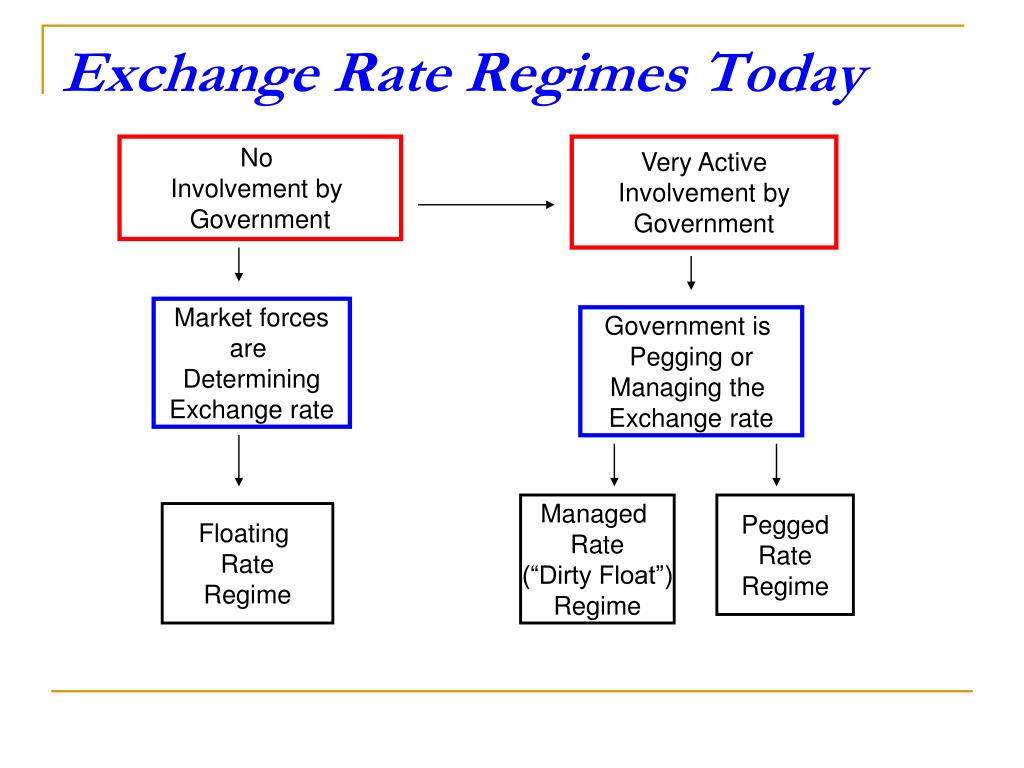
At the most basic level, exchange rate regimes can be categorized by the degree of central bank intervention.
This choice of regime involves a significant trade-off. Economists often refer to the "impossible trinity" (or the trilemma), which states that a country cannot simultaneously have all three of the following:
- A credibly fixed exchange rate.
- Full convertibility of its currency (i.e., free capital flows).
- An independent monetary policy.
A country must choose two of the three, sacrificing one. This trilemma is the "why" behind the different regime choices; each represents a different set of priorities. For instance, a country that wants to control its own interest rates (independent monetary policy) and allow capital to flow freely must let its currency float.
The following video provides a concise introduction to this concept and lays out the spectrum of regimes we will be discussing.
Level 1 CFA Economics: Currency Exchange Rates-Lecture 5
This video from IFT introduces the concept of an 'ideal' exchange rate regime and explains the inherent trade-offs (the impossible trinity). It then introduces the spectrum of regimes we will explore.
Watch from the beginning to 01:44 to understand the impossible trinity, and then from 03:38 to 04:09 to see the spectrum from fixed to floating.
2. The Ends of the Spectrum: Fixed vs. Floating
Let's start by examining the two extremes of the spectrum.
Independently Floating Regime
This is the "no involvement" branch from the flowchart.
- Definition: The value of the currency is determined solely by supply and demand in the foreign exchange market.
- Central Bank Role: The central bank does not intervene to target a specific exchange rate. It can, therefore, use its monetary policy tools (like setting interest rates) to focus on domestic objectives such as controlling inflation or stimulating employment.
- Examples: Major currencies like the US Dollar (USD), Euro (EUR), Japanese Yen (JPY), and British Pound (GBP) operate under floating regimes.
Fixed Regimes
This is the "very active involvement" branch.
- Definition: The country's government or central bank commits to maintaining a specific exchange rate against another currency (a "peg") or a basket of currencies.
- Central Bank Role: The central bank must stand ready to buy or sell its own currency in the market to maintain the pegged rate. This means it gives up its ability to conduct independent monetary policy. For example, if its currency is pegged to the USD, it must effectively adopt the monetary policy of the U.S. Federal Reserve to maintain the peg.
This graph helps visualize the difference. A floating rate is the equilibrium point where supply and demand meet. A fixed rate is a horizontal line set by policy, which the central bank must defend.

3. A Taxonomy of Currency Regimes
The CFA curriculum, drawing from the International Monetary Fund (IMF), specifies a more detailed classification that falls along this fixed-to-floating spectrum. The video below provides an excellent, exam-focused walkthrough of these categories. As you watch, focus on the key distinguishing feature of each regime.
Level 1 CFA Economics: Currency Exchange Rates-Lecture 5
This IFT video details the main currency regimes you need to know for the exam, moving from the most rigid fixed systems towards more flexible ones.
Watch from 04:09 to 09:25. Pay close attention to the examples and the subtle differences between systems like a currency board and a simple fixed parity.
Let's summarize the regimes from the video in a table, moving from most rigid (fixed) to most flexible (floating).
| Regime Type | Description | Key Feature / Implication |
|---|---|---|
| No Separate Legal Tender | The country uses the currency of another nation (dollarization) or is part of a monetary union (e.g., Eurozone). | Complete loss of independent monetary policy. |
| Currency Board System | An explicit legislative commitment to exchange domestic currency for a specific foreign currency at a fixed rate. | Very credible peg, as the monetary base is backed by foreign reserves. Still no independent monetary policy. |
| Fixed Parity | The country pegs its currency to another currency or a basket, with a narrow band of fluctuation (e.g., ±1%). | No legislative commitment, making it less credible than a currency board. The central bank has some discretion over foreign reserve levels. |
| Target Zone / Band | Similar to a fixed parity, but with wider bands (e.g., ±2%). | The wider band gives the central bank more flexibility in policy. |
| Crawling Peg | The pegged exchange rate is adjusted periodically, typically in response to inflation differentials (passive crawl) or on a pre-announced schedule (active crawl). | Aims to maintain the benefits of a peg while avoiding currency overvaluation due to inflation. |
| Managed Float | The exchange rate is largely market-determined, but the central bank intervenes at its discretion to influence the rate, without a specific target. Also called a "dirty float". | High degree of policy flexibility, but the lack of clear rules can create uncertainty. |
| Independently Floating | The exchange rate is determined by market forces. The central bank does not intervene to target a rate. | Allows for completely independent monetary policy. |
For a detailed textual reference of these categories, you can review the "Taxonomy of Currency Regimes" section in the following article.
Exchange Rate Regimes Explained | CFA Level 1 - AnalystPrep
This article from AnalystPrep provides a clear, structured breakdown of the IMF's eight currency regime categories. It's a useful resource for reinforcing the definitions we've just covered.
Read the section titled 'Taxonomy of Currency Regimes'. Use it to solidify your understanding of the different systems, from 'Arrangement with No Separate Legal Tender' down to 'Independently Floating Rates'.
4. Application: Risk and Inflation
Understanding these regimes is not just about memorizing definitions; it's about analyzing their impact on risk and economic outcomes. Let's look at a practical example.
The final part of the IFT video walks through a CFA-style problem that asks you to compare the risks of investing in countries with different regimes.
Level 1 CFA Economics: Currency Exchange Rates-Lecture 5
Let's apply these concepts to an exam-style question. This section of the IFT video demonstrates how the choice of regime affects an investor's exchange rate risk and a country's susceptibility to imported inflation.
Watch from 09:25 to 13:49. Focus on the reasoning behind the answers to two key questions: Ranking investments by exchange rate risk. Determining which country is least likely to 'import' inflation.
From this example, we can derive two crucial rules for the exam:
- Exchange Rate Risk: From the perspective of a foreign investor, exchange rate risk is highest with a floating rate, lower with a fixed/pegged rate, and virtually zero with dollarization (assuming the investment is denominated in the currency the investor uses).
- Imported Inflation: A country with a fixed peg or that has dollarized will "import" the monetary policy—and therefore the inflation—of the country to which its currency is linked. A country with a floating rate can use its independent monetary policy to insulate itself from this effect.
Conclusion
In this lesson, we have mapped out the entire landscape of exchange rate regimes, from the absolute commitment of a monetary union to the free-for-all of a floating market. You are now equipped to describe and differentiate between these systems, a key requirement for the CFA exam.
Key Takeaways:
- Exchange rate regimes exist on a spectrum based on the level of central bank intervention.
- The "impossible trinity" explains the trade-offs countries face: they can only have two of three options (fixed rate, free capital flow, independent monetary policy).
- Fixed regimes (dollarization, currency board, fixed parity) provide exchange rate stability but sacrifice monetary policy independence.
- Floating regimes provide monetary policy independence but come with exchange rate volatility.
- Intermediate regimes (crawling pegs, target zones, managed floats) attempt to find a balance between these two extremes.
- The choice of regime has direct implications for an investor's exchange rate risk and a country's exposure to imported inflation.
Preview of the Next Lesson:
Now that we understand the various "rules of the game" that govern exchange rates, we will turn our attention to the players. In the next lesson, we will delve into the underlying economic factors that cause supply and demand for a currency to shift. We will answer the question: What determines the exchange rate in the short run and the long run?