Introduction
Welcome back to our study of currency exchange rates. In the previous lesson, we categorized the different "rules of the game" that govern currencies by exploring fixed, floating, and managed exchange rate regimes. We learned that for a country with a floating currency, its value is determined by market forces.
Today, we will dive deep into what those forces are. This lesson directly addresses the learning outcome: "Explain the determinants of exchange rates in the short run and long run." We will explore why a currency's value might fluctuate wildly day-to-day, while also being anchored to more fundamental economic trends over many years.
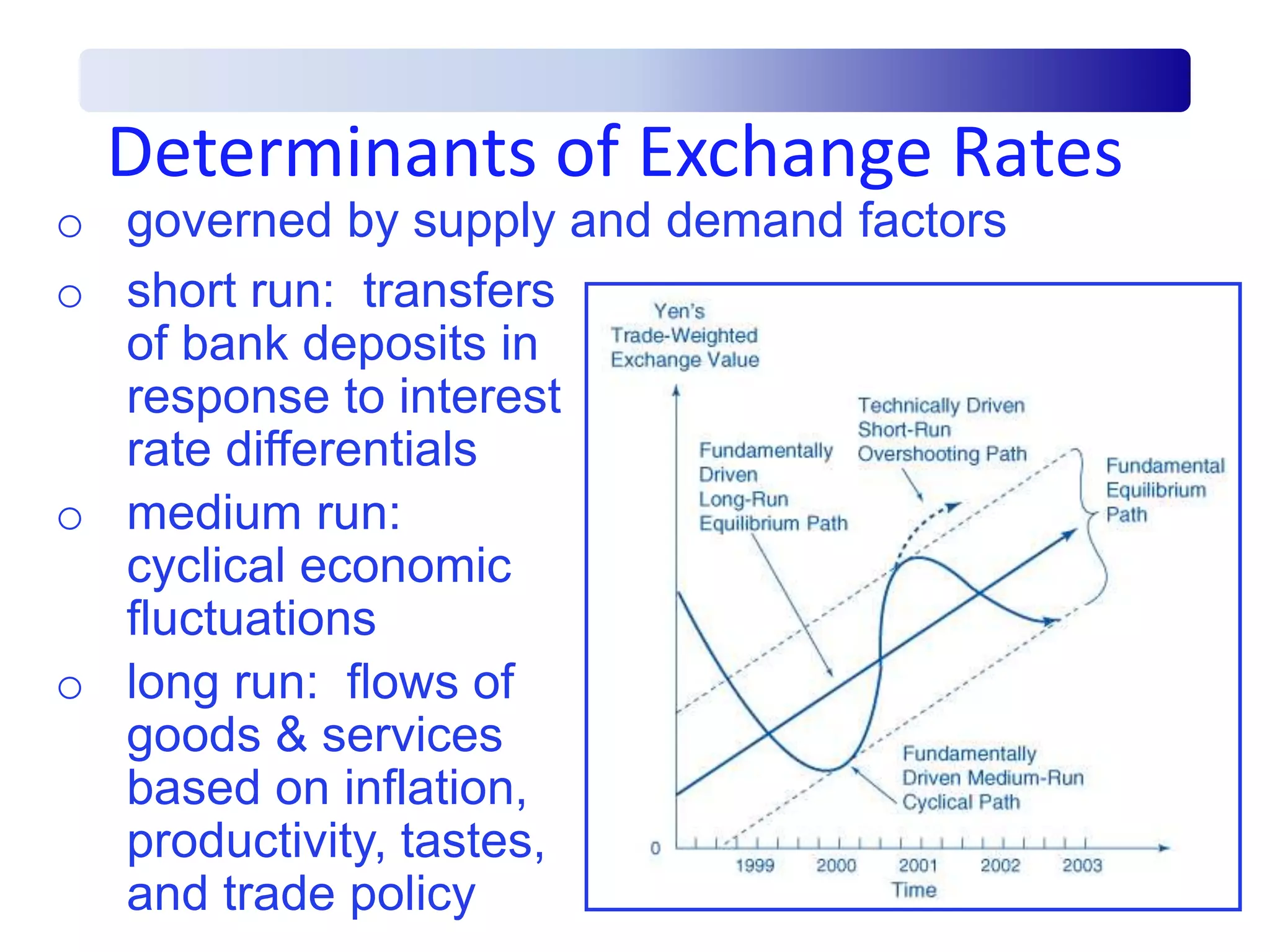
Think of an exchange rate as having two components: a volatile, short-term path and a more stable, long-term equilibrium path it tends to follow. This lesson will equip you to identify the distinct factors that drive each of these paths.
This image provides an excellent roadmap for our discussion today, visually separating the determinants across different time horizons.
1. The Core Engine: Supply and Demand
Before we can analyze what shifts exchange rates, we must first be clear on the basics of supply and demand in the foreign exchange (forex) market. In any currency pair, say USD/CAD, there are two sides to the market.
Let's watch a short video that clarifies who is demanding and who is supplying each currency. This is a foundational concept for everything that follows.
The Foreign Exchange Market- Macro 6.3
This clip from Jacob Clifford provides a clear, simple explanation of the supply and demand framework for currencies.
Watch from the beginning to 02:05. Focus on the answer to two simple questions for the USD/CAD market: Who demands U.S. dollars? Who supplies U.S. dollars?
As the video explains, the key takeaway is:
- Demand for a currency comes from foreigners who want to buy that country's goods, services, or financial assets. (e.g., Canadians demand USD).
- Supply of a currency comes from domestic residents who need foreign currency to buy foreign goods, services, or financial assets. (e.g., Americans supply USD).
Any determinant of exchange rates works by influencing either this demand or this supply.
2. Short-Run Determinants: The Flow of Capital
In the short run (days, weeks, months), the overwhelming driver of exchange rates is the movement of financial capital seeking the highest short-term returns. Investors will move billions of dollars across borders to capture even small advantages in interest rates.
The key short-run determinants are:
- Interest Rate Differentials: This is the most significant driver.
- Market Expectations and Sentiment: News, political events, and investor mood can cause rapid shifts.
Let's see a practical example of how interest rate differentials impact the market.
The Foreign Exchange Market- Macro 6.3
This video provides a fantastic, step-by-step walkthrough of how a change in interest rates affects the supply and demand for currencies, causing one to appreciate and the other to depreciate.
Watch from 01:53 to 05:04. Follow the logic of what happens in both the market for U.S. dollars and Canadian dollars when U.S. interest rates rise.
To summarize the video's crucial example:
- Event: Interest rates in the U.S. (15%) become much higher than in Canada (2%).
- Investor Action: Canadian investors want to earn the higher U.S. interest rate. To do so, they must sell their Canadian dollars (CAD) and buy U.S. dollars (USD) to invest in U.S. bonds.
- Market Impact:
- The demand for USD increases (shifts to the right), causing the USD to appreciate.
- The supply of CAD increases (shifts to the right), causing the CAD to depreciate.
This relationship is formalized by a theory called Uncovered Interest Rate Parity (UIRP). While a detailed mathematical treatment is beyond the scope here, its core idea is essential.
Foreign Exchange Markets| AnalystPrep
This text explains the concept of Uncovered Interest Rate Parity (UIRP), which provides the theoretical foundation for why interest rate differentials affect exchange rates.
Read the two sections titled 'The Uncovered Interest Rate Parity' and the 'Example: Uncovered Interest Parity' that follows. Focus on the main implication: the currency with the higher interest rate is expected to depreciate to offset the higher return.
You might notice a seeming contradiction: the video shows the high-interest-rate currency appreciating, while the UIRP theory says it should depreciate. Here is how to reconcile this for the exam:
- Short Run (Flow Effect): The immediate flow of capital into the high-interest-rate country causes its currency to appreciate. This is the effect shown in the Jacob Clifford video and is the dominant short-run driver.
- Long Run (Expectation Effect): UIRP suggests that over the long term, this appreciation must be reversed. The currency is expected to depreciate in the future to ensure that, on average, returns are equalized across countries.
For the CFA exam, when asked about short-run determinants, think of capital flows driving the high-interest-rate currency up.
3. Long-Run Determinants: The Flow of Goods and Services
Over the long run (years, decades), the temporary effects of capital flows fade, and the exchange rate is anchored by the trade of actual goods and services.
A. Purchasing Power Parity (PPP)
The most important long-run theory is Purchasing Power Parity (PPP). It states that the exchange rate between two countries should adjust so that an identical basket of goods costs the same in both countries.
The most practical version is Relative PPP, which focuses on inflation. It posits that the change in the exchange rate should be approximately equal to the inflation differential between two countries.
% Change in Exchange Rate ≈ Foreign Inflation Rate – Domestic Inflation Rate
If a country has persistently higher inflation, its currency must depreciate over the long run to keep its goods competitive.
Capital Flows and the FX Market (2025 CFA® Level I Exam – Economics – Learning Module 7)
This video explains the concept of PPP and the related idea of the real exchange rate. It also provides a practical calculation which is highly testable.
Watch from 08:42 to 14:15. Pay close attention to the Big Mac analogy for understanding PPP and the calculation for the percentage change in the real exchange rate.
B. Balance of Payments Approach
This approach states that a country's trade balance has a long-run effect on its currency. A country that consistently runs a trade surplus (exports > imports) will see a persistent demand for its currency, leading to long-run appreciation. Conversely, a country with a chronic trade deficit (imports > exports) is constantly supplying its currency to pay for foreign goods, leading to long-run depreciation.
These trade and capital flows are linked through a fundamental macroeconomic identity:
Where:
- = Trade Balance (Exports - Imports)
- = Private Sector Balance (Private Savings - Investment)
- = Government Balance (Taxes - Government Spending)
This equation shows that a trade deficit must be financed by an inflow of capital (e.g., private investment exceeding savings, or a government budget deficit).
Capital Flows and the FX Market (2025 CFA® Level I Exam – Economics – Learning Module 7)
This final video segment explains how trade flows, capital flows, and government policy interact to influence exchange rates through the balance of payments.
Watch from 40:15 to 45:50. Focus on understanding the macroeconomic equation and how a trade surplus or deficit relates to savings, investment, and government budgets.
4. Synthesis: Putting It All Together
Let's revisit our initial diagram.
- The long-run equilibrium path is determined by PPP (inflation differentials) and trade balances. This is the fundamental anchor for the currency's value.
- The short-run path is driven by capital flows. When a central bank raises interest rates, capital floods in, causing the currency to appreciate sharply, often "overshooting" its long-run equilibrium value.
- The medium-run path is influenced by the business cycle. A country in a strong economic expansion may attract investment (strengthening the currency) but also increase its imports (weakening the currency). The net effect depends on the relative strength of these factors.
Conclusion
In this lesson, we have dissected the complex forces that drive exchange rates. By separating the determinants into short-run and long-run factors, you can build a coherent framework for analyzing currency movements.
Key Takeaways:
- Exchange rates are fundamentally determined by the supply and demand for currencies.
- In the short run, the market is dominated by capital flows. The key determinant is interest rate differentials, with higher rates attracting capital and causing short-term appreciation. News and market sentiment also play a major role.
- In the long run, the exchange rate is anchored by the flow of goods and services. The key determinants are inflation differentials (Relative PPP) and persistent trade balances. A country with higher inflation or a chronic trade deficit will likely see its currency depreciate over time.
- The actual path of an exchange rate is a volatile short-run journey around a more stable long-run trend.
Preview of the Next Lesson:
We have now established what exchange rates are, the regimes they operate under, and what causes them to move. The final piece of the puzzle is to understand the consequences of these movements. In our next and final lesson of this module, we will explore the question: What is the impact of exchange rate movements on international trade and capital flows?