Introduction
Welcome to our first lesson in macroeconomics. In the previous module, we concluded our study of microeconomics by comparing how different market structures—from perfect competition to monopoly—affect price, output, and efficiency. We were focused on the behavior of individual firms and markets.
Now, we zoom out to look at the entire economy. This lesson introduces the single most important measure of a country's economic performance: Gross Domestic Product (GDP). Our goal is to define GDP and understand the two primary methods used to calculate it: the expenditure approach and the income approach. Mastering this is the first step in analyzing business cycles, economic growth, and the effects of government policy, all key topics for the CFA exam.
1. What is Gross Domestic Product (GDP)?
At its core, GDP is a monetary measure of a country's economic output. It represents the total market value of all final goods and services produced within a country's borders during a specific period, usually a quarter or a year.
The word "final" is critical. To avoid double-counting, we only include the value of goods and services sold to the end user. For example, when calculating the GDP contribution of a car, we use the final sale price of the car, not the value of the steel, tires, and glass that were used to build it. Those are intermediate goods.
An alternative way to avoid double-counting is to sum the value added at each stage of production. The following video provides an excellent illustration of this concept using the example of making a baseball bat.
How to Calculate GDP (Updated 2025): Expenditure, Income & Value-Added Approaches
To understand the crucial distinction between intermediate and final goods, and the concept of 'value added', let's watch this short video from Econbusters.
Watch the segment from the beginning until 03:37. Pay close attention to how the final price of the baseball bat ($80) is equal to the sum of the value added at each stage of production.
As the video demonstrates, whether we take the value of the final product ($80) or sum the value added by the lumberjack ($5), the lumber mill ($5), the manufacturer ($10), and the retailer ($60), the result is the same. This principle is the foundation of GDP accounting.
2. The Expenditure Approach to Calculating GDP
The most common way to calculate GDP is the expenditure approach, which sums up all the spending on final goods and services in an economy. The formula, which is essential for the exam, is:
Let's break down each component.
GDP: Expenditure and Income Approaches | CFA Level 1
This article from AnalystPrep provides clear, CFA-focused definitions for the components of the expenditure approach.
Read the sections 'Expenditure Approach' and 'Criteria for Measuring Gross Domestic Product.' Focus on the definition of the formula's components and the rules for what is included in GDP.
Based on the reading, here is a summary of the components:
-
C: Consumption (Gross private consumption expenditures)
- This is the largest component of GDP for most developed economies.
- It includes all spending by households on durable goods (e.g., cars, appliances), non-durable goods (e.g., food, clothing), and services (e.g., haircuts, medical care).
-
I: Investment (Gross private investment)
- This includes spending by businesses on capital goods like machinery and equipment, changes in business inventories, and all spending on new housing.
- Crucially, this does not include purchases of financial assets like stocks and bonds. This is a common point of confusion.
-
G: Government Purchases
- This includes spending by the government on goods and services, such as military equipment, infrastructure projects (roads, bridges), and the salaries of government employees.
- It does not include transfer payments like Social Security or unemployment benefits, as these are not payments for currently produced goods or services.
-
(X - M): Net Exports
- X (Exports): Spending by foreigners on our domestically produced goods and services. We add this because it's part of our country's production.
- M (Imports): Spending by our residents on foreign-produced goods and services. We subtract this because although it's part of our consumption (C, I, or G), it wasn't produced in our country.
3. The Income Approach to Calculating GDP
The second method for calculating GDP is based on a fundamental principle: every dollar of spending by a buyer is a dollar of income for a seller. Therefore, if we sum up all the income earned in the production of goods and services, we should arrive at the same total as the expenditure approach.
This income is paid to the factors of production: land, labor, capital, and entrepreneurship.
Measuring GDP using the Income Approach and the Expenditure Approach - HD
This video from Jason Welker provides a clear conceptual overview of the income approach and how it relates to the factors of production within the circular flow of the economy.
Watch the segment from 02:26 to 07:11. Focus on how income is earned by households in the form of rent, wages, interest, and profit in exchange for providing productive resources.
The simple form of the income approach is to sum these factor payments:
Income = Wages + Rent + Interest + Profit
However, for national accounting and the CFA exam, the formula is more formal. It adjusts this "national income" to align with the market value of output measured by the expenditure approach.
Components of GDP - PrepNuggets
Now let's look at the official formula for the income approach. This reading from PrepNuggets explains the necessary adjustments to get from national income to GDP.
Read the section titled 'Expenditure Approach and Income Approach to GDP.' Pay special attention to the income approach formula and the definitions of its three main components.
The formal income approach formula is:
- National Income: The sum of all income earned by a country's residents. This includes:
- Employee compensation (wages and benefits)
- Corporate and government profits
- Interest income
- Rent
- Indirect business taxes (e.g., sales tax) minus subsidies.
- Capital Consumption Allowance (CCA): Also known as depreciation, this is an estimate of the "wear and tear" on the existing capital stock used in production. It represents the amount that must be reinvested to maintain the economy's productive capacity.
- Statistical Discrepancy: Since the expenditure and income approaches use different data sources, they rarely match perfectly. This is a "plug" figure added to the income side to make the two numbers equal, accounting for any measurement errors.
4. Tying It All Together: The Circular Flow
The idea that total spending must equal total income can be visualized with the circular flow model of the economy. This model shows how money flows between households, firms, the government, and the rest of the world.
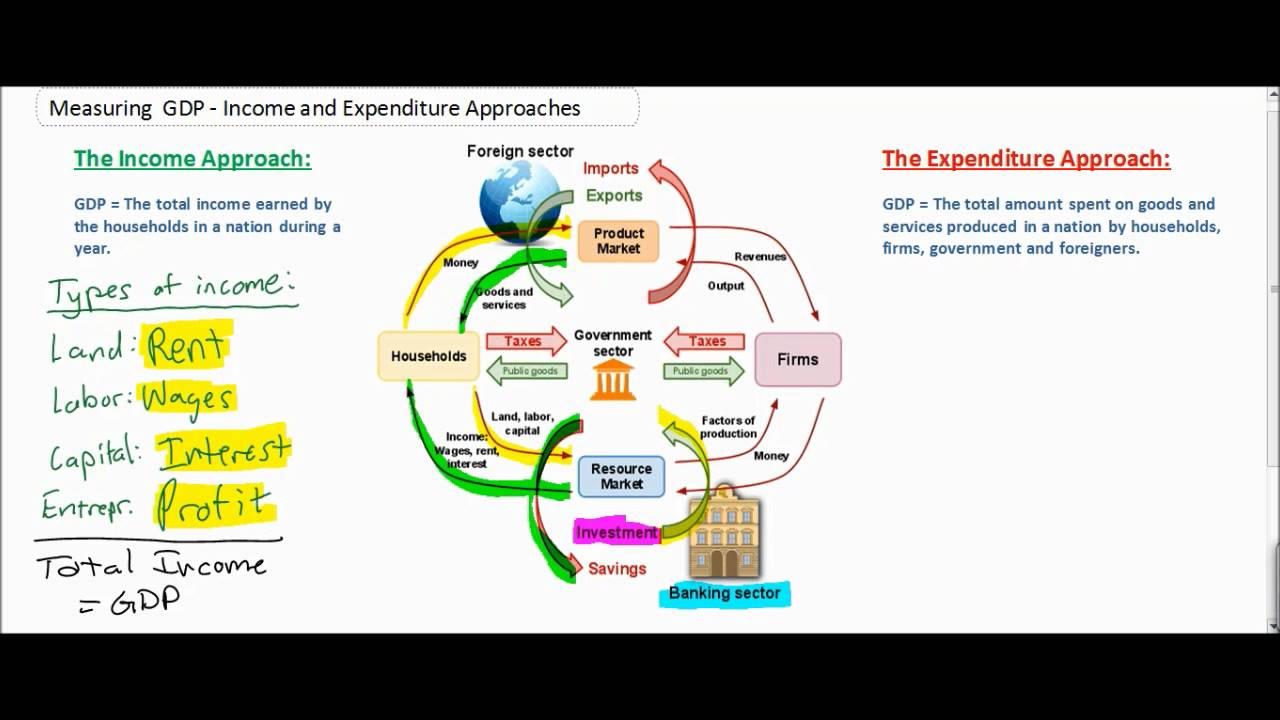
The top half of the diagram shows the expenditure flows: households consuming, firms investing, governments purchasing, and foreigners buying exports. The bottom half shows how that spending becomes income for households in the form of wages, rent, interest, and profit.
5. Practice Problems
Now, let's test your understanding with a couple of CFA-style questions.
GDP: Expenditure and Income Approaches | CFA Level 1
Apply what you've learned by tackling these practice questions from AnalystPrep. Read the question, formulate your answer, and then carefully review the provided solution.
Scroll to the end of the article and work through Question 1 and Question 2. The first question tests what is excluded from GDP, and the second tests your understanding of the 'value-added' concept.
Conclusion
In this lesson, we established the groundwork for our study of macroeconomics. We've defined Gross Domestic Product and learned how to measure it using two distinct but equivalent methods.
Key Takeaways:
- GDP is the market value of all final goods and services produced within a country in a given period.
- The Expenditure Approach calculates GDP by summing total spending:
GDP = C + I + G + (X - M). - The Income Approach calculates GDP by summing all income generated:
GDP = National Income + CCA + Statistical Discrepancy. - In principle, Expenditure = Income, a relationship visualized by the circular flow model.
- It's critical to know what is included and excluded from GDP calculations (e.g., no transfer payments, no financial transactions).
Preview of the Next Lesson:
The GDP figure we've discussed today is what economists call Nominal GDP, as it's measured in current prices. However, if prices are rising due to inflation, nominal GDP might increase even if the actual quantity of goods and services produced does not. In our next lesson, we will learn how to adjust for inflation by distinguishing between Nominal GDP and Real GDP, and we'll introduce a key measure of inflation called the GDP deflator.