Introduction
Hello! Welcome to our next lesson.
In our last session, we assembled the full Aggregate Demand-Aggregate Supply (AD-AS) model and learned how to identify the economy's state by observing where the AD and SRAS curves intersect relative to the long-run potential output (LRAS). We distinguished between long-run equilibrium, recessionary gaps, and inflationary gaps, and we saw how the economy can self-correct over time through shifts in the SRAS curve.
Today, we will focus on what causes these gaps in the first place. This lesson is all about analyzing the impact of economic "shocks"—events that cause the AD or SRAS curves to shift. Our learning outcome is to analyze the effects of shifts in AD and SRAS on the price level and real GDP.
Mastering this is essential for a financial analyst. When you read a headline about rising oil prices, a stock market boom, or a change in government spending, you'll be able to use the AD-AS framework to predict the immediate impact on economic growth and inflation. This forms the analytical backbone for understanding the business cycle, which we will explore in our next module.
1. The Four Fundamental Shifts
Any short-run fluctuation in the economy can be traced back to a shift in either the AD curve or the SRAS curve. There are four fundamental scenarios:
- An increase (rightward shift) in AD.
- A decrease (leftward shift) in AD.
- An increase (rightward shift) in SRAS.
- A decrease (leftward shift) in SRAS.
Let's begin by watching a video that provides a clear, visual walkthrough of these four scenarios and their consequences.
CFA® Level I Economics - Macroeconomic Equilibrium: Recessionary Gap, Inflationary Gap, Stagflation
This video from PrepNuggets illustrates the four primary scenarios of shifts in Aggregate Demand and Short-Run Aggregate Supply. It clearly shows the resulting impact on real GDP and the price level, connecting each shift to a specific economic condition.
Please watch from 01:33 to 06:53. For each of the four shifts discussed (AD decrease, AD increase, SRAS decrease, SRAS increase), pay close attention to: The direction of the curve's shift. The effect on the equilibrium price level. The effect on equilibrium real GDP. The name given to the resulting economic situation (e.g., recessionary gap, inflationary gap, stagflation).
2. A Deeper Look at Shifters and Outcomes
The video gave us an excellent overview of the effects. Let's summarize and formalize what we saw.
- Increase in AD (Shift Right): Leads to a higher price level and higher real GDP. This creates an inflationary gap.
- Decrease in AD (Shift Left): Leads to a lower price level and lower real GDP. This creates a recessionary gap.
- Increase in SRAS (Shift Right): Leads to a lower price level and higher real GDP. This is a favorable outcome, often driven by productivity gains or lower input costs.
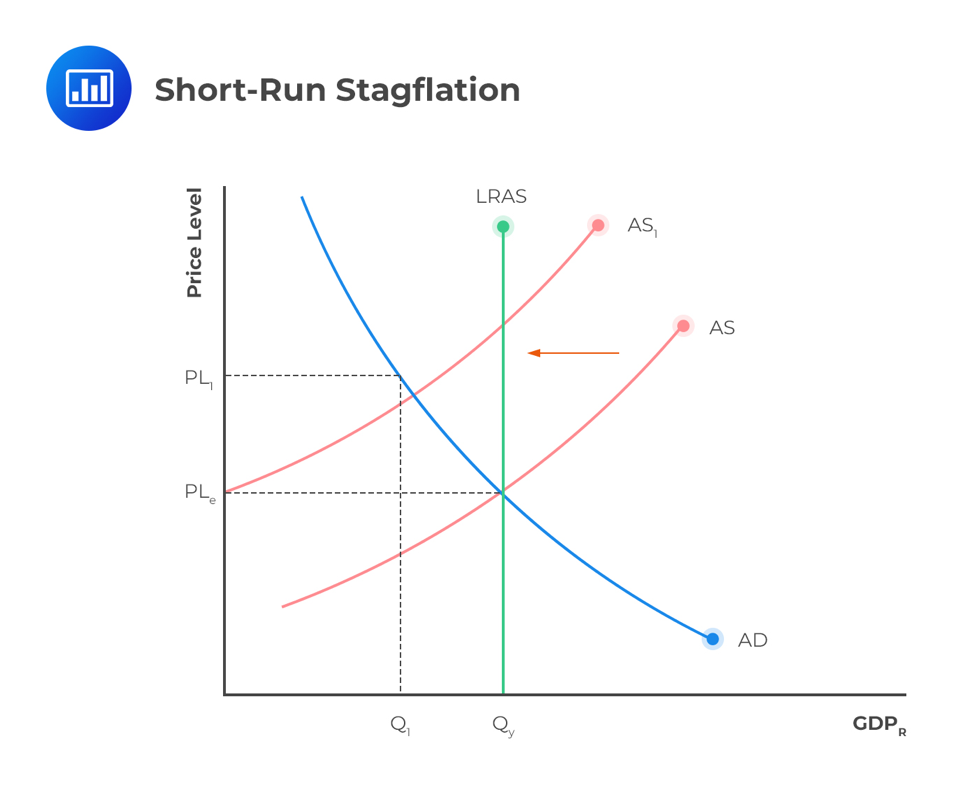
- Decrease in SRAS (Shift Left): Leads to a higher price level and lower real GDP. This unwelcome combination is known as stagflation (stagnation + inflation).
What Causes the Curves to Shift?
To analyze real-world events, you need to know which factors shift which curve. The following resource provides comprehensive tables listing the key shifters for both AD and SRAS.
LM03 Aggregate Output, Prices and Economic Growth - IFT World
Now that we've seen the effects of shifts, let's catalog the specific factors that cause them. These tables from IFT are an excellent study tool that directly aligns with the CFA curriculum.
Please review the two tables in this resource. The first, 'Shifts in the Aggregate Demand Curve', is under the heading 'Shifts in Aggregate Demand'. The second, 'Shift in the Aggregate Supply Curve', is under 'Shifts in Aggregate Supply'. For each table, try to understand the logic for a few key shifters, for example: Why does an increase in consumer confidence shift AD to the right? Why does an increase in nominal wages shift SRAS to the left?
Shift of a Curve vs. Movement Along a Curve
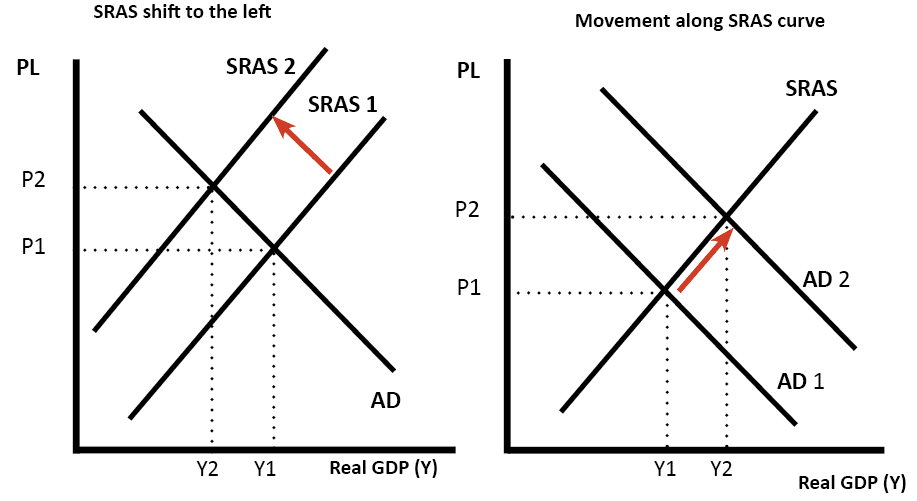
It is critical to distinguish between an event that shifts a curve and an event that causes a movement along a curve. For example, a rise in consumer wealth shifts the AD curve rightward. This shift then causes a movement along the SRAS curve to a new, higher price and output level. The SRAS curve itself does not shift.
3. Analyzing Simultaneous Shifts
In the real world, it's common for multiple events to happen at once, causing both the AD and SRAS curves to shift simultaneously. For your CFA exam, you need to be able to predict the outcome of these double shifts.
The rule is: When both curves shift, the effect on one variable (price level or real GDP) will be certain, while the effect on the other will be indeterminate.
The indeterminate outcome depends on the relative magnitude of the two shifts, which is usually not specified in an exam question.
Let's watch a short clip that introduces this concept.
CFA® Level I Economics - Macroeconomic Equilibrium: Recessionary Gap, Inflationary Gap, Stagflation
Let's return to the PrepNuggets video to see how to approach these more complex scenarios.
Watch the final segment from 06:53 to 08:00. The key insight is that when both curves shift, you can determine the direction of change for one variable, but not for the other, without more information.
Now, let's apply this with a practice exercise. The best way to master this is to reason through each combination.
LM03 Aggregate Output, Prices and Economic Growth - IFT World
This table from the IFT resource systematically lays out the outcomes for all combinations of shifts. It's a crucial tool for consolidating your knowledge and for quick review before the exam.
Scroll down to the table under the sub-heading 'Example' near the end of the webpage. Before looking at the solution, try to determine the 'Effect on Real GDP' and 'Effect on Aggregate Price Level' for the four simultaneous shift scenarios: Increase in AS & Increase in AD Decrease in AS & Decrease in AD Increase in AS & Decrease in AD Decrease in AS & Increase in AD For each case, ask yourself: which variable's change is certain, and which is indeterminate? Then, compare your reasoning with the provided solution table.
Let's walk through one example together: Aggregate Demand increases and Short-Run Aggregate Supply decreases.
- The AD increase pushes Price Level up and Real GDP up.
- The SRAS decrease pushes Price Level up and Real GDP down.
Combining these effects:
- Price Level: Both shifts push the price level up, so the price level will definitely increase.
- Real GDP: The shifts push real GDP in opposite directions. The final outcome is indeterminate; it depends on whether the AD shift is larger or smaller than the SRAS shift.
By applying this logic to all four cases, you can build the entire summary table yourself, which is an excellent way to prepare for exam questions.
Conclusion
Today we've taken a major step in our understanding of macroeconomics. We've moved from a static view of equilibrium to a dynamic analysis of how economic shocks affect output and prices.
Key Takeaways:
- Short-run economic fluctuations are caused by shifts in the Aggregate Demand (AD) and Short-Run Aggregate Supply (SRAS) curves.
- An increase in AD creates an inflationary gap (higher GDP, higher prices). A decrease in AD creates a recessionary gap (lower GDP, lower prices).
- A decrease in SRAS causes stagflation (lower GDP, higher prices). An increase in SRAS leads to non-inflationary growth (higher GDP, lower prices).
- When both curves shift simultaneously, the effect on either real GDP or the price level will be indeterminate without knowing the relative magnitudes of the shifts.
Preview of the Next Lesson:
The concepts we've mastered today—recessionary gaps, inflationary gaps, and stagflation—are not just theoretical. They are the core components of the business cycle, which describes the recurring patterns of expansion and contraction in an economy. In our next lesson, we will begin Module 8 by formally describing the phases of the business cycle and examining how resource use, unemployment, and inflation behave during each phase. You will see that the AD-AS model is the engine driving these cyclical patterns.