Introduction
Welcome back. In our previous lesson, we established how a firm in monopolistic competition maximizes its profit in the short run by producing where marginal revenue equals marginal cost (MR=MC). We saw that this can lead to positive economic profits, a key attraction of this market structure.
Today, we will explore the consequences of those profits. This lesson directly addresses the learning outcome: to describe the long-run equilibrium in monopolistic competition. We will see how the low barriers to entry, a defining feature of this market, set in motion a chain of events that systematically erodes short-run profits. By the end of this lesson, you will be able to explain and illustrate why, in the long run, firms in this market only break even, earning zero economic profit.
1. From Short-Run Profit to Long-Run Competition
The story of the long run begins with the success of the short run. When existing firms earn positive economic profits, it acts as a powerful signal to the market.
Remember two key characteristics of monopolistic competition:
- There are a large number of firms.
- Barriers to entry and exit are low.
Because it's relatively easy for new companies to enter, the economic profits earned by existing firms attract new competitors. Imagine a neighborhood where a single, highly profitable boutique coffee shop opens. It won't be long before other entrepreneurs notice this success and decide to open their own coffee shops nearby.
What is the impact on the original coffee shop?
- Demand Decreases: Some of its customers will be lured away by the new alternatives. This causes the demand curve for the original firm's product to shift to the left.
- Demand Becomes More Elastic: With more substitutes available, customers become more price-sensitive. A small price increase by the original shop is now more likely to send customers to a competitor. This makes the firm's demand curve flatter (more elastic).
This process of entry continues as long as there are economic profits to be made.
The following reading provides a clear, CFA-focused explanation of this dynamic.
PRE-READING Economics - Learning Module 2
This text from a CFA preparatory guide explains how economic profits act as a signal that attracts new competition, leading to changes in a firm's demand curve.
Please read the section titled 'Factors Affecting Long-Run Equilibrium in Monopolistically Competitive Markets'. Focus on how economic profit acts as a 'signal' and why the entry of new firms causes the demand for existing firms to be driven down.
2. The Long-Run Equilibrium Graph
This process of new firms entering and demand shifting left continues until economic profit is eliminated. This occurs when the firm's demand curve becomes tangent to its Average Total Cost (ATC) curve. At this point, the price the firm can charge for its profit-maximizing quantity is exactly equal to the average cost of producing it.
Since Profit per unit = Price - ATC, if P = ATC, the profit per unit is zero, and thus the total economic profit is zero. The firm is now earning only a normal profit—just enough to cover its explicit and implicit costs.
Drawing this long-run equilibrium graph can be tricky. The following video provides an excellent step-by-step guide to constructing it correctly, showing the dynamic shift that leads to the final equilibrium.
Y2 23) Monopolistic Competition
The video 'Monopolistic Competition' by EconplusDal provides a fantastic walkthrough of how to draw the long-run equilibrium diagram. It shows how the supernormal profits from the short run are eroded away.
Please watch the segment from 03:45 to 06:17. Pay close attention to the logic of why new firms enter and the step-by-step process for drawing the diagram, ensuring the demand curve is tangent to the AC curve at the profit-maximizing output.
Here is a clear, static image of the final long-run equilibrium.
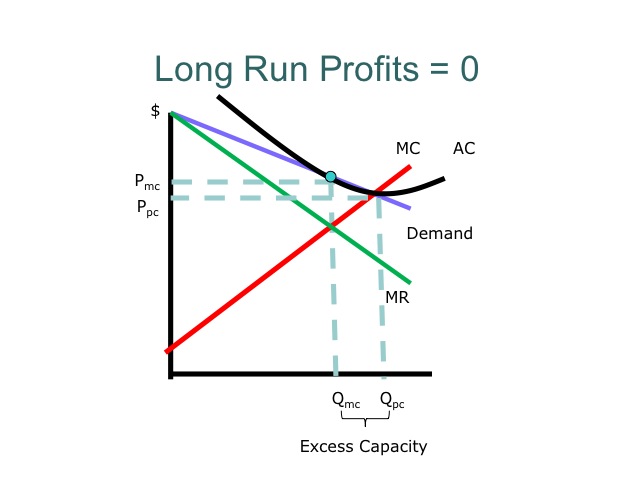
Key features to note in the long-run equilibrium:
- The firm still follows the profit-maximization rule: MR = MC.
- Demand has shifted leftward so that at the profit-maximizing quantity (Qmc), Price = Average Total Cost (Pmc = AC).
- Economic profit is zero. There is no longer an incentive for new firms to enter, and the market is stable.
3. Efficiency Implications: A Trade-Off
Is the long-run outcome in monopolistic competition efficient? To answer this, economists compare it to the benchmark of perfect competition. We find that monopolistic competition is neither allocatively nor productively efficient.
1. Productive Inefficiency and Excess Capacity
- Productive efficiency occurs when a good is produced at the lowest possible cost, which is the minimum point of the Average Total Cost (ATC) curve.
- Looking at the graph above, you can see the firm produces at quantity Qmc, which is on the downward-sloping portion of the ATC curve. It is not producing at the minimum of the ATC curve (which occurs at Qpc).
- This difference between the profit-maximizing quantity (Qmc) and the productively efficient quantity (Qpc) is called excess capacity. The firm has the capacity to produce more and lower its average cost, but it doesn't because to sell those extra units, it would have to lower its price on all units, leading to a loss.
2. Allocative Inefficiency
- Allocative efficiency occurs when resources are used to produce the goods and services most desired by society. This happens when price equals marginal cost (P = MC).
- In our long-run equilibrium graph, the firm charges price Pmc, which is determined by the demand curve. This price is greater than the marginal cost (MC) at that level of output.
- Because P > MC, it means consumers value the last unit produced more than it cost to make. From society's perspective, more should be produced. This gap represents a degree of inefficiency, leading to a deadweight loss (though smaller than in a pure monopoly).
The following reading provides another look at this long-run outcome and the comparison with perfect competition.
Monopolistic Competition | CFA Level 1
Let's read a short passage from AnalystPrep that reinforces the graphical analysis and the comparison with a perfectly competitive market.
Please read the text under the heading 'Long-Run Equilibrium under Monopolistic Competition', starting from 'Consider the following diagram'. Focus on the explanation of why economic profit is zero and the comparison between the output level Q1 and the minimum average cost output level Q2.
So, if monopolistic competition is inefficient, what do we get in return? The answer lies in its defining feature: product differentiation. The "inefficiency" is the price we pay for variety—the choice between different styles of clothing, types of restaurants, and brands of coffee. While a perfectly competitive market would give us one generic product at the lowest possible price, monopolistic competition gives us variety, innovation, and branding, which many consumers value.
4. Practice Question
Let's check your understanding of the key conditions in this long-run equilibrium.
Question:
In the long-run equilibrium of a monopolistically competitive market, which of the following statements is most accurate?
- Firms produce at the minimum point of their average total cost curve.
- Price is equal to marginal cost.
- Firms earn positive economic profits due to product differentiation.
- Price is equal to average total cost but is greater than marginal cost.
Click to view the solution
Solution:
The correct answer is 4.
In the long-run equilibrium for monopolistic competition:
- Entry of new firms forces economic profit to zero, which occurs where the demand curve is tangent to the ATC curve. At this point, Price = Average Total Cost.
- Firms still maximize profit by producing where MR=MC. Because the demand curve is downward-sloping, the price (read off the demand curve) is always higher than the marginal revenue. Therefore, P > MR = MC.
- Combining these gives P = ATC > MC.
Option 1 is incorrect because firms have excess capacity and produce on the downward-sloping part of the ATC curve. Option 2 is incorrect as P > MC, which signifies allocative inefficiency. Option 3 is incorrect because economic profits are zero in the long run.
Conclusion
This lesson traced the path from short-run profitability to long-run equilibrium in monopolistic competition. The lure of profits in a market with low entry barriers is the catalyst for change, ultimately leading to a stable but inefficient outcome.
Key Takeaways:
- Short-run economic profits attract new entrants into a monopolistically competitive market.
- The entry of new firms shifts the demand curve for existing firms to the left, making it more elastic.
- This process continues until economic profits are competed away, and firms earn only a normal profit.
- The long-run equilibrium occurs at the quantity where MR = MC, and where the demand curve is tangent to the ATC curve, such that P = ATC.
- The long-run outcome is inefficient:
- Productively inefficient: Firms have excess capacity (P > minimum ATC).
- Allocatively inefficient: Price is a markup over marginal cost (P > MC).
- The "cost" of this inefficiency is offset by the benefit of product variety and innovation.
Preview of the Next Lesson:
We have now analyzed market structures with many firms (perfect and monopolistic competition). In the next module, we will shift to the other extreme of the market structure spectrum. We will begin by examining monopoly, a market dominated by a single seller, where high barriers to entry allow for the possibility of sustained long-run economic profits.