Introduction
Welcome to your next lesson on monopolistic competition. In our last session, we identified the core characteristics of this market structure, chief among them being product differentiation. We noted that unlike in perfect competition where products are identical, firms here sell products that are close but not perfect substitutes.
Today, we will explore the direct consequences of this key feature. This lesson focuses on the learning outcome: explaining how product differentiation affects a firm's demand curve and its pricing power. We will move from the horizontal demand curve of a price-taking firm to the downward-sloping demand curve of a firm with some market power. Understanding this shift is fundamental to analyzing how real-world businesses like restaurants, salons, and clothing stores make their pricing decisions.
1. From Price Taker to Price Maker
Let's briefly recap what we know about a firm in perfect competition. Because its product is identical to that of countless other firms, it has no control over the price. If it raises its price even slightly, it loses all its customers. This reality is represented by a perfectly horizontal (or perfectly elastic) demand curve. The firm is a price taker.
Product differentiation changes this entirely. Once a firm's product is perceived as different—due to its quality, brand, location, or service—the firm gains some discretion over its price. It becomes a price maker, albeit a limited one.
To understand this transition from a theoretical and practical standpoint, let's explore how differentiation gives a firm the ability to have its own pricing policy.
Analyzing the Demand Curve in Monopolistic Competition Settings • BA Notes
The following text from BA Notes explains why the demand curve in monopolistic competition slopes downward and how product uniqueness and brand recognition give firms price-making ability.
Please read two sections from the article: Start at the beginning with 'Understanding the demand curve in monopolistic competition'. Then, jump to the section titled 'Price-making ability vs. price-taking constraints'. Focus on the link between product differentiation and the downward slope of the demand curve, and note the factors that give a firm price-setting power.
As the article explains, because the firm's product is unique in some way, it faces its own specific demand curve. If it raises its price, it won't lose all its customers, as some will remain loyal to its specific variant. Conversely, to sell more, it must lower its price to attract new customers and entice some away from competitors. This trade-off—selling less at a higher price or more at a lower price—is the essence of having a downward-sloping demand curve.
2. The Shape and Elasticity of the Demand Curve
We've established that the demand curve for a firm in monopolistic competition slopes downward. But what does it look like, and how does it compare to the other market structures?
Elasticity: The Middle Ground
The firm's pricing power is limited by the presence of many competitors. This makes the demand curve highly elastic, though not perfectly so.
- More elastic than a monopoly: A monopolist faces a much less elastic demand curve because there are no close substitutes for its product.
- Less elastic than perfect competition: A firm in perfect competition faces a perfectly elastic (horizontal) demand curve because there are perfect substitutes.
This "middle ground" is a defining feature. The following image provides a powerful visual comparison.

The Implication for Marginal Revenue
The downward-sloping demand curve has a critical consequence for the firm's marginal revenue (MR)—the extra revenue gained from selling one more unit.
To sell an additional unit, the firm must lower its price. Crucially, it must lower the price not just for the last unit but for all units it sells. This means the revenue gained from the extra unit is less than the price it sells for. Therefore, the marginal revenue curve will always lie below the demand curve.
Let's watch a video that uses a simple numerical example to make this concept crystal clear.
The Firm and Market Structures (2024/2025 CFA® Level I Exam – Economics – Learning Module 1)
This clip from an AnalystPrep video uses a simple snow cone analogy to explain why the demand and marginal revenue curves separate in any market where a firm has pricing power.
Watch the segment from 09:38 to 12:20. Pay close attention to the calculation provided around the 11:20 mark. It clearly demonstrates why marginal revenue is less than price when a firm has a downward-sloping demand curve.
As the video demonstrated with the simple math:
- Selling 10 units at $1.00 each = $10.00 Total Revenue.
- To sell 11 units, you might have to lower the price to $0.95. Total Revenue = 11 x $0.95 = $10.45.
- The price of the 11th unit is $0.95, but the Marginal Revenue (the change in total revenue) is only $0.45.
This separation of the demand (price) curve and the marginal revenue curve is a universal feature for any firm with price-making power, including those in monopolistic competition and monopoly.
3. Pricing Power, Its Limits, and Strategy
The ability to set a price above marginal cost is the definition of pricing power. The downward-sloping demand curve grants this ability. However, as we've noted, this power is constrained.
Two main factors determine the degree of a firm's pricing power:
- The number of competitors: The more firms there are, the more substitutes a consumer has, making demand more elastic and limiting pricing power.
- The degree of product differentiation: The more unique and differentiated a product is, the fewer direct substitutes it has, making demand less elastic and giving the firm more pricing power.
This leads to a core strategy in monopolistically competitive markets: non-price competition. Firms invest heavily in advertising, branding, and packaging to convince consumers their product is truly different and superior. The goal is to build brand loyalty, make the demand for their product less elastic, and thereby increase their pricing power.
The following reading summarizes how firms use product differentiation as a key part of their pricing strategy.
Pricing Strategies in Market Structures | CFA Level 1 - AnalystPrep
This short text from AnalystPrep directly addresses how firms in monopolistic competition set their prices and use branding as a strategic tool.
Read the section titled 'Monopolistic Competitive Market Pricing Strategy'. It concisely explains the link between differentiation and a firm's control over its prices.
Now, test your understanding with this practice question from the same resource.
Question
In monopolistic competitive markets, firms:
A. are price takers;
B. react to the prices set by competitors; or
C. set their own prices.
Click to see the solution
The correct answer is C.
As we've discussed, product differentiation gives each firm a mini-monopoly over its specific version of the product, allowing it to set its own price. While they are aware of competitors (unlike a pure monopolist), they don't react in the strategic, game-theory sense that oligopolists do (which we'll cover later). They have independent control over their prices.
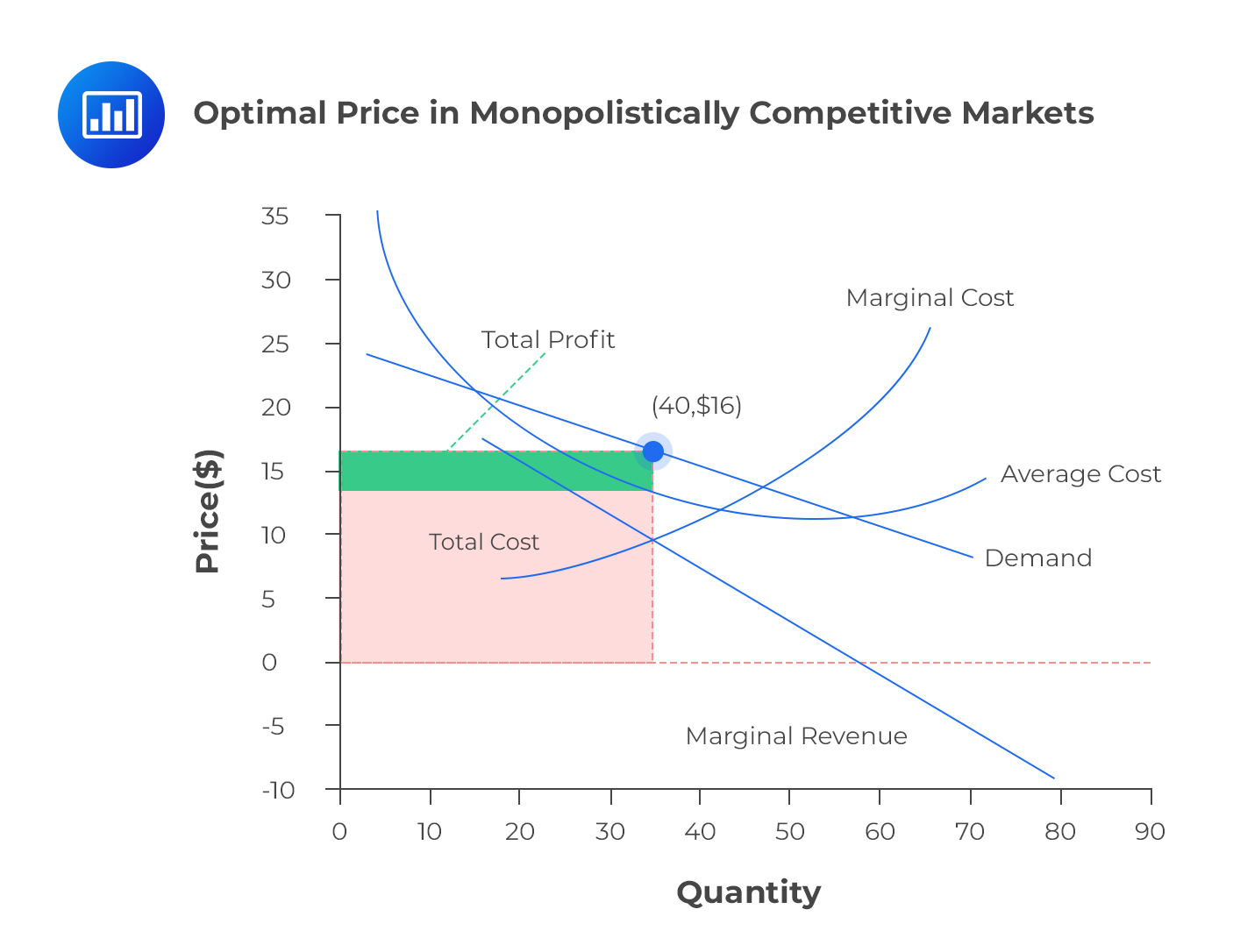
This graph neatly summarizes the concepts, showing the downward-sloping demand curve, the MR curve below it, and how the firm can choose a price and quantity based on its costs.
Conclusion
In this lesson, we have connected the characteristic of product differentiation to its direct effects on a firm's demand curve and pricing power. This is a crucial step away from the simplified world of perfect competition and toward a more realistic model of firm behavior.
Key Takeaways:
- Product differentiation creates a downward-sloping demand curve for each firm, making them limited price makers.
- This demand curve is highly elastic because of the large number of competing firms offering close substitutes.
- A consequence of the downward-sloping demand curve is that the marginal revenue (MR) curve lies below the demand (Average Revenue) curve.
- The degree of pricing power a firm has depends on the number of competitors and the extent of its product differentiation.
- Firms engage in non-price competition (branding, advertising) to increase differentiation and strengthen their pricing power.
Preview of the Next Lesson:
Now that we understand the revenue side (the demand and MR curves), we are ready to bring in the cost side. In the next lesson, we will combine these curves with the firm's cost structure to answer a critical question for the CFA exam: How does a firm in monopolistic competition determine its profit-maximizing output and price in the short run? We will also analyze the conditions under which it might be better for the firm to shut down completely.