Hello. Last lesson tested faithfulness by keeping a candidate circuit and replacing the contributions outside it, then comparing the restricted run with the full model. A faithful circuit preserves the measured behavior under that replacement policy. It does not follow that excluded components are irrelevant.
This lesson tests the missing claim: when the candidate circuit is present, do excluded components still change the behavior? You will use matched runs to estimate that effect, distinguish it from a common “complement-only” test, and interpret results when pathways interact or compensate for one another.
Keep the candidate present in the decisive comparison
Let be the candidate circuit and the set of components or edges it excludes. Define as a run on input that retains the contributions in set and gives all other tested contributions a specified replacement value. The input, embeddings, output readout, and other indispensable infrastructure remain fixed. The masks must be defined so that is the unmodified model, .
For a behavior measure , the conditional effect of the excluded set on an example is
Both runs contain . Their intended difference is that the excluded contributions are available in the full run and replaced in . If this contrast is consequential on held-out examples, the candidate omits something that matters in the presence of the candidate, under the specified intervention.
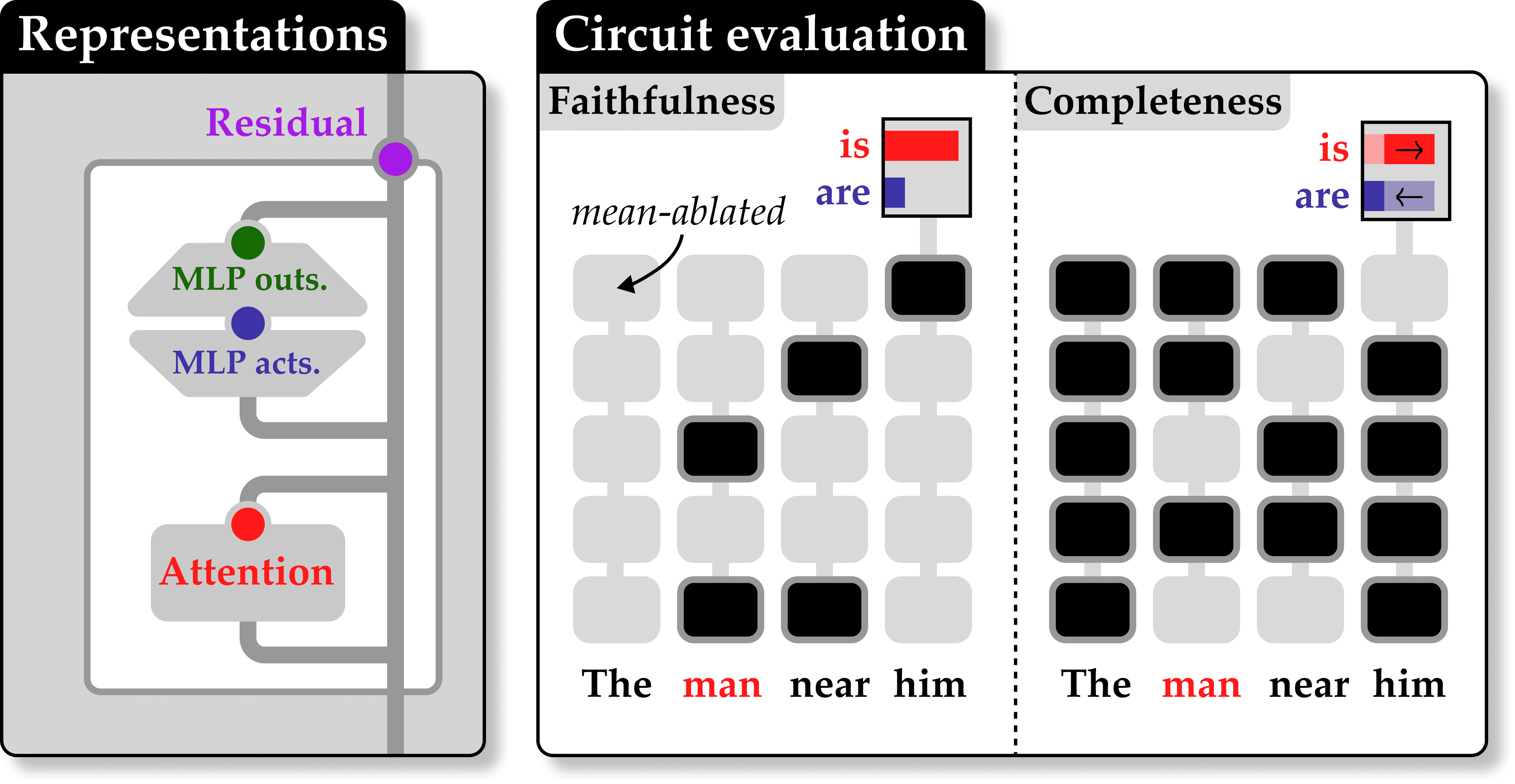
The diagram below separates two familiar circuit evaluations. Notice that its completeness panel removes the candidate while leaving the rest of the model available. That is informative, but it answers a different question from the conditional contrast above.
A useful four-run design makes the distinction explicit:
| Run | Candidate | Excluded set | Main use |
|---|---|---|---|
| Retained | Retained | Full-model reference | |
| Retained | Replaced | Conditional effect of , compared with | |
| Replaced | Retained | What the complement can do without | |
| Replaced | Replaced | Replacement baseline |
The complement-only comparison is . Some circuit papers call the performance of a completeness test: if the complement performs the task well, the proposed circuit has omitted an alternative route. That is a valuable test of the circuit’s scope, but it cannot by itself determine whether contributes when is functioning.
Sparse Feature Circuits: Discoveringand Editing Interpretable Causal Graphsin Language Models
Read the paper’s definitions to see precisely what its faithfulness and completeness measurements hold fixed. Its complement-based completeness convention is useful, but differs from the conditional test developed here.
In §3.2, “Discovering and Evaluating Sparse Feature Circuits for Subject-Verb Agreement,” find the paragraph beginning “Faithfulness. Given a circuit”. Read it through the explanation ending the baseline interpretation. Track what is mean-ablated and what its empty-circuit baseline means. Then read the adjacent paragraph beginning “Completeness. Are there parts of the model behavior that our circuit fails to capture?” through the complement test. Focus on the fact that this test ablates the discovered circuit; it does not retain that circuit while estimating the excluded set’s incremental effect.
The paper’s results also depend on its chosen units of intervention and on leaving particular reconstruction-error contributions in place. For any circuit claim, “excluded components” must name an actual set of contributions, not merely everything left uncolored in a visualization.
Make the four runs comparable
The intervention protocol from the faithfulness test carries over, but consistency matters even more when interpreting a small residual effect. Freeze the circuit, held-out inputs, target metric, and replacement policy before running the comparison. For example, if excluded edge contributions receive position-specific mean values in , use the same means when those edges are replaced in . If replacement values are resampled, specify the donor population and matching rules, repeat donor draws, and pair results by input.
Match the mask to the circuit claim. For an edge-level circuit, retain or replace contributions at their specified destinations. Ablating an entire attention head because one of its outgoing edges was excluded changes the experiment: it may also erase an edge that was meant to keep. If using hooks, verify that the “all retained” mask reproduces the ordinary forward pass and that every other mask changes only the intended sites.
Then choose a target measure for which the full model has a meaningful signal. A logit margin between the task answer and a fixed distractor is often more revealing than accuracy alone. For held-out inputs , report both the mean conditional effect
and its distribution across examples. A near-zero signed mean can conceal large effects of opposite signs. Report mean absolute change, answer reversals, and results by predeclared input stratum as well. Retain the off-target performance measure from earlier lessons: a circuit can preserve a narrow answer margin while altering other behavior.
Suppose the held-out mean margin is for and for . The mean conditional contribution of is margin units. Whether that is acceptable depends on a tolerance set before inspection, uncertainty across examples and replacement draws, and where the difference occurs. A small average is not a declaration of completeness if a particular context type repeatedly loses its answer.
With paired margin tensors already collected, the core calculation is short:
import torch

# Each tensor has one margin per held-out input, in the same order.
# full, candidate, complement, and baseline come from the four masks.
excluded_effect = full - candidate          # E added while C is present
complement_alone = complement - baseline     # E available without C

report = {
    "mean_conditional_effect": excluded_effect.mean().item(),
    "mean_absolute_effect": excluded_effect.abs().mean().item(),
    "answer_side_change": (
        (full > 0) != (candidate > 0)
    ).float().mean().item(),
    "mean_complement_alone": complement_alone.mean().item(),
}
answer_side_change detects a reversal between the specified answer and distractor, not a change in the model’s full-vocabulary top prediction. If the margins come from resampled replacements, calculate the paired contrast for each donor draw rather than silently combining unlike runs. A paired bootstrap over held-out examples can quantify sampling uncertainty; donor-to-donor variation should be reported separately.
To locate a gap, repeat the conditional comparison for predefined groups of excluded edges or components. One option is to add a group back to , leaving other excluded groups replaced. Another is to replace that group in , leaving the others active. These are different contexts, so their effects need not agree. Joint effects need not equal the sum of single-group effects.
Complements, redundancy, and interaction
The four runs prevent an appealing but invalid inference: “the complement fails alone, so nothing outside the circuit matters.” Two toy systems show why. Treat the numbers as illustrative task scores, not reported model results.
| System | ||||
|---|---|---|---|---|
| Redundant routes | 0 | 1 | 1 | 1 |
| Joint computation | 0 | 0 | 0 | 1 |
In the redundant-routes system, can perform the task without , yet its conditional effect while is present is zero. The complement-only test exposes an alternative route; the conditional test says that route adds nothing to this score under ordinary joint operation.
In the joint-computation system, neither set works alone. The complement-only test reports no task performance, but the conditional effect of is one: omitting destroys a computation that requires both sets. A complement-only failure therefore does not establish that is complete.
This distinction can also be expressed as an interaction:
If is nonzero, the measured effect of depends on whether is available. It need not indicate a single, easily named mechanism: replacement artifacts, downstream nonlinearities, and genuine interactions can all affect the contrast. The four runs reveal a pattern to investigate rather than proving a decomposition of the model into independent parts.
Actual models can also compensate after an intervention. An excluded component that is quiet when is intact may become important when a primary component is removed. Read the following example with that distinction in mind.
Evaluating Circuits: Faithfulness and Completeness | Learn MI
The Learn MI account of backup name movers shows why measuring only one unmodified or singly ablated run can miss an alternative pathway.
Find “Backup Name Movers: Built-In Redundancy.” Read from the backup account, continuing through the “Pause and think: The limits of standard ablation” discussion. Follow the sequence in which primary name movers are removed and previously quiet heads gain a contribution. Distinguish their activity in the ordinary run from their activity after the primary pathway is disrupted.
The reading describes ablation of the proposed circuit with the rest available as a completeness test. For this lesson’s narrower claim, also retain the circuit and compare with . Reporting both avoids collapsing “an alternative can take over after damage” into “the alternative contributes during the intact computation.”
State the conclusion at the scale tested
A defensible finding of conditional completeness has this form: On the specified held-out distribution, for the specified behavior and replacement policy, restoring all tested excluded contributions while the candidate is present produced no effect larger than the predeclared tolerance. That statement requires an uncertainty estimate capable of resolving effects near the tolerance; an imprecise result near zero is not evidence of negligible effect.
If the conditional effect is substantial, inspect its per-example pattern and use grouped add-back or ablation runs to narrow down the omission. If performs well but the conditional effect is negligible, report the redundant or backup route rather than folding it into the ordinary computation without qualification. If both tests show little effect, check the intervention and metric before treating the candidate as exhaustive: neither test rules out different inputs, unmeasured behaviors, or pathways activated by other interventions.
Key takeaway: faithfulness measures what survives when you retain ; conditional completeness measures what changes when you restore while remains present. The complement-only run asks another useful question—what can do without . Keeping these comparisons separate makes circuit claims more precise.
The next lesson examines a further limit of intervention evidence: an intervention can succeed by using a pathway that was inactive in the unmodified model.