Last lesson tested whether replacing an activation with its full SAE reconstruction preserves the model’s downstream predictions. That result concerns the dictionary as a whole. It does not tell you whether a particular latent deserves a label such as “negated requests to stop.”
This lesson treats a semantic description as a prediction rule, not a caption for striking examples. You will use held-out examples to check what the description captures, counterexamples to expose what it gets wrong, and neighboring concepts to test whether it is specific enough. These are tests of when a latent activates. Whether the latent has the behavioral role its label suggests is a separate causal question.
A dashboard is a source of hypotheses
An SAE latent has an activation value at a particular model site and token position. A feature dashboard gathers examples with high activation, often alongside an activation histogram, direct logit effects, and ablation results. It is an efficient place to form a description. It is a poor place to validate one if the description was invented after viewing those same examples.
Read the “Feature Dashboards” and “How to Read a Dashboard” sections of Feature Dashboards and Automated Interpretability by Learn MI. Focus on how the views complement one another, and on the warning that seemingly coherent examples can hide a mixed feature.
Feature Dashboards and Automated Interpretability | Learn MI
Learn MI introduces the evidence displayed on a feature dashboard and explains why its views should not be collapsed into a single verdict.
In “Feature Dashboards,” start with the paragraph beginning “Feature dashboards became the standard tool.” Read the overview. Continue from the paragraph beginning “Activation examples are the most intuitive component” through the logit discussion. In “How to Read a Dashboard,” find “But not all features are clean” and read the warning signs. Notice which observations suggest a label and which would actually test it.
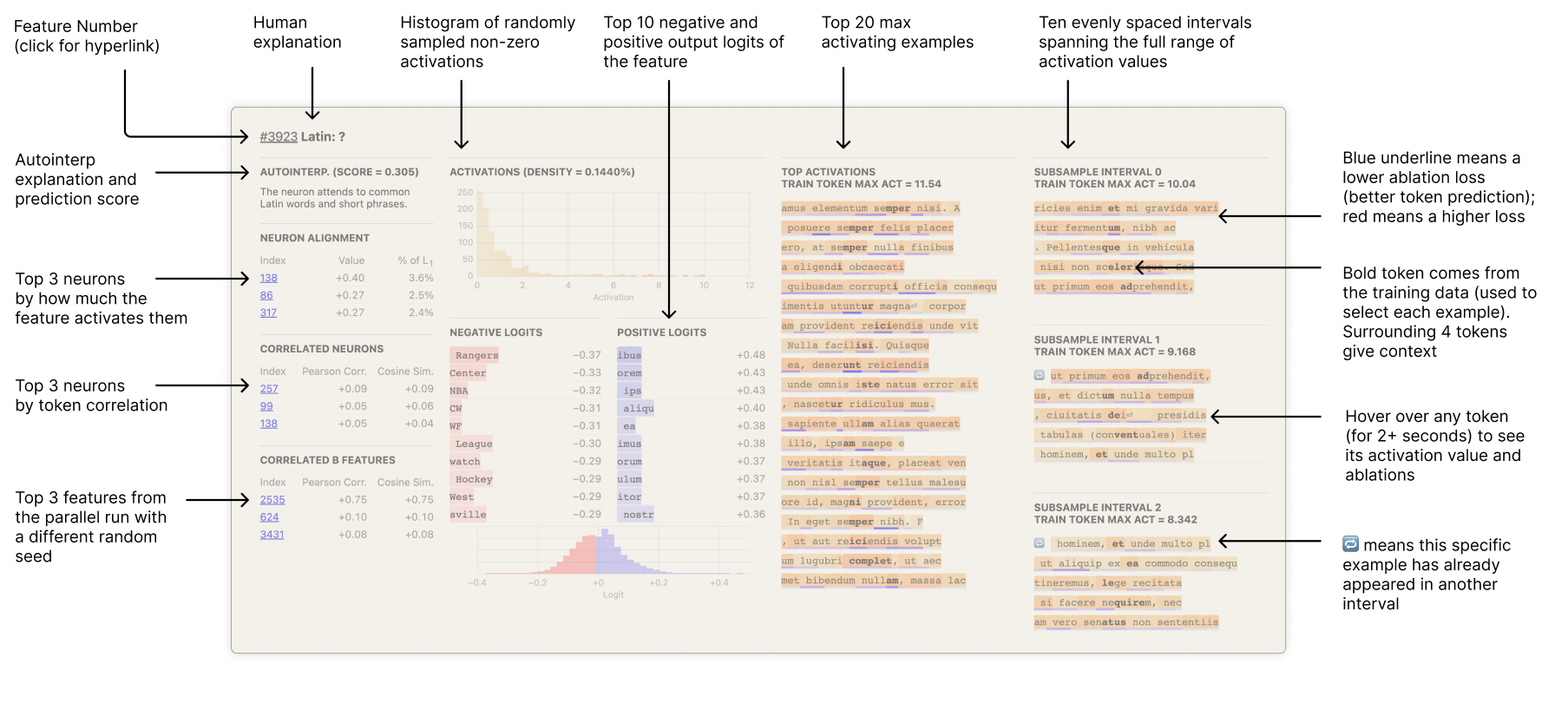
Suppose the highest-activation snippets all contain “stop.” The latent might respond to that word in any context, to “stop” after a negation, or to a broader pattern of prohibition. Selecting whichever label sounds best after seeing the snippets fits an explanation to the inspection data. The histogram and examples sampled across activation strengths may reveal more than the maxima, but they still belong to discovery if you used them to choose the label.
Direct logit effects can sharpen a hypothesis, but a decoder direction’s projection onto output tokens does not show how later layers use it. Likewise, an ablation underline on an inspected passage is not a substitute for testing the label on unseen passages.
Turn the description into an activation prediction
Write the proposed description so that someone who cannot see the latent activation could apply it to a new context. Specify the text span, token position, and model site. For example:
“At the token ‘stop,’ this latent activates when ‘stop’ follows ‘don’t’ or ‘won’t’ in the local phrase.”
That is more testable than “a stopping feature.” It predicts activation on new instances of “don’t stop” and “won’t stop,” and predicts little activation on otherwise similar instances of unnegated “stop” or “don’t move.” The word little needs an operational meaning: before examining the test set, fix an activation threshold using a separate discovery or validation split. For a nonnegative latent activation , define the measured event as , where identifies the latent and is the fixed threshold. Also retain activation magnitudes; a binary threshold should not hide whether purported positives fire only weakly.
Open Source Automated Interpretability for Sparse Autoencoder Features, from the EleutherAI Blog, develops a useful framing: a description acts like a classifier predicting feature activation. Its detection, fuzzing, and neighbor methods show why ordinary random negatives alone provide a weak test.
Open Source Automated Interpretability for Sparse Autoencoder Features | EleutherAI Blog
The EleutherAI Blog explains how to evaluate a description’s coverage and specificity, including difficult negatives drawn from similar features.
In “Scoring explanations,” begin at “We view the explanation as a classifier” and read the framing and example. Under “Detection,” read from “Rather than producing a prediction at each token” through the sampling procedure. Under “Fuzzing,” find “Future work might explore more principled ways” and read the counterexample ideas. Under “Neighbors,” read from “The above methods face similar issues” through the neighbor rationale. Finally, in the appendix subsection “Neighbor scoring,” read the co-occurrence caveat.
The two classifier errors have different implications. A description such as “activates on ‘stop’” may overpredict: it labels unnegated uses as activating even when the latent stays quiet. A description such as “activates on ‘stop’ after ‘don’t’” may underpredict: it misses activating uses after “won’t.” With the description’s prediction as the classifier output and measured latent activation as the reference, precision asks how often predicted activations occur; recall asks how much observed activation the description covers.
These quantities depend on the evaluation sample. If you deliberately assemble equal numbers of positives and negatives, the measured precision is for that assembled sample, not the prevalence of activation in ordinary text. Report results by example group as well as any aggregate score.
Build a test that can disconfirm the label
Set aside contexts the description-maker has not seen. Keep the SAE and base model fixed, and measure the same latent at the same site and corresponding token position for every example. Split by source document or prompt family where possible; near-duplicate phrases divided between discovery and test sets are not a meaningful holdout.
A useful test set has three complementary parts:
- Held-out predicted positives. Include varied new contexts for every clause of the description. If the rule says “don’t or won’t,” test each separately, rather than letting plentiful “don’t” examples conceal failure on “won’t.” Sample beyond the most extreme activations; a label that describes only showcase examples may miss much of the latent’s activity.
- Targeted counterexamples. Change one candidate trigger while retaining surrounding context where possible. Compare “don’t stop” with “please stop” to examine negation, and “don’t stop” with “don’t move” to examine the target word. Add naturally occurring examples so the conclusion does not rest entirely on awkward synthetic phrases.
- Neighboring concepts. Test close alternatives such as “can’t stop” and “never stop.” Also inspect examples that strongly activate a different, similar SAE latent. Similarity between decoder directions can help find these neighbors, but it does not establish that their meanings differ. Check whether the target latent itself is quiet on each proposed neighbor negative: similar latents can co-activate on the same text.
The last point prevents a subtle scoring error. A passage that activates neighboring latent is not automatically a negative example for target latent . If both activate, treating the passage as evidence that ’s label is wrong conflates two measurements. Where possible, look for passages with strong activation and low activation, then examine what distinguishes them.
Here is a hypothetical held-out result for the rule “activates on ‘stop’ after ‘don’t’ or ‘won’t’.” Each group is evaluated at its specified target token; the fractions are examples above the prespecified threshold, not results from the cited resources.
| Held-out group | Rule predicts | Target latent fires |
|---|---|---|
| “don’t stop” in varied contexts | Yes | 24 of 30 |
| “won’t stop” in varied contexts | Yes | 20 of 30 |
| Unnegated “stop” | No | 2 of 30 |
| “don’t move” | No | 3 of 30 |
| “can’t stop” | No | 22 of 30 |
| Random unrelated contexts | No | 1 of 200 |
The random negatives make the label look convincing: only one of 200 activates. The matched “can’t stop” examples tell a different story. They reveal a substantial activation pattern the proposed rule excludes. A broader account involving negation and “stop” is now plausible, but it is not yet validated. Revising the rule after seeing these 22 examples makes them discovery data; the revised rule needs a fresh holdout, including other forms of negation and non-negated contexts that might challenge it.
The six non-activating “don’t stop” examples also matter. Inspect whether they differ systematically in position, punctuation, tokenization, or surrounding meaning. A description may require contextual refinement, or the latent may simply respond inconsistently. Neither possibility is resolved by discarding inconvenient examples.
State exactly what the test establishes
For a reproducible report, retain the description written before testing, the latent and activation site, the threshold-selection method, the held-out source split, and counts and activation magnitudes for each group. Record both cases the rule predicted would fire but did not and cases that fired despite being outside the rule. If an automated model writes or scores descriptions, its judgments are another measurement procedure with possible blind spots; the recorded SAE activations and independently constructed contexts remain essential checks.
Successful prediction on held-out positives, targeted negatives, and neighbors supports a distribution-bounded semantic description of activation. It does not prove the latent is perfectly monosemantic: an untested activating mode may remain. It also does not prove that the model uses the latent to perform the behavior named by the description. A direction can be easy to label while its downstream effect is small, redundant, or different from what the label implies.
That distinction connects directly to last lesson. A low downstream distortion from the complete SAE reconstruction does not validate each latent’s label. Conversely, a good label is not yet evidence of an individual latent’s causal role. The next lesson isolates that role by ablating one latent while preserving the original reconstruction residual.
Key takeaways
A semantic label becomes useful when it predicts where a fixed SAE latent will and will not activate on examples withheld from label creation. Test all parts of the proposed rule, use matched counterexamples rather than relying only on random text, and check neighboring concepts without assuming that neighboring latents are mutually exclusive. Report failures as well as successes. These tests can support an activation description; a behavioral claim requires a targeted intervention.