Introduction
In our previous lessons, we've built up a toolkit for working with individual vectors—we can add them, scale them, and calculate their lengths and the angles between them. We are now ready to move from operating on vectors to using them to construct other vectors. This lesson introduces the fundamental concept of a linear combination, which is the primary way vectors are combined in linear algebra.
Building on this, we will explore the idea of span, the set of all vectors that can be reached through linear combinations of a given set. This will lead us to one of the most important ideas in this entire module: linear independence. You will learn to determine whether a set of vectors contains redundant information, a concept that is critical for understanding everything from the dimensionality of a dataset to the design of efficient machine learning models.
Building Vectors: Linear Combinations and Span
At its core, a linear combination is simply an expression formed by scaling several vectors and adding them all together. The result is a new vector. You've already seen a glimpse of this when we thought of a vector's coordinates, like , as scaling the standard basis vectors and to get .
The following video from 3Blue1Brown offers an excellent visual intuition for this idea.
Linear combinations, span, and basis vectors | Chapter 2, Essence of linear algebra
This video provides a foundational geometric understanding of linear combinations.
Please watch the section that introduces how vector coordinates can be viewed as scalars that stretch and sum basis vectors. This is the essence of a linear combination. Focus on the segment from the core idea.
Formal Definition of a Linear Combination
Formally, given a set of vectors in and a set of corresponding scalars in , a new vector is a linear combination of these vectors if it can be written as:
The scalars are the "weights" or "coefficients" of the combination.

A natural question arises: if I have a target vector and a set of "building block" vectors , how can I find the specific coefficients to construct ? This transforms the problem into solving a system of linear equations.
The following video walks through this exact process. Because you are comfortable with algorithmic thinking, you'll find the method of setting up an augmented matrix and performing Gaussian elimination to be a very systematic approach.
How to Write a Vector as a Linear Combination of Vectors in R^n | Linear Algebra
This video by Wrath of Math demonstrates the computational procedure for expressing a vector as a linear combination of others.
First, watch the formal definition and the setup for a 2D example: the introduction. Pay close attention to how the vector equation is converted into a system of linear equations, represented by an augmented matrix, and solved using Gaussian elimination: the R^2 example. Finally, grasp the general process summarized for any dimension: the general method. The video also shows what happens when a solution does not exist.
Span: The Set of All Reachable Vectors
If we consider all possible linear combinations of a set of vectors, we define a new object: the span of those vectors. It's the complete set of all vectors that can be reached by scaling and adding the original vectors in every conceivable way.
For a rigorous definition, we turn to the first resource below. Since you value formal definitions, this will provide the precise mathematical language for this concept.
This blog post by Matthew N. Bernstein offers clear, formal definitions for span and linear independence.
Please read the section titled Span. It starts with the intuitive idea and provides the formal definition you need.
The span of a set of vectors can be a line, a plane, a higher-dimensional hyperplane, or even the entire space. The 3Blue1Brown video you saw earlier gives a beautiful geometric feel for this.
Linear combinations, span, and basis vectors | Chapter 2, Essence of linear algebra
Let's revisit the 3Blue1Brown video to visualize the concept of span.
Watch the segment from visualizing span. It shows how the span of two vectors in 2D can be a line or the entire plane, and how the span of two vectors in 3D forms a plane cutting through space.
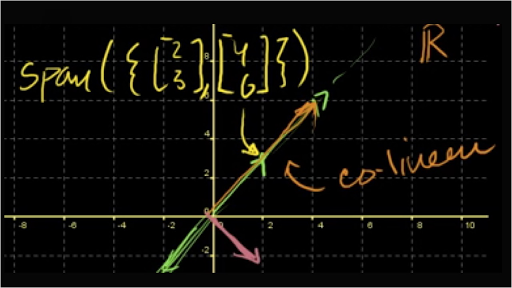
This image illustrates a key idea: sometimes our set of "building block" vectors contains redundancies. This leads directly to our next topic.
Redundancy and Uniqueness: Linear Independence
The concept of linear independence helps us formalize the notion of a "minimal" set of vectors needed to define a span. A set of vectors is linearly independent if no vector in the set can be written as a linear combination of the others. In other words, each vector adds a genuinely new direction to the span.
Conversely, a set is linearly dependent if at least one vector is redundant—it's already in the span of the other vectors.
Linear combinations, span, and basis vectors | Chapter 2, Essence of linear algebra
The 3Blue1Brown video concludes with a concise, intuitive definition of linear dependence and independence.
Watch this final clip from linear dependence to solidify the concept.
Formal Definitions and The Test for Independence
For a rigorous treatment, which is your goal, we need precise definitions and a practical test. The following reading from EECS 16A at Berkeley provides exactly this. It introduces two equivalent definitions of linear dependence and formally proves their equivalence.
This lecture note offers a rigorous introduction to linear dependence and independence, including proofs and examples.
Read the section 3.1.1 What is Linear Dependence? (page 1). This presents two common definitions. Work through the proof that shows these definitions are equivalent. This is a great exercise in the kind of formal reasoning you are looking for. Finally, read 3.1.2 Linear Independence (page 2), which defines independence and provides a simple worked example.
The most powerful and practical way to test for linear independence comes from the first definition you just read. A set of vectors is linearly independent if and only if the only solution to the equation:
is the trivial solution, where .
If there is any non-trivial solution (where at least one is not zero), the set is linearly dependent. This gives us a concrete computational test: set up the system of equations and solve for the 's. If the only solution is all zeros, the vectors are independent.
Since you appreciate full proofs, the following reading formally proves this "iff" condition.
Let's return to Bernstein's article for the central theorem on testing for linear independence and its proof.
First, read the section Linear dependence and independence, focusing on Theorem 1 and its corollary. This is the formal statement of the test. Then, to satisfy your goal for mathematical rigor, proceed to the Appendix and study the complete proof of Theorem 1. This demonstrates why the test works in both directions.
Let's trace the logic of a test. Consider the vectors and from "Example 3.2" in the EECS16A notes. To test for linear independence, we set up the equation :
This vector equation becomes a system of linear equations:
Solving this system (e.g., using substitution or Gaussian elimination) reveals that the only possible solution is and . Since only the trivial solution exists, we conclude that the vectors and are linearly independent.
Conclusion
In this lesson, we have moved from manipulating single vectors to understanding how they combine to form vector spaces. We have established a rigorous and practical understanding of two of the most fundamental concepts in linear algebra.
Key Takeaways:
- A linear combination is a sum of scaled vectors: . The process of finding the coefficients to form a specific vector amounts to solving a system of linear equations.
- The span of a set of vectors is the collection of all possible linear combinations, representing every vector that can be "reached" by the set.
- A set of vectors is linearly independent if none of them are redundant—that is, no vector can be written as a linear combination of the others.
- The definitive test for linear independence is to solve . The set is linearly independent if and only if the only solution is the trivial one ( for all ).
We have now laid all the necessary groundwork for our next topic. We have seen how vectors can be combined and how to identify a "minimal" set of vectors that define a space through their span. In the next lesson, we will formalize this by defining vector spaces and subspaces, and see how a linearly independent spanning set forms a basis for that space.