Hello! Welcome back to our study of world history.
In our last lesson, we unpacked the Neolithic Revolution, exploring the complex reasons our ancestors transitioned to farming and the sweeping consequences of that shift. We saw that agriculture was a double-edged sword, providing food surpluses at the cost of harder work, poorer health, and the beginnings of social inequality.
Today, we'll zoom in on that last point. Our learning outcome is to compare the social structures of hunter-gatherer bands with early agricultural communities. We will move beyond the general consequences of farming and place these two distinct ways of life side-by-side to understand how their social fabrics were woven in fundamentally different ways. This comparison helps us understand the origins of social and political structures that define our world even today.
1. Two Worlds: A Tale of Social Organization
To begin, let's establish a clear picture of these two contrasting lifestyles. For over 95% of our species' existence, we were all hunter-gatherers. Then, agriculture introduced a radical new way of organizing society.

The video below offers a vivid narrative comparing the daily realities and social dynamics of these two groups.
Hunter-Gatherers V Agriculture: Was Farming a Mistake?
The video 'Hunter-Gatherers V Agriculture: Was Farming a Mistake?' from the channel Dates and Dead Guys provides an excellent breakdown of the key differences in lifestyle and social structure.
Please watch two segments: 00:26 to 02:04: This part describes the classic hunter-gatherer social model. 07:54 to 12:26: This segment details how agriculture transformed that model, leading to population growth, war, and deep class divisions. As you watch, think about the core principles that governed each type of society.
Drawing from the video and our previous lesson, we can build a comparative model.
The Hunter-Gatherer Band: An Egalitarian Model
The "classic" hunter-gatherer society, which dominated the Paleolithic era, was defined by a few key social characteristics:
- Small Scale: People lived in small, mobile bands, typically numbering no more than a few dozen individuals who were mostly related by kinship.
- High Mobility: These groups were nomadic, moving through the landscape to follow animal herds and seasonal plant growth. This mobility discouraged the accumulation of possessions.
- Egalitarianism: This is the most crucial feature. There were no formal leaders, kings, or chiefs. While some individuals might have been more respected for their skill or wisdom, they had no authority to command others. Social pressure, not power, was the primary means of ensuring cooperation.
- Sharing Ethos: Resources, especially large game, were typically shared throughout the band to ensure everyone's survival. This ethic was a vital risk-management strategy.
- Minimal Property: The concept of private property was limited. While an individual might own their tools or clothing, land and its resources were seen as communal.
The Early Agricultural Community: A Hierarchical Model
The shift to agriculture dismantled this ancient structure and replaced it with a new, more complex one.
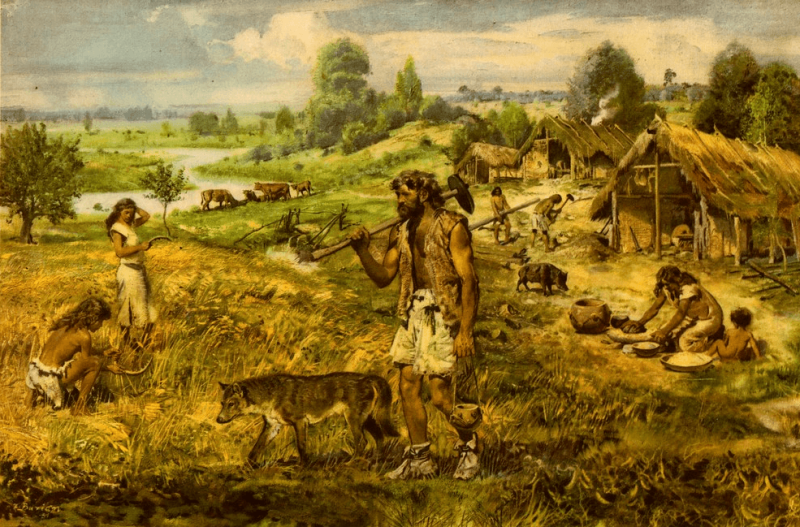
The key social transformations included:
- Sedentism and Population Growth: Settling in one place to tend crops allowed populations to grow exponentially, leading to the first villages and towns.
- Private Property: For the first time, families could claim ownership over land and, most importantly, the surplus food it produced. This concept was revolutionary.
- Social Hierarchy: Surplus and property created wealth disparities. Some families, through luck, skill, or force, accumulated more than others. This allowed a non-producing elite—chiefs, priests, and warriors—to emerge, living off the surplus produced by the majority. Your political science background will recognize this as a foundational moment: the control of resources becoming the basis for political power.
- Labor Specialization: A food surplus meant not everyone had to farm. This freed people to become artisans (potters, weavers), soldiers, priests, and administrators, creating a more complex and interdependent society.
Test your understanding!
Imagine a dispute arises between two families over access to a particularly fertile patch of land. How would this conflict likely be handled in a hunter-gatherer band versus an early farming village, and what does the difference reveal about their social structures?
Show answer
- In a hunter-gatherer band, the concept of owning land would be foreign. The conflict would likely be about access, not ownership. It would probably be resolved through community discussion, mediation by elders, or, if unresolved, one group might simply move to another area. This reflects their mobility and egalitarian structure, where group cohesion is paramount and there's no central authority to enforce a ruling.
- In an early farming village, the dispute is over a valuable, owned asset. The resolution might involve an appeal to a village headman or a council of elders who hold recognized authority. Their decision would be binding. This reflects a sedentary society with established property rights and an emerging political hierarchy capable of arbitrating disputes and enforcing rules.
2. Evidence from the Past: Inequality Written in Bone
This contrast between an egalitarian past and a hierarchical agricultural present is a compelling narrative, but how do we know it's true? The evidence comes from archaeology, and one of the most powerful arguments was laid out by scientist and author Jared Diamond.
The following reading is from his famous, provocative article, "The Worst Mistake in the History of the Human Race." It uses hard scientific evidence to support the social consequences we've discussed.
The Worst Mistake in the History of the Human Race
This article by Jared Diamond makes the case that agriculture was a 'catastrophe' for human health and social equality. We will focus on the evidence he presents for the emergence of class divisions.
Please read the section that begins 'Besides malnutrition, starvation, and epidemic diseases, farming helped bring another curse upon humanity: deep class divisions.' It continues to the end of the next paragraph, ending with '...bone lesions caused by disease.' This section details the direct skeletal evidence for social hierarchy.
As Diamond explains, the evidence is literally written in the bones of our ancestors. Archaeologists and paleopathologists studying ancient cemeteries have found that:
- Skeletons from elite tombs (like those at Mycenae in Greece) are often taller and have better teeth than the skeletons of commoners from the same period.
- These elite skeletons show far fewer signs of malnutrition and disease.
This provides stark, physical proof that the surplus generated by agriculture was not distributed evenly. A new social structure had emerged, creating a non-producing elite who enjoyed better health and nutrition at the expense of the laboring masses.
3. A More Complex Reality: Challenging the Simple Story
The model of egalitarian hunter-gatherers versus hierarchical farmers is a powerful and useful generalization. However, as with most things in history, the reality on the ground was more complex. Recent scholarship has challenged this simple binary.
This next reading introduces us to societies that break the mold and force us to refine our understanding.
Not all early human societies were small-scale egalitarian ...
The essay 'Not all early human societies were small-scale egalitarian...' from Aeon presents a fascinating counter-argument. It shows that hierarchy and complexity were not exclusively linked to agriculture.
Please read three parts of this thought-provoking article: The section about the Calusa of Florida (starts 'The Calusa ruled southern Florida...'). The short following section on the peoples of the Pacific Northwest Coast. The section discussing the lavish Paleolithic burials, nicknamed 'Il Principe' and the Sunghir burials (starts 'When the boy died...'). Focus on how these examples challenge the idea that agriculture is a necessary prerequisite for social stratification.
This article provides critical nuance to our story:
- Complex Hunter-Gatherers: Societies like the Calusa in Florida and various groups on the Pacific Northwest coast became large, sedentary, and highly stratified without farming. They built states, had powerful hereditary rulers, and commanded large labor forces. Their secret was not grain, but another abundant, storable resource: fish. This shows that it is resource surplus and storage, not necessarily agriculture itself, that provides the foundation for social hierarchy.
- Paleolithic Princes: Lavish burials from tens of thousands of years before agriculture, like those of "Il Principe" in Italy and the children at Sunghir in Russia, suggest that status differentiation and social hierarchy may be much older than we thought. The sheer labor required to create the thousands of ivory beads and other grave goods buried with these individuals implies a society that could command specialized labor and afford to remove valuable items from circulation—hallmarks of a non-egalitarian social structure.
Conclusion: Lessons on Human Social Flexibility
So, where does this leave us? We have a "classic model" showing a clear shift from egalitarian hunter-gatherers to hierarchical farmers, and then we have compelling evidence that complicates this picture. The historical lesson here is not that one model is right and the other is wrong, but that human social organization is incredibly flexible.
Key Takeaways:
- The Classic Divide: The transition to agriculture generally replaced the small, mobile, and egalitarian social structure of hunter-gatherer bands with the large, settled, and hierarchical structure of farming communities. This change was driven by the new concepts of property, surplus, and labor specialization.
- The Power of Surplus: The key ingredient for social hierarchy is not farming itself, but the ability to generate and control a reliable food surplus. This could be achieved through grain, as was most common, but also through other abundant resources like fish.
- Ancient Roots of Inequality: Evidence from the Paleolithic suggests that social status and hierarchy were not "invented" during the Neolithic Revolution. Instead, the conditions created by agriculture allowed these tendencies to become amplified, institutionalized, and the dominant form of organization for the vast majority of humanity.
This nuanced view teaches us a profound lesson about ourselves. We are not "naturally" egalitarian or "naturally" hierarchical. As the final paragraphs of the Aeon essay suggest, we appear to be psychologically adapted to navigate both kinds of social worlds. The story of our past is a dynamic interplay between our environment, our technologies, and our own flexible social capabilities.
Preview of the Next Lesson:
We've now established the fundamental differences in social structure and seen how hierarchy took root. In our next lesson, we will delve deeper into this new agricultural world to fulfill our next learning outcome: Describe the emergence of social hierarchy and labor specialization in early settled societies. We will examine the specific new roles that appeared—the priest, the warrior, the artisan—and explore how these specialized classes created the complex societies that would eventually build the world's first cities.