Welcome to our next lesson. In our previous discussion, we explored how modernist writers revolutionized the art of character portrayal, shifting the focus from the external, social self of 19th-century realism to the complex, interior world of individual consciousness. We saw how techniques like stream of consciousness and the unreliable narrator were used to capture this new, fragmented sense of self.
Today, we'll see how this internal revolution demanded a corresponding revolution in external form. Our focus will be on plot and structure. You will learn to distinguish the fragmented narratives and "mythic methods" of modernism from the coherent, linear plots that characterized 19th-century fiction. We'll examine why the old ways of telling a story no longer seemed adequate and what new forms writers invented to give shape to the modern experience.
The Well-Made Plot of the 19th Century
Before we can appreciate the modernist break, we must first have a clear picture of the structure they were breaking from. The great realist novels of the 19th century, in the tradition of writers like Dickens or Balzac, generally relied on a strong, linear plot driven by cause and effect. These stories moved chronologically, building suspense through a series of connected events that led to a decisive climax and, finally, a clear resolution where all loose ends were tied up.
This traditional structure is often visualized as a pyramid, a model developed by the 19th-century critic Gustav Freytag to describe classical and Shakespearean drama, but which applies equally well to the realist novel.
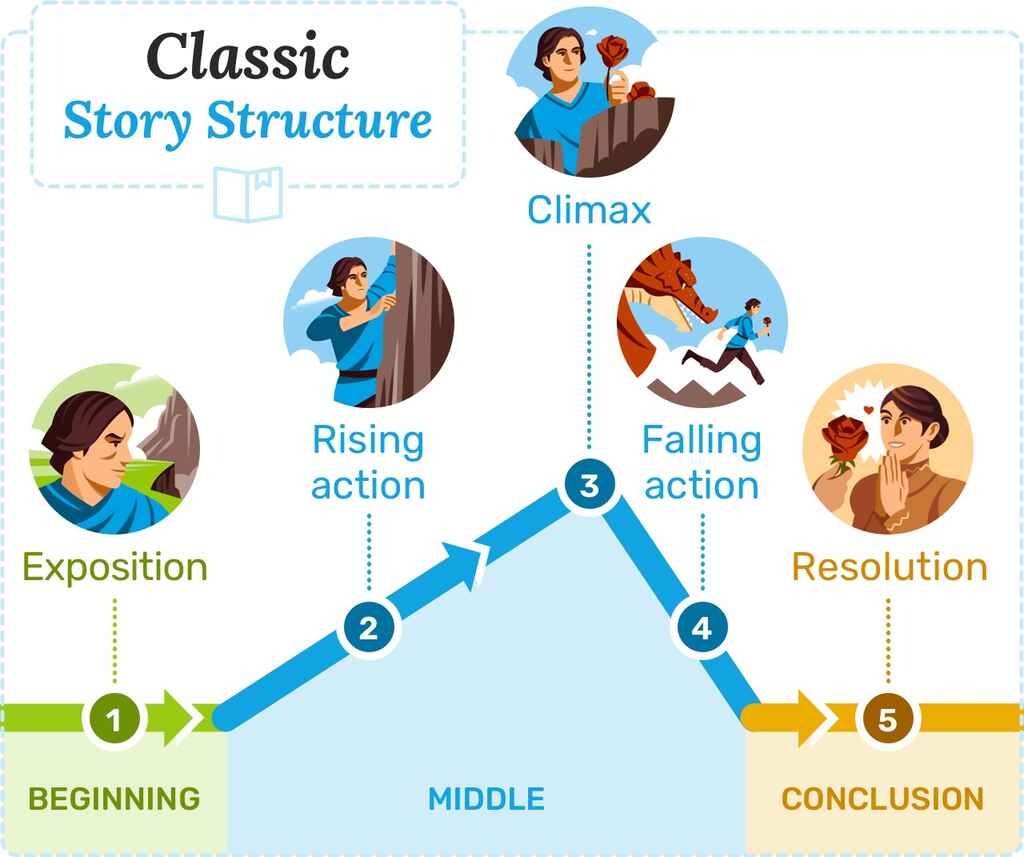
This narrative arc provided readers with a sense of order, meaning, and satisfying closure. It reflected a worldview in which events were understandable, actions had clear consequences, and life, for all its complexities, followed a legible pattern.
The World in Pieces: Narrative Fragmentation
As we've discussed, the early 20th century shattered this confident worldview. The trauma of World War I, the disorienting speed of industrialization and urbanization, and new theories of the mind from thinkers like Freud all contributed to a sense that the world was no longer a coherent, stable whole. For modernist writers, a simple, linear plot felt like a dishonest simplification of a chaotic and disjointed reality.
Art began to mirror this sense of fragmentation. The video below offers a concise introduction to this concept, explaining how historical events directly influenced this new artistic direction.
What is Modernist Fragmentation? (Modernism 4)
This video, "What is Modernist Fragmentation?", provides an excellent overview of the concept and its origins.
Please watch the first part of the video, up to the discussion of fragmentation in art. It effectively captures the feeling that the "good old recognizable world seemed to have shattered into a thousand pieces."
In literature, this fragmentation most obviously manifested in the structure of the plot itself. Writers began to abandon linear chronology, mirroring the way our own minds experience time—not as a straight line, but as a jumble of present sensations, past memories, and future anxieties.
The next segment of the video uses F. Scott Fitzgerald's The Great Gatsby (a novel we will study in detail later) to illustrate exactly how this fractured timeline works in practice.
What is Modernist Fragmentation? (Modernism 4)
This segment demonstrates how modernists fractured the traditional, linear timeline of a story.
Please watch from the discussion of time in fiction. Notice how the narrator breaks down the non-chronological structure of Gatsby and connects it to the way our own consciousness fluidly moves between past, present, and future.
As the video explains, this technique is not just a stylistic quirk; it's a way of representing a more psychologically accurate reality. By shattering the timeline, modernist authors could better reflect the inner lives of their characters, for whom the past is never truly past but is constantly erupting into the present. This formal fragmentation is the direct structural consequence of the focus on interiority we discussed in our last lesson.
Order from Chaos: The Mythic Method
This new, fragmented approach to storytelling raised a critical question for modernists: If you discard the traditional plot, how do you prevent your work from dissolving into pure chaos? How do you give shape and significance to what T.S. Eliot called "the immense panorama of futility and anarchy which is contemporary history"?
One of the most influential solutions was what Eliot himself termed the "mythic method." In a seminal 1923 review of James Joyce's Ulysses, Eliot defined this new technique.
[PDF] THE MYTHIC METHOD AND INTERTEXTUALITY IN T.S. ELIOT'S ...
This article clearly explains Eliot's concept of the mythic method.
Please read the first paragraph of the section "1. Eliot and Joyce," starting from the quotation. Focus on Eliot's core definition: the mythic method.
The mythic method, then, involves using an ancient myth (like Homer's Odyssey in the case of Joyce's Ulysses) as a hidden scaffolding for a contemporary story. On the surface, the novel might seem fragmented and chaotic—a day in the life of an ordinary man in Dublin. But underneath, the structure of the ancient epic provides order, a parallel against which the modern events unfold.
This method serves two key functions:
- It creates order and significance. By mapping the mundane events of modern life onto a timeless, universal myth, writers could suggest that even in a seemingly meaningless world, human experience still followed deep, archetypal patterns.
- It generates irony. The contrast between the heroic scale of the ancient myth and the often trivial or squalid reality of the modern world creates a powerful sense of irony and pathos.
The following passage expands on this ironic dimension, using the contrast between Homer's heroic Odysseus and Joyce's modern protagonist, Leopold Bloom.
[PDF] THE MYTHIC METHOD AND INTERTEXTUALITY IN T.S. ELIOT'S ...
This section delves into the ironic function of the method.
Please read the paragraph beginning "The other major characteristic". Note how the comparison between the epic past and the modern present highlights the "tragedy of this loss."
Unifying the Fragments
Narrative fragmentation and the mythic method were not mutually exclusive; in fact, they often worked in tandem. The mythic method could serve as the "glue," as one critic puts it, holding the broken pieces of a fragmented narrative together. Ernest Hemingway's first major work, In Our Time (1925), is a prime example.
This article on Hemingway offers a brilliant insight into how fragmentation and the mythic method can be combined.
Please read the paragraph that describes In Our Time as a "fragmentary novel." Focus on this key sentence: the central idea that the mythical method provides the underlying structure for the book's collage-like collection of stories and vignettes.
Hemingway's collection presents a series of disconnected moments reflecting the trauma and disillusionment of the post-WWI era. Without an obvious plot, the book can feel disjointed. However, as the article explains, a subtle pattern of allusions to classic texts (in this case, Dante's Divine Comedy) provides a submerged structure, unifying the fragments into a coherent artistic whole. This is a perfect illustration of how modernists built new kinds of order after dismantling the old.
Conclusion
In this lesson, we have charted the modernist departure from traditional plot structures. Faced with a world they perceived as chaotic and fragmented, they created new forms to match that perception.
Key Takeaways:
- 19th-Century Plot: Characterized by a linear, chronological, and causally-driven narrative, often following the clear arc of Freytag's Pyramid to a decisive resolution.
- Modernist Narrative Fragmentation: Abandoned linear chronology in favor of disjointed, non-linear structures that reflected the chaos of the modern world and the associative logic of human consciousness.
- The Mythic Method: Employed ancient myths as a structural framework for contemporary stories. This technique served to impose order on fragmented material and to create a resonant, often ironic, dialogue between the past and the present.
These innovations were not just formal experiments; they were essential tools for making sense of—and making art from—the turbulent experience of modernity.
In our next lesson, we'll read a famous essay by Virginia Woolf, "Mr. Bennett and Mrs. Brown," in which she forcefully argues for the necessity of these changes, declaring that "on or about December 1910 human character changed."