Welcome to the next lesson in our exploration of the modernist break with the past. In our previous sessions, we've examined the internal and external revolutions in the novel: the shift towards interiority and the fragmentation of traditional plot structures. We saw how modernist form changed; today, we will explore why it had to change, guided by one of its most brilliant pioneers, Virginia Woolf.
This lesson focuses on Woolf's influential 1924 essay, "Mr. Bennett and Mrs. Brown." Here, she delivers a powerful manifesto for her generation, famously declaring that "on or about December 1910 human character changed." By the end of this lesson, you will be able to articulate her argument and understand why she believed the old ways of writing novels were no longer sufficient to capture the reality of modern life.
A New Way of Seeing
Before we dive into Woolf's text, let's look at a painting by her sister, the artist Vanessa Bell. Both were central figures in the Bloomsbury Group, a circle of English writers, intellectuals, and artists who profoundly shaped modern culture.
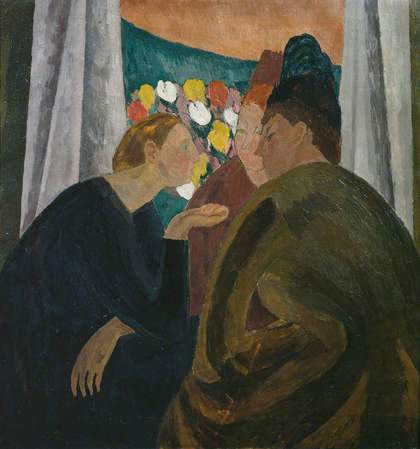
This painting is a visual counterpart to Woolf's literary project. Like her sister, Woolf was less interested in the precise, photographic depiction of reality and more concerned with capturing the elusive essence of experience and consciousness. This new way of seeing required a new way of writing.
The Quarrel: Georgians vs. Edwardians
Woolf's essay is framed as a response to a criticism levelled by the older, established novelist Arnold Bennett. Bennett, along with writers like H.G. Wells and John Galsworthy, represented the "Edwardian" generation. He argued that the younger "Georgian" writers (Woolf's modernist contemporaries) were failing at the fundamental task of the novelist: creating believable characters.
Woolf takes up this challenge and turns it back on the accuser. The core of her argument, as a helpful summary from the Yale Modernism Lab explains, is that the Edwardians themselves failed to create truly living characters because they were obsessed with the wrong things.
Mr. Bennett and Mrs. Brown – Modernism Lab
This article provides an excellent overview of the debate at the heart of Woolf's essay.
Read the section that begins with this paragraph. Focus on how Woolf defines her position against the Edwardians and the central charge she makes: that while they described countless external details, their books lacked "a single man or woman we know."
Now, let's see how Woolf herself sets up this confrontation. She begins her essay by agreeing with Bennett on one point: the novel is all about character. The challenge is how to "catch" that character.
[PDF] Mr. Bennett and Mrs. Brown
In these opening paragraphs, Woolf frames the entire discussion.
Please read from the beginning of the essay until the point where Woolf divides the writers into two camps. Notice how she uses Bennett's own words—"The foundation of good fiction is character-creating"—to launch her investigation into what "character" and "reality" truly mean in a novel.
"On or about December 1910..."
Having established the terms of the debate, Woolf makes her audacious central claim. This is perhaps the most famous statement in all of modernist literary criticism. The short video below gives a concise explanation of this pivotal idea.
This video from MASSOLIT on Literary Modernism will help clarify Woolf's celebrated but often misunderstood declaration.
Please watch the clip from the discussion of 'Mr. Bennett and Mrs. Brown'. The speaker explains what Woolf meant by this "change in human character" and how it related to the relationship between the individual and society.
The video gives you the context. Now, let's read Woolf's own provocative words. She isn't being literal, of course. She's using a specific date to mark a seismic shift in consciousness.
[PDF] Mr. Bennett and Mrs. Brown
Here Woolf lays out her core thesis.
Read the section where Woolf makes her famous assertion. Start from this point. Pay attention to the examples she uses—from the cook to the Carlyles—to illustrate that "All human relations have shifted." This, for Woolf, means that literature must shift as well.
This change in human relations—between masters and servants, husbands and wives, parents and children—meant that the old certainties were gone. A new, more complex, and more interior sense of self was emerging, and it required a new art to express it.
The Strange Case of Mrs. Brown
To make her argument concrete, Woolf invents a character sketch. She imagines a little old lady she sees on a train, whom she names Mrs. Brown. This woman becomes the test case for all fiction. Can a writer capture her—her inner life, her essence, her soul?
This anecdote is the heart of the essay. As you read it, consider how Woolf builds a powerful impression of Mrs. Brown not from a list of facts, but from subtle observations and imaginative leaps.
[PDF] Mr. Bennett and Mrs. Brown
This is Woolf's masterclass in character creation.
Read the long story of her journey with "Mrs. Brown," beginning with the introduction to the anecdote. Note the contrast between the quiet, suffering Mrs. Brown and the bullying Mr. Smith. See how a single, strange question about oak trees opens up a world of speculation. Woolf is showing us, not telling us, what "character in itself" means.
Having presented us with the vivid but mysterious Mrs. Brown, Woolf then performs a brilliant thought experiment. What would the great Edwardian novelists have done with her? The answer reveals the core of their failure.
[PDF] Mr. Bennett and Mrs. Brown
Here, Woolf dissects the Edwardian method and finds it wanting.
This is a longer section, but it is crucial. Begin with the paragraph imagining the Edwardians in the carriage. Woolf satirizes each in turn: H.G. Wells would ignore Mrs. Brown in his passion for designing a future Utopia. John Galsworthy would see her only as a case study for a social polemic. Arnold Bennett, the arch-materialist, would document the house, the rent, the cost of her gloves, the upholstery of the carriage—everything except Mrs. Brown's soul. Continue reading to Woolf's devastating conclusion about this method: "Mr. Bennett has never once looked at Mrs. Brown". This is the central indictment. They described the "fabric of things" but missed life itself.
Smashing the Tools, Finding the Truth
If the Edwardian tools are useless, what is the modern writer to do? Woolf's answer is simple and violent: they must be destroyed. The "smashing and crashing" you hear in modern literature is the sound of writers breaking old conventions to get at the truth.
[PDF] Mr. Bennett and Mrs. Brown
In this section, Woolf connects her argument to the new, difficult forms of modernism.
Read the paragraph that begins with the Georgian predicament. This passage directly links the need to "rescue" Mrs. Brown with the formal experimentation we've been discussing. The fragmentation of the modern novel is the result of this necessary destruction.
This effort to find a new way of "telling the truth" explains the difficulty of some modernist texts. As Woolf notes, writers like James Joyce and T.S. Eliot had to break the windows to let in fresh air. The Yale article you read earlier makes this connection explicit, framing it as a call for a new "psychological realism" that traces "the atoms as they fall on the mind."
Conclusion
Virginia Woolf's "Mr. Bennett and Mrs. Brown" is more than just a piece of literary criticism; it is a declaration of independence for the modern novel. It provides a powerful justification for the formal experiments that we have been exploring.
Key Takeaways:
- Human Character Changed: Woolf's central thesis is that a fundamental shift in human relations and self-perception around 1910 rendered the old literary conventions obsolete.
- Materialists vs. Modernists: She contrasts the Edwardian "materialists" (Bennett, Wells, Galsworthy), who focused on external reality (houses, jobs, social conditions), with the "Georgian" modernists, who sought to capture the internal reality of consciousness.
- The Problem of Mrs. Brown: The elusive "Mrs. Brown" symbolizes life itself—the complex, internal, and often contradictory nature of an individual's character that cannot be captured by merely describing their possessions or social status.
- Smashing the Tools: For Woolf, the fragmentation and difficulty of modernist literature were not arbitrary but were the necessary result of writers breaking the inadequate tools of their predecessors to forge new ones capable of expressing this new reality.
Woolf concludes her essay with a call to the reader: "Tolerate the spasmodic, the obscure, the fragmentary, the failure." She asks us to be partners in the difficult but essential project of capturing Mrs. Brown.
Having established the philosophical and historical context of the modernist break, our next lesson will ground this movement in its physical geography. We will take a brief tour of the key European cities—London, Paris, Dublin, Prague—where these revolutionary ideas took shape, setting the stage for the specific authors and works we will encounter.