Welcome to your course on 20th-century literature! This first module, "Setting the Stage," will explore the seismic shifts in art, culture, and thought that gave rise to literary modernism. We will begin by looking at one of the most significant of these shifts: a radical new understanding of the human mind.
In this lesson, you will learn how the psychoanalytic theories of Sigmund Freud challenged the 19th-century realist portrayal of a stable, rational, and knowable self. This will lay the groundwork for understanding why so many 20th-century authors abandoned traditional forms of characterization to explore the complex, often contradictory, inner lives of their characters.
The 19th-Century Self: A Well-Ordered House
Before we delve into the new theories, let's briefly consider what they were reacting against. The great realist novels of the 19th century, written by authors like George Eliot and Charles Dickens, generally presented characters as fundamentally stable and coherent individuals. Their personalities were knowable, their motivations could be traced, and their moral development often followed a clear path. The self was like a well-ordered house, with the conscious mind firmly in control. While characters certainly had inner conflicts, the assumption was that these conflicts were accessible to reason and could be understood, by both the character and the reader.
This view reflected the broader Enlightenment faith in reason and the Victorian emphasis on self-control and moral clarity. The novel's job was to represent a shared social reality, and a key part of that reality was the belief in a stable, unified human character.
Freud and the Unveiling of the Mind
At the turn of the 20th century, this confident view of the self came under intense pressure. A Viennese doctor named Sigmund Freud began publishing theories that would utterly transform how we think about our own minds. He argued that the conscious, rational self was only the tip of the iceberg. Beneath the surface lay a vast, turbulent, and powerful unconscious: a repository of repressed desires, primal drives, and hidden memories that exert a profound influence on our thoughts, feelings, and actions.
Freud proposed a structural model of the psyche, dividing it into three warring factions:
- The Id: The entirely unconscious, primitive part of the mind that operates on the "pleasure principle," seeking immediate gratification for our most basic urges (e.g., hunger, aggression, libido).
- The Superego: Our internalized moral conscience, derived from parental and societal standards. It represents our ideals and produces feelings of pride or guilt.
- The Ego: The "executive" of the personality, which operates on the "reality principle." The ego's job is to mediate the conflicting demands of the impulsive Id, the moralistic Superego, and the constraints of external reality.
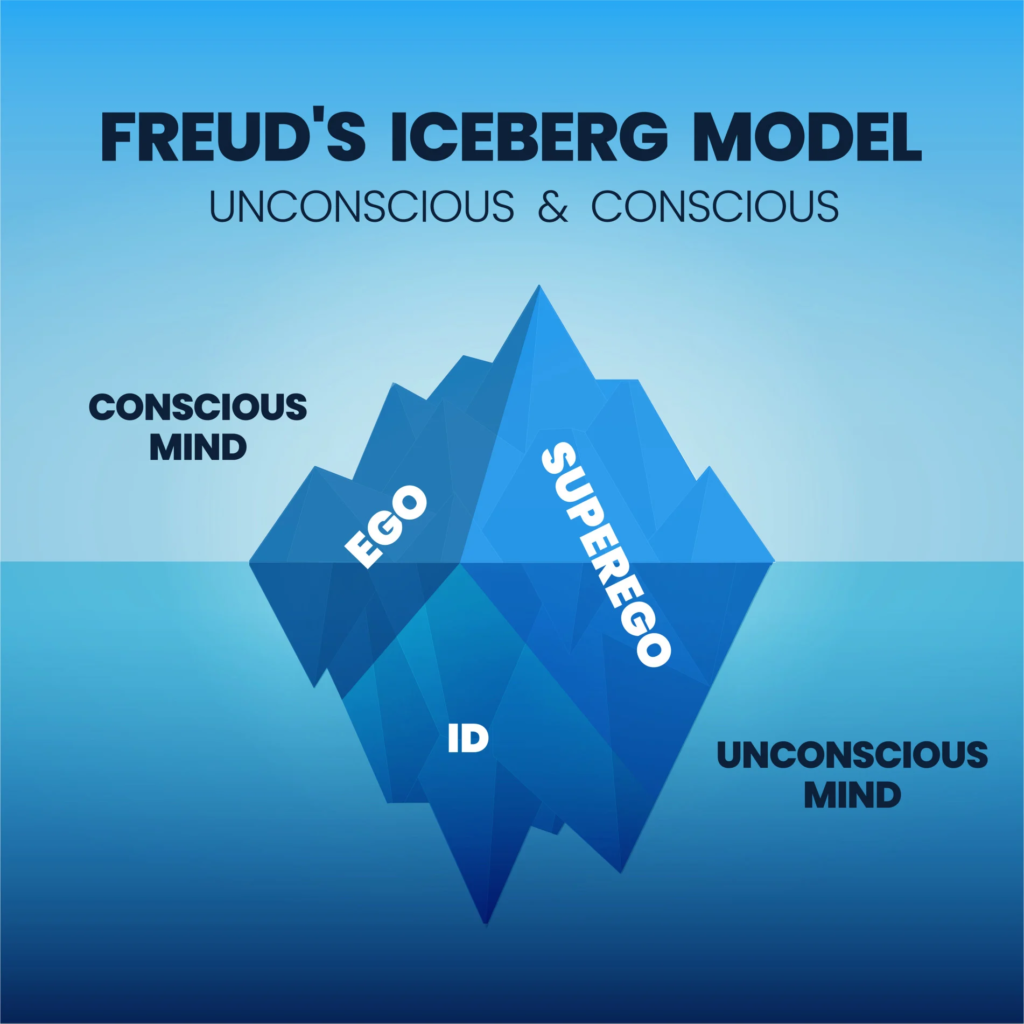
As you can see from this model, much of the action—including the entire Id and parts of the Ego and Superego—happens below the waterline of consciousness. For Freud, the self was not a harmonious entity but a site of perpetual, dynamic conflict. This idea was revolutionary. It suggested that human beings are not the rational masters of their own destiny, but are instead driven by forces they can't fully see or control.
To understand this new model of the psyche, please read the following short passage from the article "The Influence of Psychoanalysis on Modernism."
The Influence of Psychoanalysis on Modernism - coremag
This excerpt introduces Freud's theory of personality and explains how the concepts of the id, ego, and superego suggested that humans have a "deep, dark side" that is not rational.
Please read the paragraph beginning "Freud brought forth his theory". Then, continue reading the following section, which describes how these hidden desires and fears are repressed and how our conscious life is a negotiation between our primitive pleasure principle and the reality principle. Focus on the description of the Id, Superego, and Ego.
From Psychoanalysis to Modernist Fiction
This new psychological map had profound implications for literature. If the self was fragmented, irrational, and mysterious, how could fiction continue to portray it as stable and coherent? The old tools of realism seemed inadequate for this new, deeper reality.
Modernist writers embraced this challenge, turning fiction into a laboratory for exploring the hidden depths of consciousness. The article "Modern Literature in a Broken World" provides an excellent overview of how Freud's ideas were absorbed into literary practice.
Modern Literature in a Broken World (1901 - 1914)
This reading directly connects Freudian theory to the works of major modernist writers like Virginia Woolf and James Joyce, explaining how their innovative techniques were responses to this new understanding of the mind.
Please read the entire section titled "The Mind Unveiled — Freud and Psychology." As you read, pay close attention to: How Freud's work revealed the conscious mind to be a "fragile crust". The idea that modernist fiction became a "laboratory for exploring" these insights. The connection between Freud's method of free association and the literary technique of stream of consciousness. How this led to a new thematic focus on repression and neurosis.
As the article mentions, techniques like stream of consciousness became the quintessential method for representing this new, fragmented self. Instead of an orderly narrative guided by an omniscient author, writers like Virginia Woolf and James Joyce plunged the reader directly into the chaotic flow of a character's mind—a jumble of sensations, memories, anxieties, and half-formed thoughts.
This was a radical departure from the "shallow definitions of personalities" found in much earlier fiction. The new "psychological realism," as it was called, sought to capture the hidden dramas taking place within the psyche.
To reinforce this connection, watch this brief clip that explicitly links character fragmentation in modernist literature to Freud's model of the mind.
What is Modernist Fragmentation? (Modernism 4)
This short excerpt from "What is Modernist Fragmentation?" directly explains how the Freudian concept of a non-unified self was explored in Virginia Woolf's novels.
Please watch the segment from this brief explanation.
This idea—that identity isn't a unified whole but a collection of multiple, often conflicting layers—is perhaps the most crucial insight modernism took from psychoanalysis. The coherent self of the 19th-century novel was shattered, replaced by the complex, unpredictable, and ultimately fascinating modern subject.
Conclusion
In this lesson, we have seen how the intellectual revolution sparked by Sigmund Freud provided a powerful new framework for understanding human character.
Key Takeaways:
- 19th-century realist fiction generally portrayed the self as stable, rational, and coherent.
- Freud's theories of the unconscious, the Id, Ego, and Superego revealed the self to be a site of hidden conflict, driven by repressed desires and fears.
- This shattered the idea of a stable, unified self, replacing it with a model of a fragmented and internally divided psyche.
- Modernist writers responded by developing new techniques, most notably the stream of consciousness, to explore this complex inner world, shifting the focus of fiction from external events to internal "psychological realism."
This internal fragmentation was amplified by external events. In our next lesson, we will explore how the historical trauma of World War I and the disorienting experience of modern urban life further contributed to the modernist sense that the world, and the self within it, had been broken into pieces.