In our previous lesson, we explored the internal revolution that set the stage for modernism: Sigmund Freud's discovery of the unconscious. We saw how his theories fractured the 19th-century ideal of a stable, rational self, revealing a psyche driven by hidden conflicts and desires. Today, we turn our attention to the external world to examine two powerful forces that mirrored and magnified this inner fragmentation: the unprecedented trauma of World War I and the disorienting experience of modern city life.
Your goal for this lesson is to describe how WWI and urbanization created a sense of fragmentation that undermined the confidence of traditional realist narratives. By the end, you'll understand why the stately, ordered novels of the 19th century seemed profoundly inadequate to capture the chaotic reality of the early 20th century.
The Great War: The Collapse of Meaning
Before 1914, war in the popular imagination was often framed by heroic ideals of glory, honor, and noble sacrifice for one's country. The First World War utterly demolished this romantic vision. It was a new kind of conflict: impersonal, industrialized, and waged on an unimaginable scale of slaughter. Machine guns, barbed wire, poison gas, and trench warfare created a landscape of perpetual mud, stalemate, and mechanical death.
This brutal reality didn't just kill millions of soldiers; it inflicted a deep wound on the Western psyche. The war seemed to prove that civilization was a thin veneer, that progress was an illusion, and that the language of patriotism and honor was a grotesque lie.
To begin, please read the powerful introduction to the article "Modernist literature and World War I," which explains how the war didn't just kill men, but "mutilated meaning" itself.
Modernist Literature and World War I
This excerpt powerfully establishes the core idea that WWI was a crisis not just of politics, but of language and narrative. It contrasts the patriotic poetry before the war with the raw, fragmented verse that emerged from the trenches.
Please read the introductory section, starting from the beginning. Focus on how the author argues the war "shattered meaning" and created a "crisis in language."
The experience was so shattering that it created a profound disconnect between what soldiers experienced and what language could express. The orderly plots and confident narrators of 19th-century realism felt hopelessly false in the face of such chaos. Watch this brief video clip which reinforces how the war shattered the perception of a stable, familiar world.
What is Modernist Fragmentation? (Modernism 4)
This clip from "What is Modernist Fragmentation?" quickly summarizes how WWI acted as a catalyst, breaking down trust in traditional values and creating a sense of a chaotic, more complicated world.
Please watch the segment from the beginning until the main explanation.
Form Follows Trauma
The psychological impact of the war was immense. A new term, "shell shock," was coined to describe the severe trauma soldiers suffered, manifesting as uncontrollable anxiety, nightmares, mutism, and memory loss. This condition provided a stark, real-world example of the fragmented psyche that Freud had theorized. The self was not a solid, unified entity; it could be shattered by overwhelming experience.
This internal breakdown demanded new literary forms. How could a writer use a straightforward, linear plot to represent a mind trapped in a loop of traumatic memory? How could a reliable, omniscient narrator speak for a generation whose faith in authority had been destroyed?
The following reading explores this connection between psychological trauma and literary innovation.
Modernist Literature and World War I
This section, titled "'A Mind in Ruins'," delves into the concept of shell shock and directly connects this psychic rupture to the breakdown of traditional narrative conventions and the rise of modernist interiority.
Please read the entire section "A Mind in Ruins". As you read, pay close attention to: How the author describes the failure of old language to capture the reality of the trenches. The connection made between shell shock and the unreliability of cause-and-effect in novels. The example of Septimus Smith in Virginia Woolf's Mrs Dalloway as a literary representation of war trauma. The conclusion that new narrative devices like stream of consciousness became a "truth's sake" necessity.
As the article argues, modernist techniques like stream of consciousness, fractured timelines, and unreliable narrators were not just stylistic games. They were necessary tools for writers trying to honestly portray a world, and the minds within it, that had been broken.
The Modern City: A Crowd of Strangers
While the war was a single, cataclysmic event, a slower but equally profound force of fragmentation was transforming daily life: urbanization. The early 20th century saw a massive migration from rural communities to swelling metropolises like London, Paris, and Berlin. This shift fundamentally altered the human experience.
The traditional, tight-knit community was replaced by the anonymous, overwhelming modern city. For the first time in history, millions of people lived surrounded by strangers, adrift in a sea of faces. This created a profound paradox: one could be intensely lonely while in the middle of a crowd.
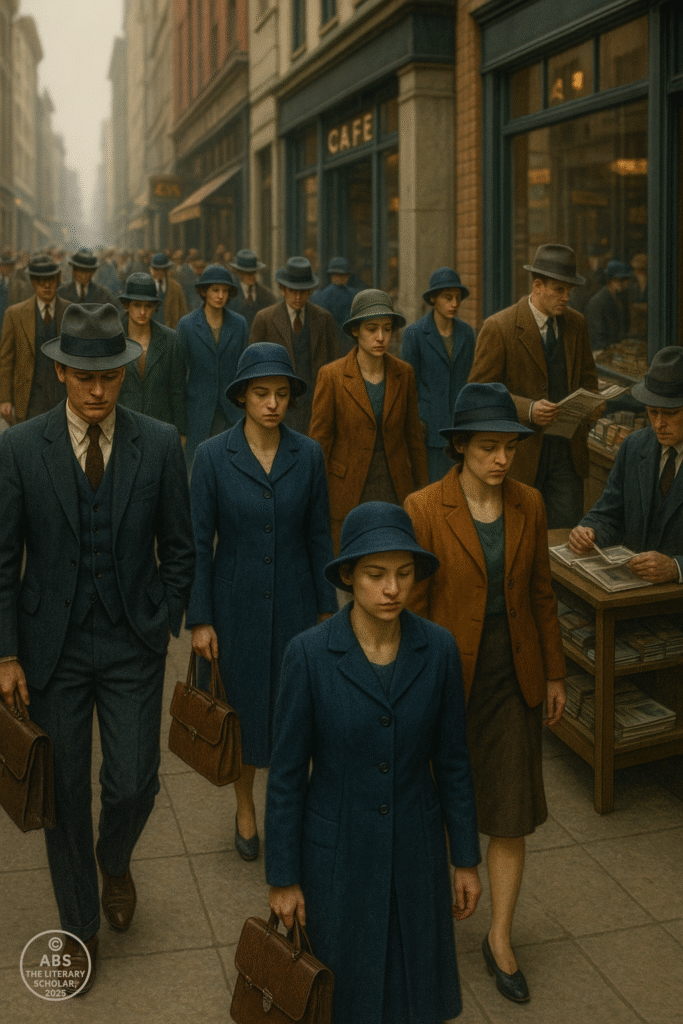
This experience of urban alienation—of being simultaneously stimulated and isolated—became a central obsession for modernist writers. The city was not just a background; it was a state of mind.
The following excerpt from "Modern Literature in a Broken World" explains how the city became a metaphor for the modern condition itself.
Modern Literature in a Broken World (1901 - 1914)
This reading explains how the modern city, with its speed, anonymity, and sensory overload, became a key symbol of alienation and fragmentation in the work of writers like T.S. Eliot and James Joyce.
Please read the section titled "Urban Alienation — The Modern City as Maze." Note the description of the city as a "spiritual wasteland" and how its "cacophony drowned out the inner voice."
Just as with the trauma of war, this new urban reality required a new kind of narrative. The city's constant motion, sensory overload, and fleeting encounters were mirrored in literary techniques that broke from the stable, single perspective of realism. Writers began to use montage-like descriptions, jump between different characters' viewpoints, and present consciousness as a stream of disconnected impressions, much like a person walking through a busy street.
This video clip offers a concise summary of how the experience of the "cripplingly isolating city" influenced the introspective nature of the modernist protagonist.
Understanding Modernist Literature: Context & Concepts
This short excerpt from "Understanding Modernist Literature" explains how the move to the metropolis fostered a new kind of individual, the introspective 'flaneur' (urban wanderer), who lives primarily inside their own head.
Please watch the clip from this section on urbanization.
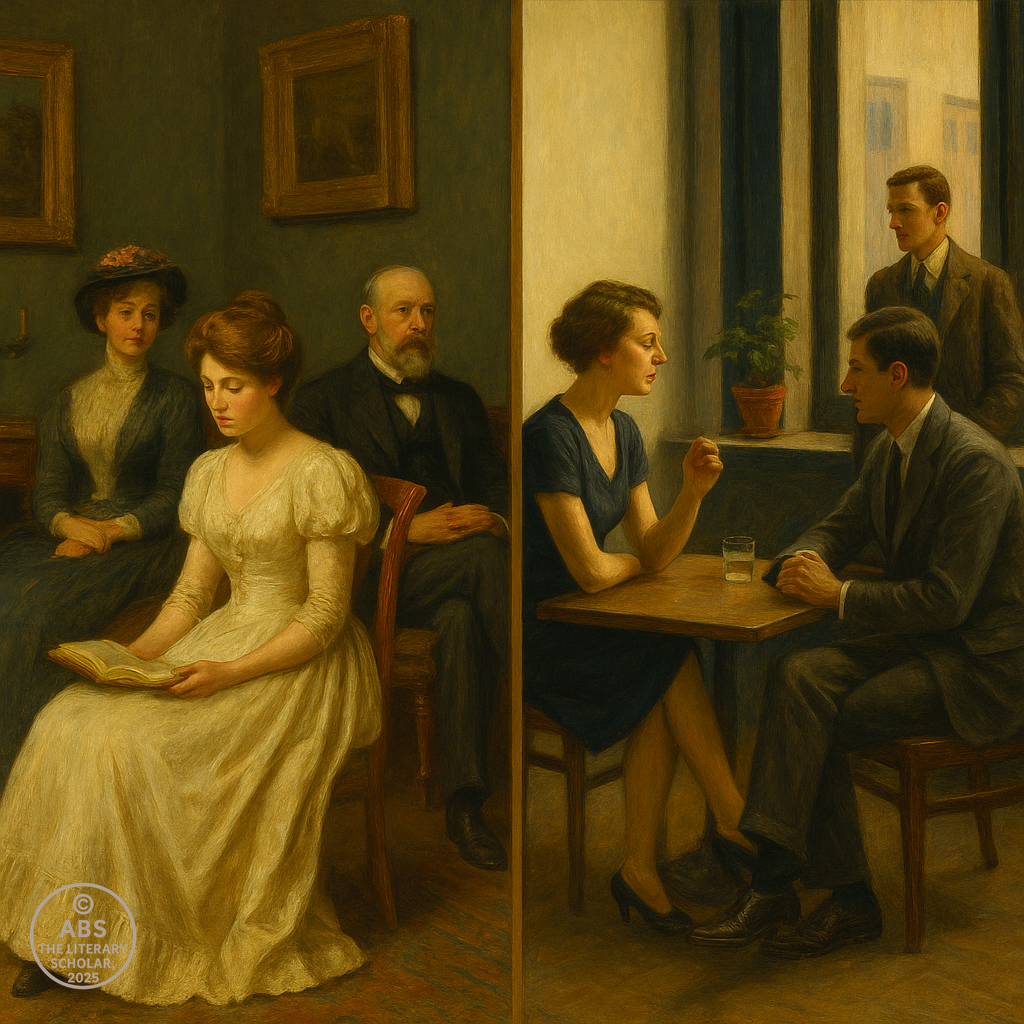
The confident, socially-embedded characters of 19th-century novels gave way to the wandering, alienated consciousness of the modernist protagonist, for whom the city is a labyrinth and reality is a subjective, fleeting experience.
Conclusion
In this lesson, we have seen how the external shocks of war and urbanization shattered the 19th century's faith in a stable, coherent, and knowable world. These forces provided a brutal, real-world confirmation of the fragmented self that psychoanalysis was exploring internally.
Key Takeaways:
- World War I destroyed the romantic myth of war and replaced it with a reality of mechanized, meaningless slaughter. This trauma created a "crisis in language," making traditional narrative forms seem dishonest and inadequate.
- The psychological phenomenon of shell shock provided a direct model for the fragmented literary character, leading to innovations like non-linear time and unreliable narration to represent trauma.
- Urbanization replaced close-knit communities with the anonymous, isolating modern city. This created a sense of alienation and a subjective experience of reality as a series of fleeting, disconnected impressions.
- Modernist writers responded to these conditions by making the city a central metaphor for the fractured modern psyche and developing narrative techniques that mirrored its fragmented nature.
Together, the inner world explored by Freud and the outer world shattered by war and the city created the perfect storm for a literary revolution. The confidence of realism was gone, replaced by the doubt, anxiety, and formal experimentation of modernism.
In our next lesson, we will take a brief step back to see how some late-19th-century writers, such as Joseph Conrad and Anton Chekhov, were already sensing these cracks in the foundation, anticipating the modernist concerns with subjectivity and moral ambiguity before the great rupture occurred.