Introduction
In our last lesson, we explored why route summarization is a critical tool for building large, scalable networks. We established that its main purpose is to reduce the size of routing tables, which in turn saves router resources, reduces bandwidth consumption from routing updates, and improves overall network stability. You learned that a well-designed hierarchical addressing plan is the prerequisite for effective summarization.
This lesson transitions from the "why" to the "how." Our goal is to master the practical skill of creating a summary route. You'll learn the step-by-step method to take a group of contiguous subnets and calculate the single, most efficient summary route that represents them. This skill is the mechanical core of making your large network designs efficient.
The Objective: Finding the "Just Right" Summary
When creating a summary route, the goal is to find a perfect balance. A summary that is too broad can be dangerous. For instance, summarizing 10.1.1.0/24 and 10.1.2.0/24 with 10.0.0.0/8 is technically a summary, but it's far too general. The router would start advertising that it can reach any 10.x.x.x address, which is likely untrue. This can lead to traffic being sent to your router for networks it doesn't know how to reach, creating a routing "black hole."
To see this problem in action, let's watch a short clip.
This video from Keith Barker demonstrates the problem of a 'gross over-summarization' and why it's crucial to be precise.
Watch from 03:28 to 05:23. Notice how the overly broad summary route (23.0.0.0/8) makes the router advertise reachability to networks it doesn't actually have, creating a potential failure point.
The key, therefore, is to calculate the most specific summary route possible. This is the summary that is just large enough to cover all your target subnets, but no larger.
The Method: Calculating the Summary Route
The most reliable way to calculate the perfect summary route is to work with the addresses in binary. The process involves four main steps.
- List the network addresses you intend to summarize.
- Convert the addresses to binary, paying close attention to the octet where they begin to differ.
- Find the boundary of common bits. Line up the binary addresses and count, from left to right, how many bits are identical across all of them. This number of common bits becomes your new CIDR prefix.
- Determine the summary network address. Take the common bits you identified and set all the remaining (non-common) bits to zero. Convert this new binary number back to decimal to get your summary network address.
Let's look at a clear visual of this process.
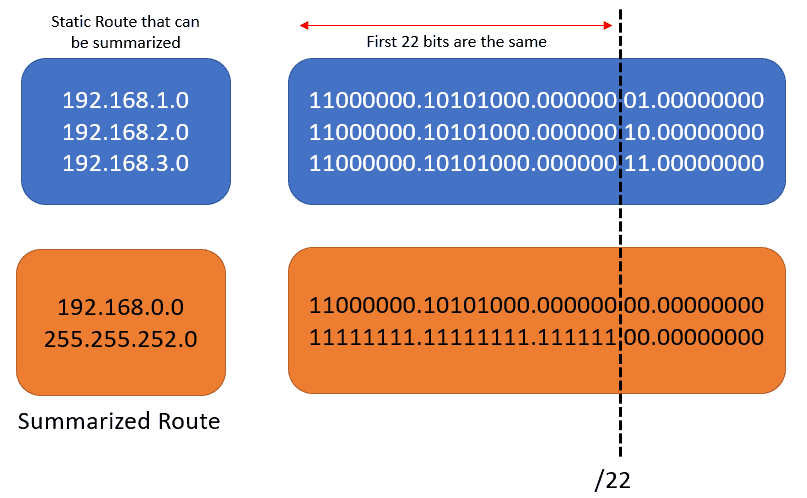
Now, let's dive into more detailed examples. The following reading provides a step-by-step walkthrough of this binary method.
This article from Cisco Press, 'Route Summarization - Example', provides a clear, methodical breakdown of how to summarize several groups of networks. It reinforces the binary conversion method we've just discussed.
Read the section 'Step 1: Summarize Winnipeg’s Routes'. Follow the conversion of the four 172.16.x.0 networks into binary and see how the common 22 bits lead to the 172.16.64.0/22 summary route.
For a dynamic walkthrough of the same process, the video we watched earlier also has an excellent segment on the calculation.
Let's return to the Keith Barker video. This part walks through the exact binary calculation process to find the perfect summary for a set of subnets.
Watch from 05:23 to 07:38. Follow along as he breaks down the last octet of five different networks into binary, identifies the three common high-order bits, and uses that to derive the summary address 23.1.12.128/27.
Hierarchical Summarization: Summarizing Summaries
In a large, hierarchical network like the one you're designing, you can apply this logic at multiple layers.
- Access to Distribution: A distribution L3 switch might summarize all the user VLAN subnets on an entire floor into one route.
- Distribution to Core: A core switch might then summarize the routes from several distribution switches into an even broader summary representing an entire building.
This is where your structured IP addressing plan becomes essential. By allocating contiguous blocks of addresses to specific buildings or functions, you enable this powerful, multi-layered summarization.

Practice: Calculating Summary Routes
Now it's time to apply this method. Let's work through an exercise. The following PDF provides a framework and problems for practicing routing calculations.
Exercises on Static IP Routing and Route Aggregation
This document contains a series of routing exercises. We will focus on a specific one to practice summarization.
First, briefly read the section '1.2. Deriving the routing table: methodology', starting from 'The proposed methodology includes the following steps:' to the end of the section. This provides a formal 4-step process for analyzing a topology. Then, read '1.2.4. Identify possible route aggregations' to understand the final step where summarization occurs.
Now, let's tackle Exercise 3 from that document.
Network diagram for Exercise 3. R1 is connected to R2 and R3. R2 is connected to networks 130.192.0.0/24 and 130.192.1.0/24. R3 is connected to network 130.192.1.128/25. Note that the original exercise image has been replaced with a clearer version of the relevant topology for this problem.
Your Task:
Imagine you are configuring router R1. Your goal is to create the most efficient routing table possible. Based on the diagram, router R2 gives you a path to the following remote networks:
130.192.0.0/24130.192.1.0/24130.192.2.32/30(the link between R2 and R3)
All three of these networks are reachable via the same next-hop from R1's perspective (the interface of R2).
Calculate the best summary route for these three networks. Follow the 4-step process:
- List the network addresses.
- Convert them to binary (focus on the 3rd octet, as the first two are the same).
- Find the number of common bits.
- Calculate the summary network address and new CIDR prefix.
Take a few minutes to work through it.
Click here to see the step-by-step solution
Step 1: List the Networks
130.192.0.0/24130.192.1.0/24130.192.2.32/30
Step 2: Convert to Binary (focusing on the 3rd octet)
Let's look at the third octet for each address:
...0.0->00000000...1.0->00000001...2.32->00000010
Step 3: Find the Common Bits
Let's align them and find the boundary:
00000000
00000001
00000010
^-----^
The first 6 bits (000000) are common to all three addresses. The 7th bit is where they differ.
The original addresses share the first 16 bits (130.192). We found 6 more common bits in the third octet.
Total common bits = 16 (from the first two octets) + 6 (from the third octet) = 22 bits.
Therefore, our new prefix is /22.
Step 4: Calculate the Summary Address
We take the common bits and set the rest to zero.
- First octet:
130 - Second octet:
192 - Third octet: The common bits are
000000. We set the last two bits to00. So,00000000->0. - Fourth octet:
0
The summary network address is 130.192.0.0.
Result: The most efficient summary route for those three networks is 130.192.0.0/22.
This single route (130.192.0.0/22) covers the address range from 130.192.0.0 to 130.192.3.255, which neatly contains all three of our target networks. Instead of three entries in R1's routing table, we now need only one.
Conclusion
You have now learned the practical, step-by-step method for calculating a summary route. This is a fundamental skill that moves you beyond just configuring networks to actively optimizing and designing them for scale and efficiency.
Key Takeaways:
- Accuracy is Key: The goal of summarization is to create the most specific summary that still covers all desired subnets, avoiding overly broad routes that can cause black holes.
- The Binary Method: The definitive way to calculate a summary is to convert addresses to binary, find the number of leading bits they have in common, and use that to define the new prefix and network address.
- Hierarchical Design Pays Off: Effective summarization is a direct benefit of a well-planned, hierarchical IP addressing scheme where related networks are grouped into contiguous blocks.
In our next and final lesson of this module, we will explore a powerful technique for virtualization that you specifically asked about: Virtual Routing and Forwarding (VRF). You'll learn how VRFs allow you to create multiple, independent virtual routers on a single physical L3 switch, providing the ultimate traffic separation for scenarios like isolating guest internet access from your internal corporate network.