Hello! Welcome to the next lesson in our journey to master enterprise network design.
In the last lesson, you successfully created and documented a complete VLSM plan. You now know how to take a set of requirements, carve up an address block, and document the network, usable, and broadcast addresses for each subnet. That's the how of IP address planning.
Today, we're focusing on the why. A key goal of your project is to minimize IP address waste, and this lesson gives you the tool to measure exactly how well you're doing. Our learning outcome is to calculate the address utilization efficiency for a given VLSM plan. This skill allows you to put a concrete number on the effectiveness of your design and quantitatively demonstrate the superiority of VLSM over older, fixed-size methods.
1. Defining Address Utilization Efficiency
At its core, address utilization efficiency is a simple percentage that answers the question: "Of all the IP addresses I've set aside (allocated), how many do I actually need?"
A high efficiency percentage means your plan is lean and wastes very few addresses. A low percentage indicates significant waste, which could lead to running out of addresses sooner than necessary.
This concept is visualized perfectly in the diagram below, which contrasts a Fixed Length Subnet Mask (FLSM) scheme with a VLSM scheme.
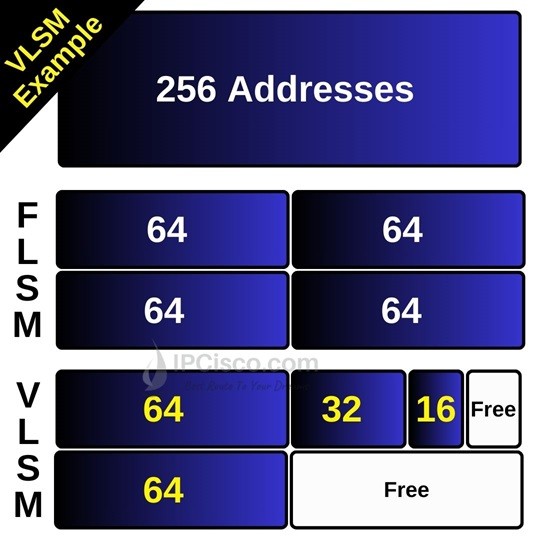
The FLSM plan uses four equal /26 subnets (64 addresses each) regardless of need, while the VLSM plan tailors the subnet size to each requirement. The result is obvious: VLSM leaves more address space unassigned and available for future growth.
2. The Efficiency Formula
To calculate this as a number, we use a straightforward formula. There are two main components: what you need and what you allocated.
The formula for the overall efficiency of a plan is:
Let's break down those terms:
- Total Required Host Addresses: This is the sum of all the hosts you need to support across all your subnets (e.g., 50 users in Sales + 120 in Engineering, etc.). This is your starting requirement.
- Total Allocated Addresses: This is the sum of the total block sizes for each subnet you assigned. Remember, a
/26subnet contains 64 total addresses, a/27contains 32, and so on.
3. Calculating Efficiency: A Step-by-Step Example
Let's apply this to a real plan. We'll use the example from the Comparitech article, which you've seen before. It provides a clear set of requirements and a final allocation table.
Variable Length Subnet Mask (VLSM) Tutorial - Fully Explained
To see the calculation in action, let's revisit the network plan from the 'Variable Length Subnet Mask (VLSM) Tutorial'. We will use its requirements and final allocations.
Please review the section titled 'Implementing VLSM Subnetting'. Take note of the initial host requirements in 'Table 4.0' and the final subnet allocations in 'Table 9.0'. We'll use those two sets of numbers.
Here is the step-by-step calculation based on that article:
Step 1: Sum the Required Host Addresses
From Table 4.0 in the article, the requirements are:
- LAN A: 60 hosts
- LAN B: 29 hosts
- LAN C: 14 hosts
- Link AB: 2 hosts
- Link AC: 2 hosts
- Link BC: 2 hosts
- Total Required = 60 + 29 + 14 + 2 + 2 + 2 = 109 hosts
Step 2: Sum the Total Allocated Addresses
From Table 9.0, the allocated subnets are:
- LAN A (/26): Block size of 64
- LAN B (/27): Block size of 32
- LAN C (/28): Block size of 16
- Link AB (/30): Block size of 4
- Link AC (/30): Block size of 4
- Link BC (/30): Block size of 4
- Total Allocated = 64 + 32 + 16 + 4 + 4 + 4 = 124 addresses
Step 3: Calculate the Overall Efficiency
This VLSM plan is nearly 88% efficient.
For comparison, let's see how an FLSM plan would fare. To accommodate the largest requirement (60 hosts), we would need to use /26 subnets (64 addresses) for all six segments.
- Total Allocated (FLSM) = 6 segments × 64 addresses/segment = 384 addresses.
- Total Required is still 109 hosts.
- FLSM Efficiency =
The difference is stark. Your VLSM plan uses the address space more than three times as efficiently.
4. Your Turn: Analyze a Network Plan
You asked for plenty of practice, so let's analyze a new plan. The image below shows a network topology and its corresponding addressing table from a Cisco training activity.
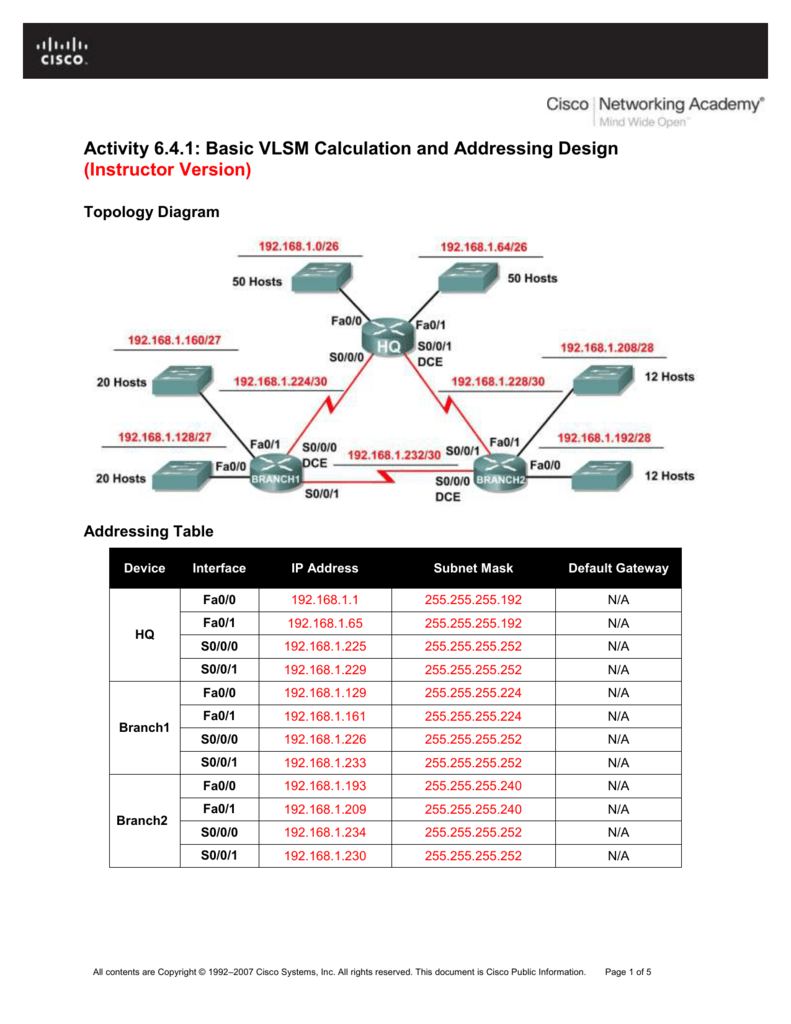
Your Task:
Calculate the overall address utilization efficiency for the network design shown in this diagram.
- The parent address block is
192.168.1.0/24. - Consider all six network segments shown in the topology (the four LANs and the two point-to-point WAN links).
Take your time to sum the requirements and the allocated block sizes, then apply the formula.
Click here to see the solution and check your work.
Step 1: Sum the Required Host Addresses
- Branch1 LAN (VLAN 10): 50 Hosts
- Branch1 LAN (VLAN 20): 20 Hosts
- Branch2 LAN (VLAN 30): 12 Hosts
- Branch2 LAN (VLAN 40): 20 Hosts
- WAN Link (HQ to Branch1): 2 Hosts
- WAN Link (HQ to Branch2): 2 Hosts
- Total Required = 50 + 20 + 12 + 20 + 2 + 2 = 106 hosts
Step 2: Sum the Total Allocated Addresses
The diagram and table show the following prefixes were assigned:
- VLAN 10 (
192.168.1.0/26): Block size of 64 - VLAN 20 (
192.168.1.128/27): Block size of 32 - VLAN 30 (
192.168.1.96/28): Block size of 16 - VLAN 40 (
192.168.1.64/27): Block size of 32 - WAN HQ-B1 (
192.168.1.160/30): Block size of 4 - WAN HQ-B2 (
192.168.1.164/30): Block size of 4 - Total Allocated = 64 + 32 + 16 + 32 + 4 + 4 = 152 addresses
Step 3: Calculate the Overall Efficiency
The overall efficiency of this plan is approximately 69.7%.
Bonus Question: How many addresses from the parent 192.168.1.0/24 block are still available for future expansion?
- A /24 block contains 256 addresses.
- We have allocated 152 addresses.
- Available Addresses = 256 - 152 = 104 addresses.
Conclusion
Great work. You can now not only create an efficient IP plan but also prove its efficiency with a clear, defensible metric. This is a crucial skill for any network architect.
Key Takeaways:
- Address utilization efficiency is a percentage that measures how much of your allocated address space is actually required.
- The formula is
Efficiency = (Total Required Hosts / Total Allocated Addresses) * 100%. - A high efficiency score demonstrates that you have successfully minimized address waste, a core goal of modern network design.
- VLSM provides a dramatic improvement in efficiency over older FLSM schemes.
In our next lesson, we will complete our study of VLSM by focusing on a specific, common requirement: planning subnets for point-to-point links using /30 or /31 prefixes. We'll discuss why /30 is the traditional choice and when the even more efficient /31 can be used.