Hello! Welcome to the first lesson in our course on writing your ebook.
Given your background as a nonfiction author exploring complex emotional topics, you're already skilled at structuring ideas and connecting with readers. This course is designed to help you refine and calibrate that skill for this specific project, ensuring your book is not only emotionally resonant but also ethically sound and safe for your readers.
Today's lesson focuses on a foundational principle for this book: distinguishing between therapeutic intervention and empathetic validation. This distinction is the cornerstone of your entire project. It's what will allow you to make your reader feel deeply seen and understood, as you intend, without crossing the crucial line into offering clinical advice. Mastering this will build profound trust with your audience and ensure the book delivers on its promise of validation, not cures.
Let's begin by defining our key terms.
1. Understanding the Difference: Empathy, Sympathy, and Therapy
To write with empathy, we first need to be clear on what it is—and what it isn't. People often confuse empathy with sympathy, but for your work, the difference is critical.
A sympathetic response often involves pity or agreement, which can unintentionally reinforce a person's negative feelings. Empathy, on the other hand, is about understanding and connection.
How empathy works - and sympathy can't
To explore this further, watch this brief segment from Dr. Paul Furey's video, 'How empathy works - and sympathy can't.' It clearly explains why sympathy can keep someone 'in the pit' while empathy offers a way forward.
Please watch from 00:42 to 02:32. Pay close attention to the contrast between the 'sympathetic response' based on pity and agreement, and the 'empathetic response' based on reflecting feelings to show understanding.
As Dr. Furey explains, empathy is about reflecting back the feeling you perceive, showing the person they are deeply understood. This doesn't mean offering solutions; it means being present with their experience.
This presence is the heart of empathetic validation. It's different from the goal of therapy, which is oriented toward specific outcomes like behavioral change or symptom reduction.
Let's look at a clear visual breakdown.

As an author, your goal is to foster understanding and provide validation for its own sake. A therapist's goal uses that validation as a tool to facilitate a clinical outcome. Your book's "outcome" is the reader's feeling of being seen and the internal permission to rest with their feelings, not an directive to change them.
2. Putting Empathetic Validation into Practice
So, how do you translate the act of empathy into the art of writing? It involves moving from simply stating a feeling to exploring its texture and meaning for the reader.
Psychologist On How To Be More Empathic | Empathetic
This video from psychologist Dr. Maika Steinborn, 'Psychologist On How To Be More Empathic,' offers excellent, actionable techniques for expressing empathy that we can adapt for writing.
First, watch the section 'What empathy is not' from 01:23 to 03:09. This reinforces that empathy isn't about solving problems or minimizing pain. Then, watch 'Verbalize' and 'Validate' from 06:57 to 10:08. Notice the sentence starters she provides, like 'It sounds like you're really...' or 'It's natural to feel...'. These are conversational cues for the kind of validating prose you'll be writing.
When you write, you can "verbalize" and "validate" a reader's experience on the page. For example, instead of a conversational "It sounds like you're really exhausted," you can write a passage that describes the bone-deep weariness that comes from performing strength day after day. You're not telling them they are exhausted; you're showing them you understand the quality of that exhaustion.
A key part of this is avoiding "toxic positivity"—phrases that seem helpful but actually dismiss or minimize a person's pain.
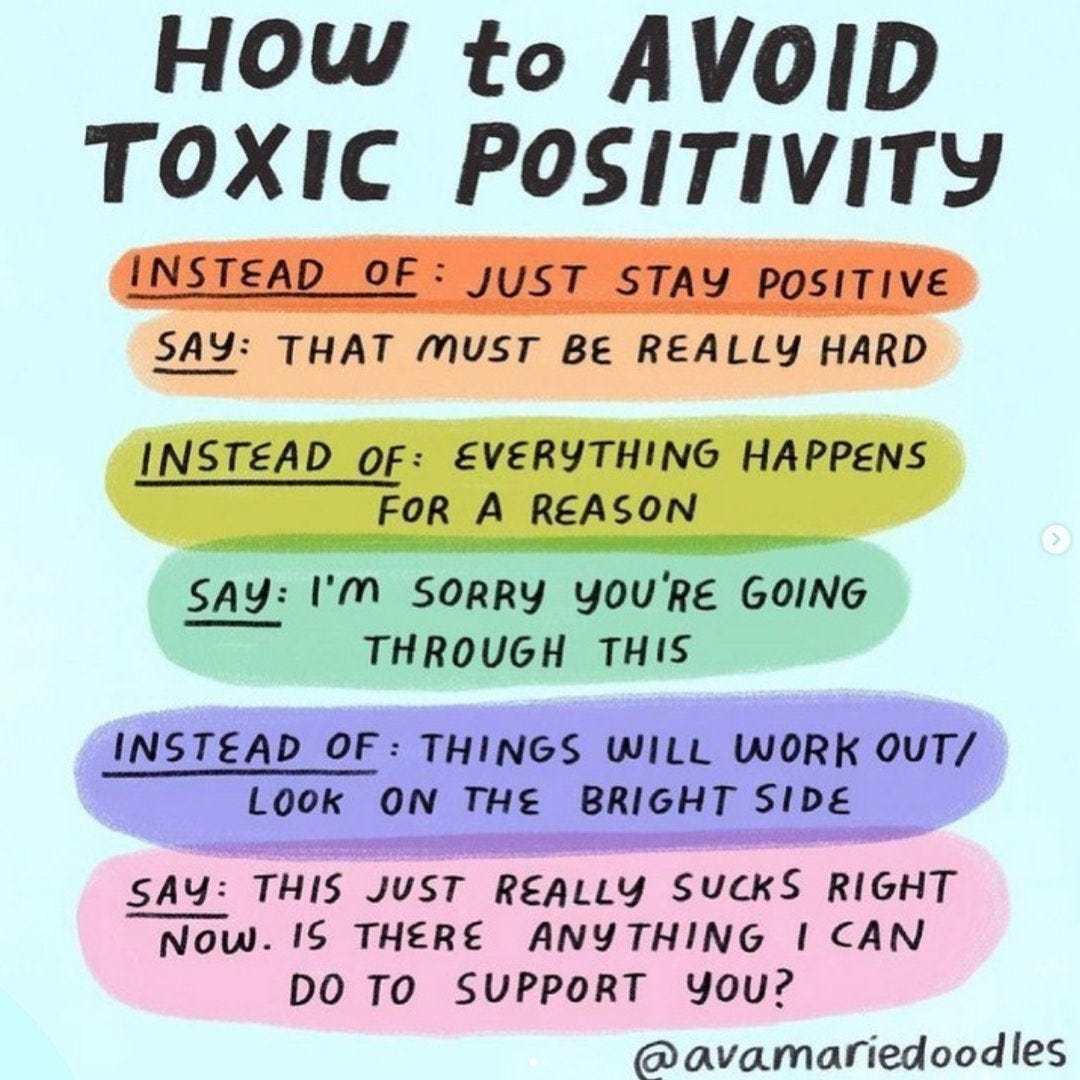
Your book should feel like a steady, understanding presence that says, "This is incredibly hard," rather than an optimistic friend who says, "Just look on the bright side!"
Test your understanding!
Let's use one of the core emotional phrases from your project brief: “I’m not lazy, I’m just broken.”
Based on what we've covered, draft two distinct, one-sentence responses to this sentiment:
- A sentence that represents a therapeutic intervention.
- A sentence that represents empathetic validation.
Show answer
Here are some examples. Your versions may differ, but they should capture the same essential distinction.
-
Therapeutic Intervention: "This feeling of being 'broken' can often be addressed by identifying and challenging the core beliefs that fuel negative self-perception."
- Why it's intervention: It identifies a problem ("negative self-perception") and points toward a process for fixing it ("identifying and challenging"). It is solution-oriented.
-
Empathetic Validation: "There is a profound difference between the body's refusal to perform and a lack of will—one is exhaustion, the other is choice, and the world is not built to recognize the distinction."
- Why it's validation: It doesn't offer a fix. Instead, it defines and honors the feeling, legitimizing the speaker's experience by drawing a sharp contrast and acknowledging an external pressure ("the world is not built to recognize..."). It says, "I see the distinction, and I affirm it."
3. The Author's Ethical Responsibility
Distinguishing between validation and intervention isn't just a stylistic choice; it's a profound ethical commitment to your reader. As a writer creating structured, research-based ebooks on mental health, you're already familiar with the importance of responsible communication. Let's deepen that understanding.
Healing Narrative: Ethics and Writing about Patients
This article, 'Healing Narrative: Ethics and Writing about Patients' from the AMA Journal of Ethics, explores the moral responsibilities of physicians who write for a popular audience. While you are not a physician, the core principles are directly applicable to your work.
Please read the introduction, the section starting with 'Narrative medicine teaches us...', and the concluding section starting with 'As physician and bioethicist Edmund Pellegrino puts it...'. Focus on the concepts of writing as a 'moral enterprise,' the distinction between 'story-truth' and 'what-happened truth,' and the duty to handle 'the stories of our patients with equal care.'
Your book will be built on the emotional truths found in the phrases you've collected—a form of "story-truth." Your ethical duty is to render that truth with immense care, respecting the reality of the pain without claiming to have the authority to treat it.
This establishes a unique and powerful bond with your reader. To understand the philosophical depth of this author-reader relationship, we can turn to the field of nonfiction ethics.
Sarah Einstein, 'The Self-ish Genre': Questions of Authorial ...
This essay, 'The Self-ish Genre' by Sarah Einstein, provides a rigorous philosophical framework for the ethics of nonfiction writing. It's a more advanced text that will help you calibrate the 'why' behind your authorial voice.
Read the sections titled 'Levinas & the Ethics of First Person Nonfictional Narration' and the subsequent section that begins 'Both Ricœur and Levinas consider...'. Don't worry about grasping every philosophical nuance. Focus on the central idea: when an author presents a nonfiction account (their 'face'), they create an ethical relationship with the reader, who is compelled to trust them. The James Frey example powerfully illustrates the harm done when that trust is broken by presenting falsehoods or, in our case, false promises.
The core takeaway here is that your book establishes an ethical contract. By presenting these emotional experiences, you invite the reader into a space of trust. A therapeutic intervention would violate that contract because you are not a therapist, and the book is not a clinical tool. Empathetic validation, however, fulfills the contract. It delivers exactly what is promised: a truthful, respectful reflection of a difficult human experience.
Your role is not to be a guide who leads the reader out of the dark woods, but a fellow traveler who sits with them in the darkness and says, "You are not alone here." That, in itself, is a powerful and ethical act.
Conclusion
In this lesson, we've established the critical boundary between telling a reader "Here's how to fix it" and telling them "What you're feeling is real and it makes sense."
Key Takeaways:
- Empathetic Validation is the act of connecting with and reflecting a reader's emotional experience with respect and understanding. Its message is: "I see you, and your feelings are valid."
- Therapeutic Intervention is a goal-oriented process aimed at creating change or alleviating clinical symptoms. Its message is: "Here is what you can do to feel differently."
- Your Ethical Stance as an author is to remain firmly on the side of validation. This builds trust, ensures reader safety, and allows your book to achieve its primary purpose: to make people feel deeply understood.
In our next lesson, we will build directly on this foundation by learning to identify language patterns that imply medical diagnosis and rewrite them using descriptive, non-clinical emotional language. This will give you another practical tool for maintaining the crucial ethical boundary we've defined today.