Hello.
In our last lesson, we focused on crafting the opening passages of your book to establish immediate emotional safety and non-judgmental authority. We discussed how to earn a reader's trust by validating their experience from the first sentence.
Today, we will extend that principle to the entire manuscript. This lesson addresses the learning outcome: Identify and revise phrases that constitute 'toxic positivity' or false reassurance into grounded, validating statements. This is a critical skill for calibrating your authorial voice, ensuring the sanctuary you create in the introduction is maintained from cover to cover. It's what separates a book that makes a reader feel seen from one that makes them feel dismissed.
1. Understanding Toxic Positivity and Its Impact
Toxic positivity is not about the value of optimism itself. It becomes "toxic" when positivity is used to deny, minimize, or invalidate authentic human emotional experiences. For your readers, who are likely grappling with exhaustion, loneliness, and despair, encountering false reassurances can be profoundly alienating. It reinforces the very feeling you seek to dismantle: the sense that their pain is wrong or unacceptable.
To begin, let's establish a clear definition of this concept and its potential harm.
Toxic Positivity: The Reality of Suppressing Emotions
The video 'Toxic Positivity: The Reality of Suppressing Emotions' by psychiatrist Dr. Tracey Marks provides a concise clinical perspective on this phenomenon. It explains how insisting on a positive outlook can lead to emotional suppression and damage.
Please watch from 00:45 to 02:49. As you watch, focus on the examples of toxic positive phrases (e.g., 'Look on the bright side,' 'Everything happens for a reason') and the explanation of why suppressing real emotions can be detrimental.
As Dr. Marks explains, forcing positivity doesn't make negative feelings disappear; it pushes them down, where they can curdle into anxiety, depression, or a sense of personal failure for not being "positive enough." This directly contradicts your book's goal of giving readers permission to feel and to rest.
The following article offers a more detailed breakdown of the different forms toxic positivity can take.
The Dangers of Toxic Positivity (And How to Avoid It)
This article, 'The Dangers of Toxic Positivity,' provides a comprehensive list of the ways this mindset can manifest in communication.
Please read the sections titled 'What is toxic positivity?' and 'Forms of Toxic Positivity.' Pay close attention to the list of manifestations, such as oversimplification, denying reality, and imposing a happy narrative on a painful situation.
The concepts in these resources are supported by extensive psychological research. Studies show that a culture of enforced positivity can increase emotional exhaustion, contribute to burnout, and even lead to alexithymia—a difficulty in identifying and expressing emotions—by discouraging emotional introspection. For your book, this means that every phrase must be examined to ensure it offers authentic validation, not dismissive optimism.
2. The Alternative: Grounded Validation and Empathy
If toxic positivity is the problem, genuine validation is the antidote. Validation is not about agreeing with a person or cheering them up. It is the act of acknowledging their internal experience as real, understandable, and acceptable. It communicates: "What you are feeling makes sense, and you are allowed to feel it."
The following TEDx talk is a powerful demonstration of validation in its purest form. While the speaker, Naomi Feil, works with the elderly, the principles she demonstrates are universal and directly applicable to your writing.
Validation, communication through empathy | Naomi Feil | TEDxAmsterdamWomen
In 'Validation, communication through empathy,' Naomi Feil masterfully shows the difference between dismissive sympathy ('I know how you feel... try having some tea') and true, empathetic validation.
Please watch from 00:53 to 05:26. Notice how she avoids arguing with or correcting the person's reality. Instead, she uses techniques like: Rephrasing: Repeating their words back as a question to show she is listening. Polarity: Asking about the worst part of the feeling to help them explore it. Holding space for emotion: Allowing for tears and pain without trying to fix them.
Feil's approach teaches us that the most powerful way to connect with someone in pain is not to pull them out of their reality, but to enter it with them and listen. In writing, this translates to an authorial voice that acknowledges the darkness before ever pointing toward light.
The two images below provide excellent, practical examples of how to shift from invalidating phrases to validating ones.

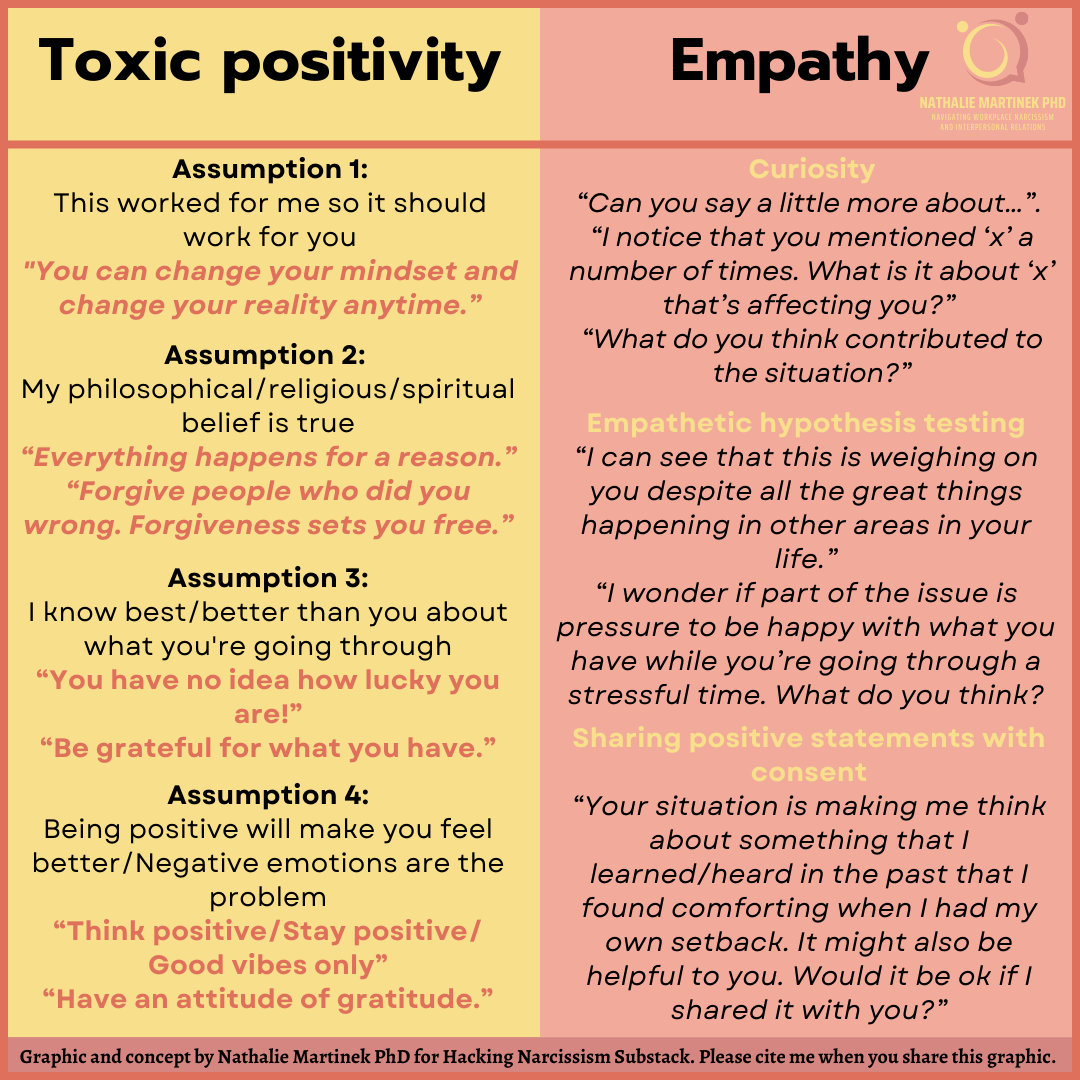
3. Application: Revising for Grounded Validation
Now, let's put this into practice. Your task is to transform common, well-intentioned but ultimately unhelpful platitudes into grounded, validating statements that align with the empathetic voice of your book.
Instructions:
Below are four phrases that exemplify toxic positivity or false reassurance. For each one, write a 2-3 sentence revision that would be appropriate for your book. Your revision should validate the underlying feeling without offering a simplistic fix.
Here is an example to guide you:
- Toxic Phrase: "What doesn't kill you makes you stronger."
- Grounded Revision: Surviving a difficult experience doesn't obligate you to be stronger. Sometimes, the goal is simply to get through it. The pressure to emerge from pain as a more resilient person can be its own silent burden.
Now, please revise the following four phrases:
- "Everything happens for a reason." (Often said in response to loss or a painful life change.)
- "Just be positive!" / "Look on the bright side." (Often said in response to expressions of sadness or despair.)
- "This is an opportunity for growth." (Often said in response to a setback like job loss or divorce.)
- "It could be worse." (Often said to try and reframe someone's suffering.)
Take your time with these. Think about your ideal reader. What do they need to hear? They don't need their pain explained away or minimized; they need it to be seen and held with respect.
Conclusion
Mastering the distinction between toxic positivity and grounded validation is fundamental to your book's success. It is the ethical and empathetic core of your promise to the reader. By consciously choosing language that acknowledges reality, permits difficult emotions, and offers presence over platitudes, you maintain the container of safety your reader needs to engage with their own experience.
Key Takeaways:
- Toxic positivity dismisses or minimizes real emotional pain with false reassurances.
- Grounded validation acknowledges that a person's feelings are real, understandable, and acceptable, without needing to fix them.
- Empathetic writing involves entering the reader's reality, rephrasing their unspoken feelings, and allowing space for pain.
- Revise relentlessly to replace platitudes like "look on the bright side" with statements that say, "it's okay that things are not bright right now."
In our next lesson, we will build directly on this foundation. Having learned to avoid false reassurance, we will explore how to apply the concept of 'grounded hope' to acknowledge despair without offering simplistic solutions. This will involve crafting a narrative that holds space for pain while gently pointing toward the possibility of rest and quiet resilience.