Hello.
In our last lesson, we focused on identifying and replacing phrases of toxic positivity with grounded, validating statements. We established that the foundation of an empathetic voice is the willingness to acknowledge a reader's pain without trying to fix or minimize it.
Today, we will build directly upon that foundation. This lesson addresses the learning outcome: Apply the concept of 'grounded hope' to acknowledge despair without offering simplistic solutions. This is the next crucial step in calibrating your authorial voice. Where the last lesson was about what not to say, this one is about what you can offer instead—a way to hold space for hardship while still imbuing your writing with a quiet, resilient sense of forward movement. For your book, this is the difference between leaving a reader in their despair and sitting with them in it, gently suggesting a way to endure.
1. Defining Grounded Hope
The opposite of toxic positivity is not pessimism; it's a concept we can call "grounded hope." Unlike the wishful thinking of "everything will be okay," grounded hope is rooted in reality, acknowledges the presence of pain, and finds its power in small, deliberate actions rather than grand, abstract promises.
For a reader who feels "done" or that their efforts are "pointless," the idea of hope itself can feel like a betrayal. The following article explores this tension with profound honesty.
The Traitor Hope: Reflections on toxic positivity
The article 'The Traitor Hope: Reflections on toxic positivity' from the UK's National Suicide Prevention Alliance offers a critical perspective on hope from the standpoint of severe mental distress. It's an essential read for understanding why simplistic promises of 'getting better' can be harmful.
Please read the sections 'Reflections on hope' and the passage beginning 'When we hope for things grounded in reality...' (found under the 'Navigating the conflicts' heading). Focus on how the author distinguishes between the 'idealistic fantasy' of cure-all hope and a hope that is grounded in the reality of the present moment, however small.
This article makes a vital point: for many people, the goal isn't a miraculous recovery but simply the ability to "keep going." Grounded hope, therefore, isn't about the destination of happiness, but about the process of enduring.
Now, let's look at a more formal definition and framework for this concept.
How to Shift From Cynicism to Grounded Hope
The Psychology Today article 'How to Shift From Cynicism to Grounded Hope' defines the term and contrasts it with both cynicism and unchecked optimism.
Please read the introduction (under the heading 'Key points'), the section 'From Doomscrolling to Hopeful Skepticism,' and the section 'Leading and Creating With a New View of Hope.' Pay particular attention to the definition of hope as 'the belief that a better future is possible through our actions.'
As these resources show, grounded hope has three key components:
- It Acknowledges Reality: It doesn't deny or downplay pain, despair, or cynicism.
- It Includes Agency: It hinges on the belief that our actions, no matter how small, can create change.
- It is Process-Oriented: It focuses on the next step, not a distant, perfect future.
2. The Language of Acknowledgment and Possibility
So, how do we translate this into the empathetic voice your book requires? It means moving away from phrases that offer solutions and toward phrases that offer presence and possibility.
A core tenet of this approach is captured beautifully in the following video.
How to Deal with Toxic Positivity
In 'How to Deal with Toxic Positivity,' Dr. Ish Major provides a powerful metaphor for true compassion that is the heart of grounded hope.
Please watch from 01:54 to 02:30. Focus on the metaphor of sitting with someone in a dark room without feeling the need to 'turn on the light.' This is the essence of acknowledging despair without rushing to a solution.
Your writing should aim to be that friend sitting in the dark. It says, "I see your pain. I am not afraid of it. We can sit here for a while."
From that place of shared presence, you can then gently transition from pure validation to grounded hope. The following video offers excellent, practical examples of how to make this linguistic shift.
Toxic Positivity: Why Positive Vibes are Ruining You
The video 'Toxic Positivity: Why Positive Vibes are Ruining You' by Vanessa Van Edwards provides a list of direct replacements for common dismissive phrases.
Please watch from 02:11 to 03:22. Notice how the replacement phrases shift the focus from dismissing the problem ('It'll all be fine') to offering support and collaboration ('How can I help?' or 'I'm here for you').
The key is to replace invalidating platitudes with phrases that acknowledge the struggle and offer companionship.
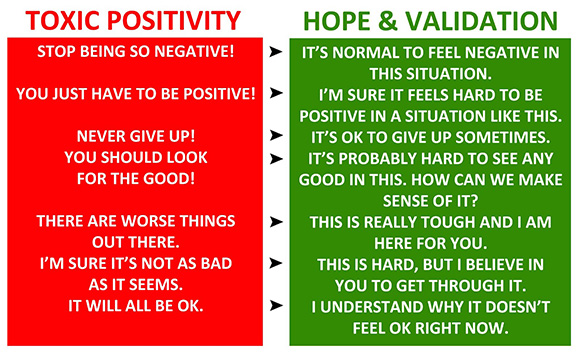
3. Application: Writing with Grounded Hope
Let's put this into practice. Your goal is to respond to a reader's deep sense of despair not by trying to fix it, but by acknowledging it and then gently opening a small window of possibility—the essence of grounded hope.
Instructions:
Below are two of the emotional phrases from your source material. For each phrase, write a short paragraph (3-5 sentences) as it might appear in your book. Your paragraph should:
- Acknowledge the feeling directly and validate it. Show the reader you understand the weight of this emotion.
- Avoid offering a solution or a promise of a better future.
- Introduce a small, grounded sense of possibility or permission. This could be the permission to rest, the possibility of a single breath, or the quiet acknowledgment of one's own endurance.
Phrase 1: "I’m not sad, I’m just… done."
Phrase 2: "I’m trying so hard and it still feels pointless."
Take your time with this exercise. The calibration is subtle. You are moving from saying "I see your pain" (the focus of the last lesson) to saying "I see your pain, and I will sit with you in it. When you're ready, just breathing is enough."
Conclusion
Mastering grounded hope is how you fulfill your book's core promise: to provide validation and reflection without offering false cures. It allows your writing to be a companion to the reader, one that is unafraid of their darkness but also holds a quiet belief in their capacity to endure. This is not about cheering from the sidelines; it's about walking with them, step by step.
Key Takeaways:
- Grounded hope acknowledges pain and is rooted in the reality of the present moment.
- It is not wishful thinking but a belief in the power of small, deliberate actions and one's own agency.
- The language of grounded hope offers presence over promises and collaboration over solutions.
- In your writing, it translates to validating despair and then gently introducing the possibility of rest, endurance, or a single, small next step.
In our next and final lesson of this module, we will consolidate these skills. We'll focus on how to refine the authorial voice to be consistently calm, respectful, and emotionally intelligent, ensuring that the principles of validation and grounded hope are woven seamlessly throughout your entire manuscript.