Hello. In our previous lessons this week, we've been focused on building a more disciplined and truthful mind. We identified common cognitive distortions, practiced questioning our own conclusions, and learned to apply the Stoic 'view from above' to gain perspective on our problems. You've been developing a toolkit for observing and interrogating your own thoughts.
Today, we come to the capstone reflection for this module. We will synthesize everything we've learned to confront a deeper question, which is this lesson's central goal: to write a reflection exploring where your thinking serves your fears rather than the truth.
This isn't about finding simple errors in logic; it's about uncovering the complex ways our minds construct narratives to protect us from what we are afraid to face. We'll explore the architecture of self-deception, drawing on both psychology and existential philosophy to provide a framework for this challenging but essential self-examination.
1. The Psychology of the Honest Lie
First, let's establish a psychological foundation for understanding self-deception. Our minds are not just truth-seeking instruments; they are also wired for survival, and sometimes that means protecting our sense of self from painful realities. This self-protection can lead us to believe things that aren't true or refuse to see truths that are right in front of us.
To understand how and why this happens, please watch the following TEDx talk.
Honest liars -- the psychology of self-deception: Cortney Warren at TEDxUNLV
In her talk 'Honest liars -- the psychology of self-deception,' Dr. Cortney Warren provides an accessible overview of why we lie to ourselves and the psychological mechanisms we use to do it. This will help connect the cognitive distortions we've already studied to deeper emotional drivers.
Please watch these three segments: The introduction from 00:00 to 02:09, which defines self-deception and its connection to fear. The segment on psychological mechanisms from 03:40 to 05:56, which describes ego-defenses and cognitive distortions. The segment on existential fears from 05:56 to 07:22, which explains how we deceive ourselves to avoid the 'Givens of Life.' Pay close attention to the link she makes between lies, fear, and the need for 'psychological strength.'
As Dr. Warren explains, we deceive ourselves to avoid dealing with the consequences of the truth. These consequences are often frightening: confronting our mortality, our ultimate aloneness, the responsibility that comes with freedom, or the shame of our perceived imperfections. The tools for this deception are often the very cognitive distortions and defense mechanisms (like denial and rationalization) we've been discussing.
2. The Philosophy of Self-Deception: "Bad Faith"
Now, let's look at this same phenomenon through a philosophical lens. Your familiarity with Albert Camus will serve as a good entry point into the world of his contemporary, Jean-Paul Sartre, who gave this act of self-deception a famous name: mauvaise foi, or "bad faith."
Bad faith, for Sartre, is the specific lie we tell ourselves that we are not free. We pretend we are objects without choice—a waiter who is just a waiter, an employee who has to agree with the boss—to escape the crushing anxiety and responsibility of our own freedom.
This short animated video from The School of Life offers a quick and clear introduction to Sartre's concept of 'bad faith.'
Watch the segment from 00:06 to 02:12. It defines bad faith and uses Sartre's classic example of the waiter to illustrate how we play roles to deny our freedom and the possibilities of who we could become.
To deepen your understanding of this powerful concept, let's explore it more thoroughly.
Living in Bad Faith: The Existentialist Guide to Stopping ...
The article 'Living in Bad Faith' by Jonathan Pham provides an excellent, in-depth exploration of the topic, connecting the philosophy to modern life.
Please read the following sections of the article: Start at the beginning with 'What is Bad Faith?' and read through 'The Philosophy of Bad Faith,' ending just before 'The Many Faces of Bad Faith in Life.' This will define the concept and explain Sartre's key examples. Then, skip to the section 'Why Do We Live in Bad Faith?' and read it in full. This part is crucial as it directly addresses the connection between our thinking and our fears (the burden of freedom, fear of failure, comfort of conformity).
The core insight here is that we often choose to see ourselves as fixed objects defined by our "facticity" (our job, our past, our personality type) to avoid the terrifying responsibility of our "transcendence" (our freedom to choose, change, and create ourselves anew).
3. Integrating the Concepts: A Framework for Self-Inquiry
We now have two complementary frameworks for understanding how our thinking can serve fear over truth:
- The Psychological View: We use defense mechanisms and cognitive distortions to avoid the psychological pain associated with our fears (of inadequacy, abandonment, etc.).
- The Existential View: We live in "bad faith," denying our freedom and responsibility to escape the anxiety of choice and the possibility of failure.
These are two sides of the same coin. The Stoic practice you learned, the Discipline of Assent, provides a useful model for intervention.
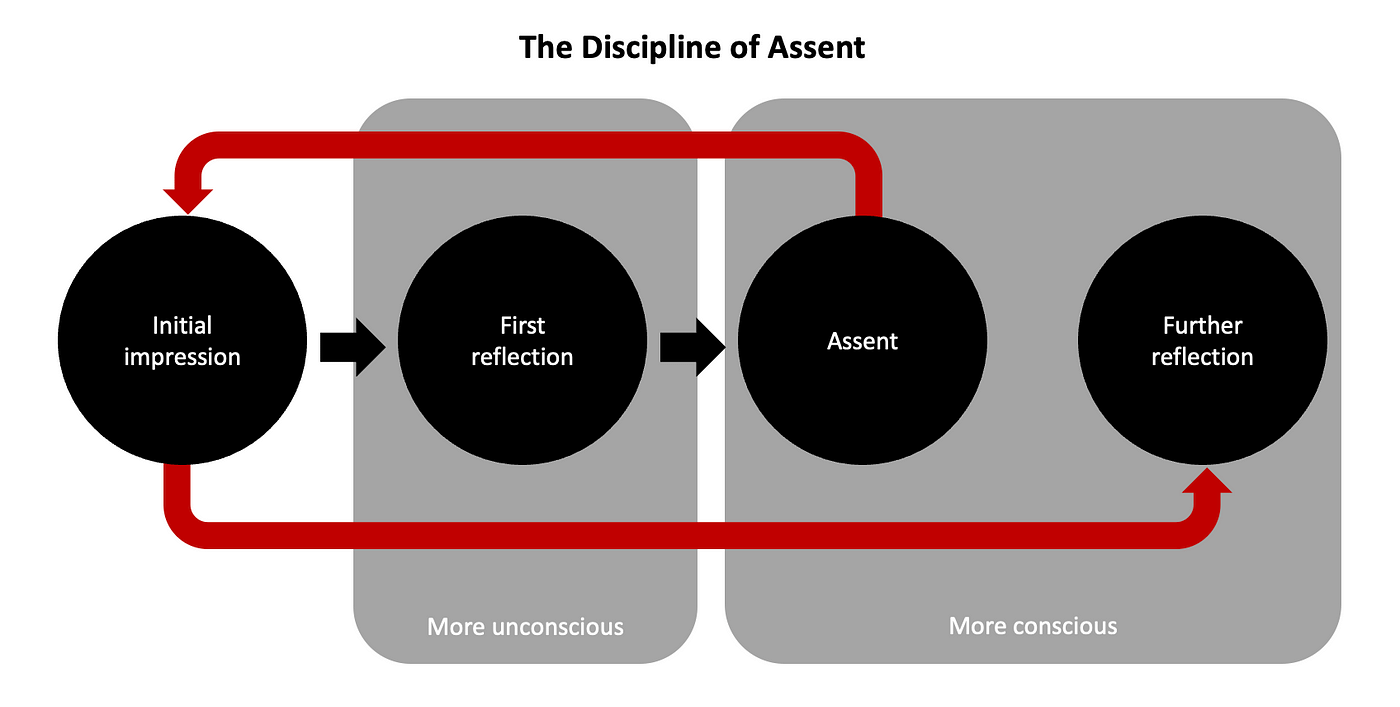
To prepare for your reflection, take a few minutes to probe your own experience using the concepts we've just covered. Ask yourself these questions:
- The Role: Drawing on Sartre's waiter, what "roles" do you play in your life (e.g., The Good Student, The Supportive Friend, The Responsible One)? Where might you be "playing" the role so perfectly that you've forgotten the person behind it?
- The Excuse: Where in your life do you use the phrases "I have to..." or "I can't..."? Challenge these. Are they objective truths, or are they ways to avoid making a difficult choice? (e.g., "I have to please my family" vs. "I am choosing to prioritize my family's desires over my own right now because I fear their disapproval.")
- The Fear: What is the underlying fear that these roles and excuses protect you from? Is it the fear of failure? Of being judged? Of being alone? Of meaninglessness?
- The Gap: In a separate article, "Lying to Others, Lying to Ourselves," the author suggests we "track the gap" between what we say and what we do. Where does such a gap exist in your life? The truth you are avoiding often resides there.
Test your understanding!
A person consistently tells themselves, "I'm just too introverted and shy to speak up in meetings, that's just how I am." How would you analyze this statement using the concepts of 'facticity/transcendence' and 'bad faith'?
Show answer
This statement is a classic example of living in bad faith.
- Denying Transcendence: The person is treating their "introversion" and "shyness" as fixed, unchangeable parts of their being (their facticity). They are saying, "I am an object called 'shy person,' and shy people do not speak in meetings."
- Avoiding Freedom: By doing this, they deny their transcendence—their freedom to choose to act differently. They are free to prepare a point beforehand, to challenge themselves to speak just once, or to decide that the risk of speaking is worth it.
- Serving Fear: This thinking serves a fear—perhaps the fear of being judged, of saying something stupid, or of failing to be persuasive. The label "I'm just shy" becomes a convenient and believable story that allows them to avoid confronting this fear and the responsibility of choosing to be brave.
4. Your Reflection: The Central Question
You are now prepared to tackle this module's final writing task. Spend at least 30-45 minutes on this reflection. The goal is not to judge yourself, but to bring a difficult pattern into the light with clarity and honesty.
Central Question: Where does my thinking serve my fears rather than the truth?
To guide your writing, structure your reflection as follows:
- Identify an Area: Choose one specific and concrete area of your life where you suspect your thinking is dishonest. (This could be your career aspirations, a specific relationship, your self-image, your health, etc.)
- Describe the Narrative: Write down the story you tell yourself in this area. What are the key thoughts, beliefs, and rationalizations? What "role" are you playing?
- Uncover the Fear: What is this narrative protecting you from? Name the fear as clearly as you can. What painful truth or difficult responsibility are you avoiding?
- Glimpse the Truth: What might the situation look like if you were not afraid? What would be the "truth" of the matter? What choices would you see that you currently pretend you don't have?
This is a courageous act of self-inquiry. Be patient and compassionate with yourself as you write.
Conclusion
In this lesson, we have delved into the complex topic of self-deception. You have learned to identify it not just as a series of cognitive errors, but as a deep-seated strategy for avoiding fear and the anxiety of freedom, a state the existentialists call "bad faith." By bringing these patterns to light, you are no longer a victim of them; you are an observer who can begin to make new choices.
Key Takeaways:
- Self-deception is a psychological mechanism to protect the self from painful truths and the fears associated with them.
- Sartre's concept of "bad faith" describes how we lie to ourselves about our own freedom to avoid the responsibility that comes with it.
- We often do this by over-identifying with our roles and circumstances ("facticity") and ignoring our capacity for choice and change ("transcendence").
- Recognizing where our thinking serves fear is the first step toward living more authentically and freely.
Preview of the Next Lesson:
Confronting hard truths can, and often does, bring up difficult emotions. It is not enough to simply see the truth with our minds; we must also learn to handle the emotional fallout. In our next lesson, we will begin Module 6, "The Practice of Emotional Resilience," by exploring the crucial difference between suppressing emotions and metabolizing them. This will equip you with the tools to process the feelings that arise when you stop lying to yourself and start living more truthfully.