Hello! Welcome back to your study of Stoic Foundations.
In our last lesson, we established the theoretical groundwork for Stoicism by exploring its most fundamental principle: the dichotomy of control. We clarified the distinction between what is truly 'up to us'—our judgments, intentions, and choices—and what is not. You learned that much of our anxiety stems from trying to control the uncontrollable, or from neglecting to take ownership of what is ours to manage.
Today, we move from theory to practice. An idea is only as valuable as its application. Your goal for this lesson is to learn a systematic method for applying the dichotomy of control to a current source of personal distress. This isn't about making problems disappear; it's about fundamentally changing your relationship to them, reclaiming your mental energy, and finding a measure of peace even when external circumstances are challenging.
The Anatomy of Worry
Before we dive into the "how," let's briefly touch upon the "why." Why do we instinctively pour so much energy into things we cannot control? The short answer is fear. We believe that by worrying, planning, and mentally rehearsing every possible negative outcome, we are somehow protecting ourselves. But as the Stoics observed, this is an illusion that drains our energy and creates more suffering inside us than the external events themselves.
This video explores the reasons we cling to the illusion of control and clearly restates the domains we should focus on.
How to Focus on What You Can Control - STOIC PHILOSOPHY
The video 'How to Focus on What You Can Control' explains the psychological pull of trying to manage the unmanageable and provides a simple, direct reminder of where our true power lies.
Watch the following two clips: 02:08 - 04:11: This section explores why we try to control the uncontrollable, linking it to fear and the exhaustion that results. Notice how it describes worry as 'fear dressed up as strategy.' 08:29 - 09:28: This part provides a very clear, concise list of what is in your domain (thoughts, choices, response) versus what is not (the weather, the past, others' actions).
This futile focus on the external isn't just tiring; it's the engine of anxiety. The Roman Stoic Seneca wrote about how our minds create "false shapes of evil," tormenting us with things that haven't happened and likely never will. This is a crucial insight: much of our distress isn't caused by reality, but by the speculative fictions we create about it. Engaging with these fictions is a choice.
The Core Practice: The Control Inventory
Now, let's get practical. The most direct way to apply the dichotomy of control is through a structured writing exercise. Think of it as a mental audit. By externalizing your thoughts on paper, as we practiced in the first module, you can examine them with clarity and detachment.
The exercise is simple. You will take a current source of distress, and, like an accountant, sort every aspect of it into two columns: "Not Up to Me" and "Up to Me."
The article "5 Stoic Exercises for Managing Anxiety" offers a clear, actionable guide for this practice.
5 Stoic Exercises for Managing Anxiety
This article provides a very straightforward exercise called 'The Dichotomy of Control Inventory.' We will use this as our primary tool for this lesson.
Read the section titled '2. The Dichotomy of Control Inventory: Breaking Free from Anxiety's Grip'. Pay close attention to the simple two-step process and the example provided about a work presentation. This is the exact exercise you will be doing.
A Step-by-Step Guide for Your Journal
Now, it's your turn. Open your journal and prepare to work through a current problem. This could be anything that is causing you anxiety, frustration, or worry—a difficult relationship, a looming deadline, a health concern, or a financial stressor.
Follow these steps, which expand on the exercise above:
-
Identify the Situation: Write down a clear, objective sentence describing the situation causing you distress. (e.g., "I had a disagreement with a family member, and now they are not speaking to me.")
-
Draw Two Columns: Label the left column "Not Up to Me" and the right column "Up to Me."
-
Populate the Columns: Brainstorm every aspect of the situation and place it in the appropriate column. Be ruthlessly honest.
- In the "Not Up to Me" column, list things like: other people's feelings, their reactions, their opinions, the final outcome of the situation, past events.
- In the "Up to Me" column, list things like: my intentions, my actions from this moment forward, the effort I put in, my judgments about the situation, how I speak to myself, my choice to be patient.
-
Accept and Release: Read through the "Not Up to Me" column. For each item, consciously tell yourself, "This is not my concern," or "I release this." This is an act of acceptance, not of defeat. You are acknowledging reality.
-
Focus and Act: Now, look only at the "Up to Me" column. This is your entire sphere of action. This is where your power lies. Choose one single, concrete action from this list that you can take, no matter how small. (e.g., "I will focus on my own work for the next hour," or "I will write down what I want to say clearly and kindly, without trying to control their response.")
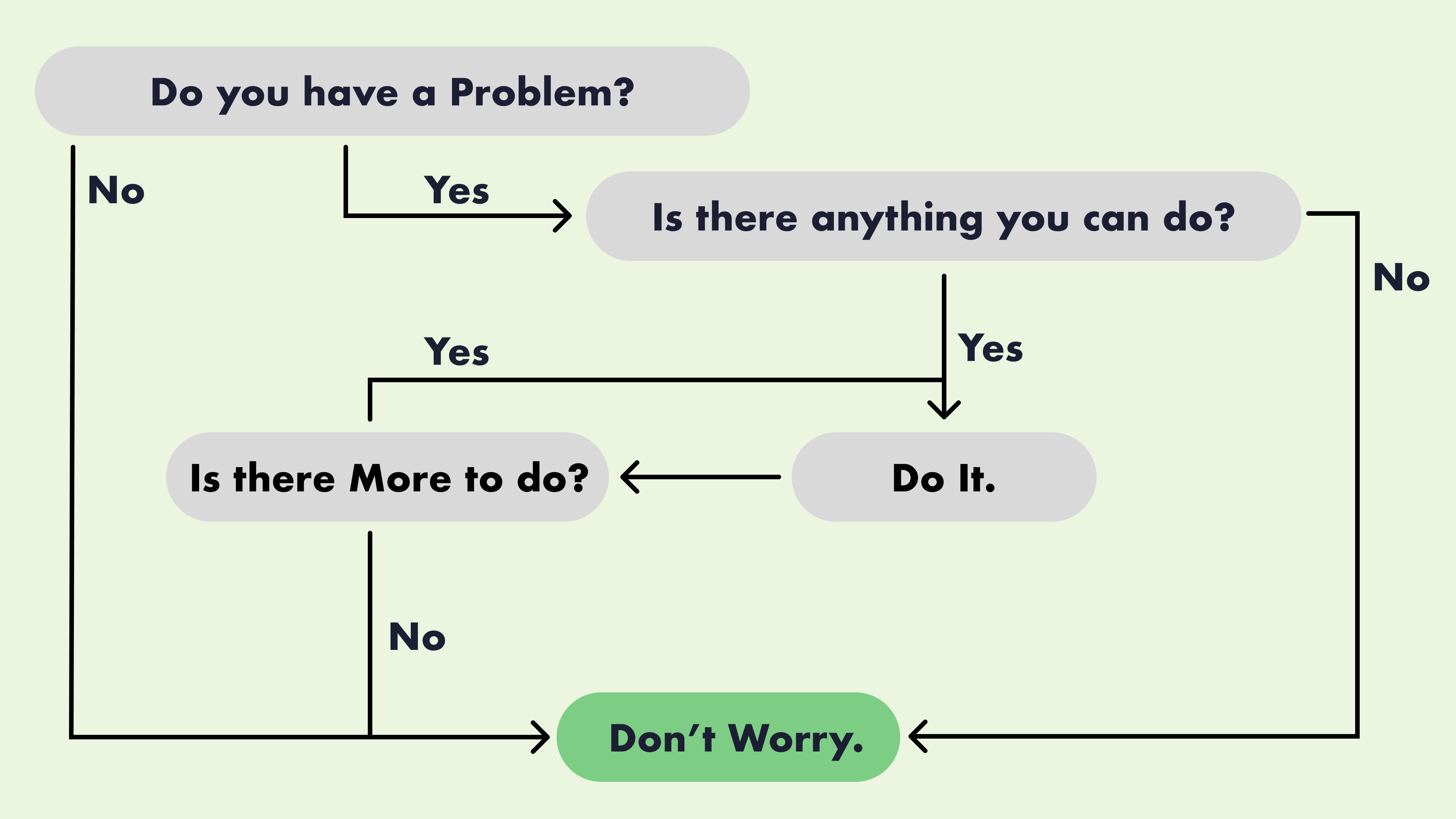
This entire process is captured brilliantly in the following flowchart. It is the logic of Stoic action.
Test your understanding!
Imagine you are anxious about an upcoming exam. You studied, but you're worried you will fail. Using the two-column inventory method, what are two things that would go in the "Not Up to Me" column, and two things that would go in the "Up to Me" column? What is one concrete action you could take based on your "Up to Me" list?
Show answer
-
Not Up to Me:
- The specific questions that will be on the exam.
- The final grade the professor gives me.
- Whether I feel nervous on the day of the exam.
-
Up to Me:
- How I schedule my review sessions today.
- Getting a good night's sleep before the exam.
- My judgment about the feeling of nervousness (seeing it as energy vs. a sign of failure).
-
Concrete Action: "I will spend the next 45 minutes reviewing Chapter 3, and then I will take a 15-minute break away from my desk." This action is specific, immediate, and entirely within your control.
From Analysis to Real-Time Action
The Control Inventory is an excellent tool for deep analysis, but life doesn't always give you time to sit down with a journal. The ultimate goal is to integrate this principle into your moment-to-moment experience.
The key is to create what Carl Jung called a "space between stimulus and response." In that space lies your power to choose. When you feel a surge of anxiety or anger, the practice is to pause, even for a single breath, before you react.
This video segment explains how this "inner pause button" works and why it is the foundation of freedom.
How to Focus on What You Can Control - STOIC PHILOSOPHY
This clip from 'How to Focus on What You Can Control' beautifully describes the 'space' where we can choose to respond intentionally rather than react automatically.
Watch from 28:13 to 30:41. Listen for the distinction between reacting (fast, emotional, automatic) and responding (slower, intentional, deliberate). This 'space' is where you apply the dichotomy of control in real-time.
In that moment of pause, you ask the simple question: "Is this up to me?"
- If the answer is no (e.g., someone's rude comment, a traffic jam), then your job is to recognize that the event itself is neutral. Your suffering comes from your judgment about the event.
- If the answer is yes (e.g., your own angry impulse, your procrastination), then your job is to take responsibility and act virtuously.
This idea is powerfully illustrated by a story about two scouts sent to observe the enemy.
Don't Worry, Everything is Out of Control | Stoic Antidotes to Worry
The video 'Don't Worry, Everything is Out of Control' uses an anecdote from Epictetus to show how two people can face the exact same external reality but experience it in completely different ways based on their internal judgments.
Watch from 05:32 to 07:57. Notice how both scouts see the same things (death, poverty), but one labels them 'terrible' and panics, while the other sees them as neutral and remains at peace. The external events are not in their control, but their judgment of those events is.
Conclusion
Today you have moved from knowing a concept to using it as a tool. The dichotomy of control is not a passive philosophy of resignation; it is an active practice of sorting reality, conserving your energy, and directing your power where it matters most. By consistently practicing the Control Inventory and the "Stoic Pause," you stop being a victim of circumstance and become the author of your responses.
Key Takeaways:
- Applying the dichotomy of control is a practical, systematic process.
- The "Control Inventory" is a writing exercise to separate a distressing situation into what is "Up to Me" and "Not Up to Me."
- The goal is to accept and release what is not up to you, and to focus your energy on taking concrete action on what is.
- In real-time, this practice takes the form of a "pause" between stimulus and response, where you can consciously choose your judgment.
Preview of the Next Lesson:
This lesson has set the stage perfectly for our next topic. We saw repeatedly today that while external events are not up to us, our judgments about them are. In the next lesson, we will explore this idea in depth, examining the Stoic view that our emotions are the direct products of our judgments, not the events themselves. This will give you an even more powerful lever for managing your inner world.