Introduction
In our last lesson, we constructed a comprehensive template for a hall pass agreement. We established the crucial sections—Intentions, Logistics, Health, and Communication—that transform the abstract idea of a hall pass into a concrete, mutually understood plan. Within that template, we identified two primary structures for the duration of the pass: time-limited and event-specific.
Today, we will focus on the learning outcome: to script the negotiation of time-limited versus event-specific hall pass arrangements. The choice between these two structures is not merely a logistical detail; it fundamentally shapes the emotional landscape of the experience for both you and your partner. It dictates the balance between spontaneity and predictability, freedom and control, and anticipation and anxiety.
This negotiation is a critical step in tailoring the hall pass experience to your unique relationship dynamic. By scripting this conversation, you can navigate the decision collaboratively, ensuring the chosen structure aligns with the comfort levels and desires of both partners.
Deconstructing the Two Structures: A Cost-Benefit Analysis
Before scripting the negotiation, it's essential to have a clear-eyed view of what each structure entails. Think of this as analyzing two different models, each with its own set of variables and potential outcomes. Your background in statistics may lead you to see this as a trade-off between different types of uncertainty and risk.
1. The Time-Limited Hall Pass
This structure grants permission for an encounter to occur within a defined period (e.g., over the next month, during the summer).
- Definition: A window of time during which the partner is free to act on an opportunity that meets the agreement's criteria.
- Pros:
- Flexibility & Spontaneity: It allows for a genuine connection to spark without the pressure of a specific deadline. The focus is on finding the right person and moment, not forcing an outcome.
- Reduced Performance Pressure: The partner using the pass doesn't feel like they have "one shot" to make something happen. If one opportunity doesn't pan out, another might arise.
- Cons:
- Prolonged Uncertainty: For the partner at home, this can create a lingering state of "what if?" The unknown timing can be a source of sustained, low-grade anxiety. The question isn't if, but when, which can be mentally taxing.
- Potential for Procrastination or "Analysis Paralysis": The wide window might lead the partner using the pass to overthink opportunities, waiting for a "perfect" scenario that may never come.
2. The Event-Specific Hall Pass
This structure ties permission to a discrete, pre-defined event (e.g., a work conference in another city, a solo vacation, a specific festival).
- Definition: A geographically and/or chronologically contained opportunity.
- Pros:
- High Predictability & Containment: Both partners know the exact window when the hall pass is active. This makes it easier for the partner at home to mentally prepare for and compartmentalize the experience. The anxiety, if any, is time-boxed.
- Clear Boundaries: The event itself provides a natural start and end point, leaving little room for ambiguity.
- Cons:
- High Performance Pressure: There is significant pressure on that single event to yield an opportunity. If nothing happens, it can lead to feelings of disappointment or even failure for the partner who had the pass.
- Lack of Flexibility: It relies on serendipity striking within a very rigid timeframe, which can feel contrived or forced. A genuine connection might arise the week before or after the event, but would fall outside the agreement.
| Feature | Time-Limited Pass | Event-Specific Pass |
|---|---|---|
| Primary Advantage | Flexibility & Spontaneity | Predictability & Control |
| Primary Challenge | Sustained anxiety from uncertainty | High pressure on a single event |
| Best For... | Couples comfortable with ambiguity, prioritizing authentic connection. | Couples new to the dynamic, prioritizing emotional safety and containment. |
| Analogy | A fishing license valid for a season. | A ticket to a specific concert. |
Scripting the Negotiation Conversation
The goal of this conversation is not to win a debate, but to collaboratively select the model that maximizes excitement while minimizing anxiety for both of you. This conversation should take place after you've generally agreed to the idea of a hall pass and are now working on the specifics, using the template from our previous lesson.
Here are scripted dialogues illustrating how you might navigate this choice.
Scenario Opener
This script starts the negotiation, framing it as a joint decision.
Partner A: "Okay, so we've got our agreement template ready. The next big piece is figuring out the 'when.' I've been thinking about the two options we talked about: tying it to a specific event, like my upcoming work trip, versus setting a general timeframe, like saying it's okay for one night sometime in the next two months. What feels better to you?"
Script 1: Advocating for Event-Specific (Prioritizing Security)
This script is useful if one partner anticipates feeling anxious and needs predictability.
Partner B: "Honestly, I think starting with the work trip might be easier for me. Knowing the exact dates—that it's only those three nights when you're in a different city—feels much more manageable. I can wrap my head around that. The idea of it being an open possibility for two whole months... I think my mind would be racing every time you went out with friends. This feels more contained, like we're running a very specific experiment."
Script 2: Advocating for Time-Limited (Prioritizing Spontaneity)
This script is for the partner who feels an event-specific pass is too high-pressure and wants the experience to feel more organic.
Partner A: "I completely understand wanting it to feel contained. My worry about tying it only to the trip is the pressure. It feels like I have to make something happen in that 72-hour window. What if I don't meet anyone I click with, or the moment just isn't right? It could end up feeling like a failure. Having a longer window, say a month, would let me act on a real connection if it happens naturally, rather than trying to force it. It would feel more authentic that way."
Script 3: Proposing a Compromise or Hybrid Model
Often, the best solution lies between the two extremes. These scripts offer ways to find that middle ground.
Compromise Option A: The "Trial Run"
Partner B: "Okay, I hear you about the pressure. How about this: let's use the work trip as our 'pilot program.' We'll do an event-specific pass for that. We can see how it goes, how we both feel during and after. If it goes well and we both feel good about it, then for the next time, we could feel more confident trying a time-limited pass. It lets us walk before we run."
Compromise Option B: The "Constrained Time-Limited" Pass
Partner A: "What if we try to get the best of both? We could do the one-month timeframe that I like, but we add a rule to give you the predictability you need. For example, the rule could be that I have to give you at least 48 hours' notice that I'm planning a night out where I might try to use the pass. That way, you're never caught completely off guard, but I still have the flexibility to wait for the right moment. It's not 'any time,' it's 'any time with notice.'"
Finalizing the Agreement
Once you've negotiated and settled on a structure, you formalize it by filling in that section of your agreement template. This act of writing it down confirms the decision and makes it real.
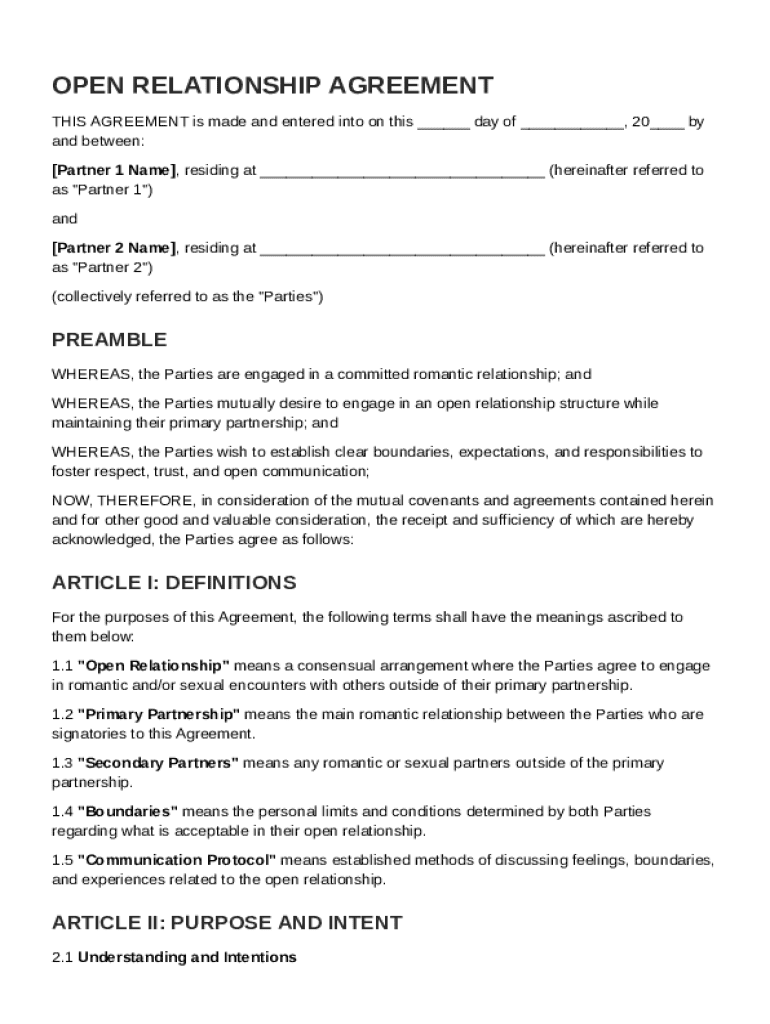
Using the template from our previous lesson, here is how the outcomes of the negotiation would look:
Outcome: Event-Specific
| Section | Agreement Point | Our Agreement |
|---|---|---|
| 2.1 Duration | Type (Time-limited/Event-specific), Start/End Dates. | Type: Event-specific Event: Annual Design Conference Dates: November 8-11 |
Outcome: Constrained Time-Limited
| Section | Agreement Point | Our Agreement |
|---|---|---|
| 2.1 Duration | Type (Time-limited/Event-specific), Start/End Dates. | Type: Time-limited Start Date: Oct 1 End Date: Nov 30 Special Condition: 48-hour notice required before a planned attempt. |
Conclusion
Today we've dissected the two primary hall pass structures—time-limited and event-specific—and scripted the crucial negotiation for choosing between them. This conversation is a profound exercise in balancing individual desires with mutual emotional safety.
Key Takeaways:
- Time-limited passes offer flexibility and spontaneity but can create prolonged anxiety due to uncertainty.
- Event-specific passes provide predictability and containment but can create intense pressure to "succeed" within a narrow window.
- The negotiation should be a collaborative process aimed at finding the structure that best fits your relationship's current risk tolerance and emotional needs.
- Compromise solutions, such as a "trial run" with an event-specific pass or adding a "notice period" to a time-limited pass, are powerful tools for finding a comfortable middle ground.
Next Lesson Preview:
With the 'when' and 'what' of your hall pass agreement now firmly established, the next logical step is preparing for the 'how.' In our next lesson, we will focus on the practicalities. Our learning outcome will be to create a step-by-step preparation checklist for the partner using the hall pass, covering everything from mental and emotional readiness to logistical planning.