Introduction
Welcome back. In our previous lesson, we focused on the delicate task of initiating a conversation about a hall pass arrangement. We developed scripts to open this dialogue in a way that fosters trust and collaboration, emphasizing that the immediate goal was simply to start talking, not to get a "yes."
Now that the topic is on the table, our next step is to move from the abstract concept to a concrete, workable agreement. Today's learning outcome is to define specific terms and conditions for a hall pass using a structured agreement template.
A well-defined agreement is the foundation of a successful and safe hall pass experience. It transforms a potentially ambiguous situation into a set of clear, mutually understood parameters. For this process to be effective, it must be a collaborative effort, turning potential anxieties into a shared project of building trust. Think of it as defining the rules of a game before you play, ensuring everyone knows the objectives and boundaries.
The Anatomy of a Hall Pass Agreement
A hall pass agreement is more than just a permission slip; it is a detailed document that outlines the who, what, where, when, and how of the arrangement. Creating this document together is a crucial act of care and communication.
To begin, let's look at a resource that, while legally framed, provides an exceptionally detailed and structured approach to defining sexual consent. We will adapt its granular framework for our purposes.
Free Sexual Consent (Contract) Form - PDF | Word - eForms
The resource 'Free Sexual Consent (Contract) Form' from eForms, though clinical, offers a fantastic checklist of items to consider. We will use its structure as a scaffold for building our own, more personal agreement.
Scan through the entire document to understand its structure. Pay close attention to the headings: 'II. Time,' 'III. Activities,' 'IV. Contraception,' and 'V. Ratchet Clause.' We will be dissecting these sections to build our template. Don't worry about the legalistic tone; focus on the categories of rules it presents.
Now, let's build our agreement template section by section. The idea is to create a document you can both review and fill out together.
Section 1: Intentions and Shared Goals
Before diving into rules, reaffirm the 'why'. This section sets the emotional tone and purpose of the agreement. It answers the question: "What positive outcome are we hoping this brings to our relationship?"
Questions to answer together:
- What is our primary goal with this arrangement? (e.g., exploring a fantasy, bringing new erotic energy back to the couple, celebrating one partner's desirability).
- What are our hopes? (e.g., to feel compersion, to have a fun story to share, to build trust through honesty).
- What are our fears? (e.g., jealousy, feeling disconnected, one person getting hurt). Acknowledging fears allows you to build rules specifically to mitigate them.
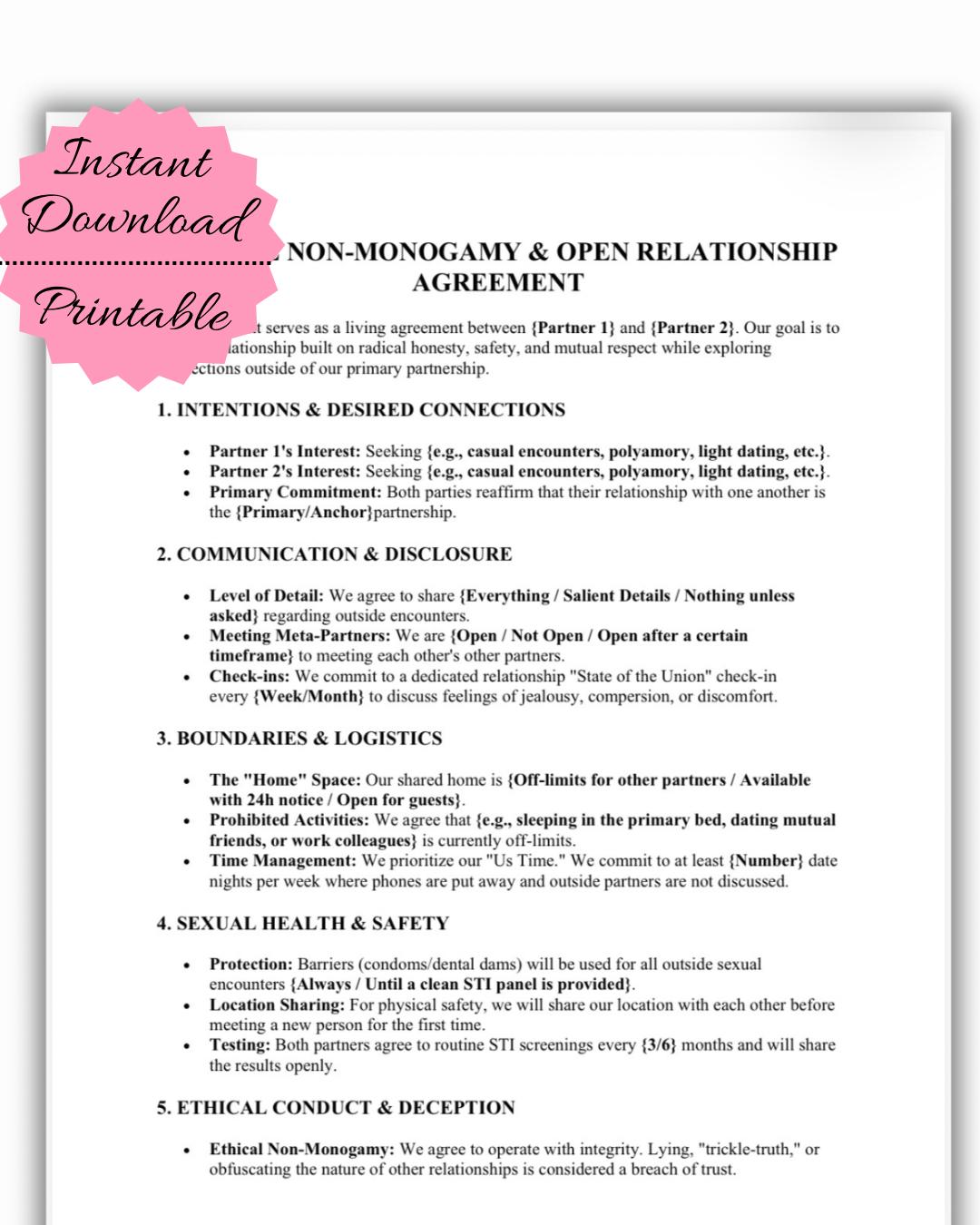
Section 2: Logistics and Scope (The "Hard Rules")
This is the core of the agreement, where you define the explicit parameters. Clarity here prevents misunderstandings later.
2.1: Type and Duration
This defines the 'when' and 'how long'. As the novelty "Hall Pass" card shows, an expiration date is a key feature.

Drawing from the "II. Time" section of the eForms resource, consider these options:
- Time-Limited Pass: The pass is valid for a specific period (e.g., "one night out within the next month").
- Start Date:
- Expiration Date:
- Event-Specific Pass: The pass is tied to a particular event (e.g., "during the upcoming work conference," "on the solo trip to another city").
- Event Name/Description:
- Date(s) of Event:
- Single-Use vs. Multiple: Is this for one encounter or multiple encounters within the defined period?
We will explore the nuances of negotiating these types in our next lesson. For now, the goal is to choose one and define it.
2.2: Allowed Activities
This is arguably the most critical section for ensuring emotional and physical safety. You must be explicit. The "III. Activities" section of the eForms document provides an excellent, if exhaustive, checklist. Use it as a menu to select from.
Activity Checklist (Initial together):
- Kissing:
- With/without tongue?
- Manual Stimulation (Giving/Receiving):
- Are any body parts off-limits?
- Oral Sex (Giving/Receiving):
- Is this permitted?
- Vaginal Intercourse:
- Yes/No?
- Anal Sex (Giving/Receiving):
- Yes/No?
- Use of Devices/Toys:
- Any specific toys that are okay or not okay?
- Photography/Video:
- Strictly forbidden, or allowed under certain conditions? (We will cover security protocols for this in a later module).
- Other Specific Activities:
- List any other hard 'yes' or hard 'no' activities here.
2.3: Partner Selection Criteria
Who is an acceptable partner for the hall pass?
- Relationship to the Couple: Stranger only? Acquaintance okay? Are mutual friends off-limits (highly recommended)?
- Vetting Process: Does the primary partner need to see a photo or have a brief bio of the potential person beforehand? Or is the choice left entirely to the person using the pass?
2.4: Location
- Where can the encounter take place? A hotel? The other person's home?
- Are there off-limits locations, such as the couple's home or car?
Section 3: Health and Safety Protocol
This section is non-negotiable and focuses on physical well-being.
- Safer Sex Practices (Contraception): As outlined in the eForms resource, be specific.
- Mandatory Practice: E.g., "Condoms must be used for all penetrative acts (oral, vaginal, anal)." or "Dental dams for oral sex."
- Responsibility: Who is responsible for providing the protection?
- STI Status Discussion:
- Requirement to discuss STI status and last test date with the third party.
- Substance Use:
- Are there limits on alcohol or drug consumption for the partner using the pass? This is crucial for ensuring they can adhere to the agreed-upon rules.
Section 4: Communication and Flexibility
This section governs the flow of information and what happens if circumstances change.
4.1: Communication Protocol
- During the Event: Are real-time text check-ins desired, required, or forbidden?
- Post-Event "The Debrief":
- Timing: When will the debrief happen (e.g., the next day, within 48 hours)?
- Level of Detail: What is the expected level of disclosure? "Just the highlights," "A play-by-play," or "I don't want to know any details"? This must be agreed upon beforehand.
4.2: The Flexibility Clause (The "Ratchet Clause")
The eForms resource provides an excellent framework for this. What happens if the mood is right and both people in the encounter want to do something not on the "Allowed Activities" list?
- Option 1: Strict Conditions. The agreement is absolute. No activities are permitted unless pre-approved in writing. (Safest for a first-time experience).
- Option 2: Verbal Consent for Escalation. The partner using the pass can agree to new activities in the moment, provided it's enthusiastic consent.
- Option 3: Real-Time Check-In. The partner must pause and text the primary partner for permission to deviate from the script.
4.3: The Veto
It should be explicitly stated that either partner in the primary couple can veto the entire hall pass arrangement at any point before the encounter happens, without penalty. This reinforces that consent is ongoing.
Putting It All Together: A Hall Pass Agreement Template
Here is a simplified template you can use as a starting point.
| Section | Agreement Point | Our Agreement |
|---|---|---|
| 1. Intentions | What is the shared goal for this experience? | e.g., To explore compersion and add excitement. |
| 2.1 Duration | Type (Time-limited/Event-specific), Start/End Dates. | |
| 2.2 Activities | What is explicitly allowed? (List from checklist) | |
| What is explicitly forbidden? | ||
| 2.3 Partner | Rules for who the third party can be. | e.g., No mutual friends or colleagues. |
| 2.4 Location | Where can the encounter happen? | e.g., Hotel or third party's home only. |
| 3. Health | Required safer sex practices. | e.g., Condoms mandatory for all penetration. |
| 4.1 Communication | Rules for check-ins and the post-encounter debrief. | e.g., No check-ins. Debrief next day, G-rated. |
| 4.2 Flexibility | How are deviations from the plan handled? (Strict/Verbal Consent) | e.g., Strict adherence to the plan. |
| 4.3 Veto | Either partner can cancel the plan at any time before it happens. | Agreed. |
To solidify this, let's briefly look at one more resource that reinforces the value of documenting these points.
10 Consent-First Ways to Invite Your Wife Into Cuckolding
The article '10 Consent-First Ways to Invite Your Wife Into Cuckolding' discusses creating written agreements as a way to enhance clarity and safety. This supports our work today.
Please read the subsections 'Create a Pilot Agreement' and 'Creating Consent Documentation'. Notice how these focus on clarity around what's included/excluded, duration, and safety measures—all elements we've built into our template.
The process of filling out this template is the negotiation. It forces a deliberate, thoughtful conversation about every facet of the experience, leaving as little as possible to assumption.
Conclusion
Today, we've moved the hall pass from a vague concept into a structured, actionable plan. By meticulously defining the terms and conditions, you create a framework of safety and trust that allows for more genuine and enjoyable exploration.
Key Takeaways:
- A hall pass agreement is a collaborative document that defines the parameters of the experience.
- The key sections of an agreement are: Intentions, Logistics (Duration, Activities, Partner, Location), Health & Safety, and Communication & Flexibility.
- Being extremely specific, especially regarding allowed activities and safer sex, is crucial for preventing misunderstandings and hurt feelings.
- The agreement should include clauses for flexibility (the "ratchet clause") and the universal right to veto, reinforcing ongoing consent.
Next Lesson Preview:
In this lesson, we noted that a hall pass can be either time-limited or event-specific. These two structures create different emotional and logistical dynamics. In our next lesson, we will script the negotiation of time-limited versus event-specific hall pass arrangements, doing a deep dive into the pros and cons of each to help you decide which is right for you.