Hello! Welcome to the final lesson in our module on the differences between startup and MNC equity.
So far, we've broken down the key distinctions:
- Risk & Reward: Startups offer a high-risk, high-reward gamble, while large public companies (MNCs) offer more predictable, lower-risk returns.
- Liquidity: Cashing out startup equity depends on uncertain events like an IPO or buyback. Cashing out MNC equity is as simple as selling shares on the stock market.
- Grant Type: Startups typically grant ESOPs (the option to buy shares), while MNCs grant RSUs (actual shares).
Today, we will bring all these concepts to life. We're moving from theory to reality. By the end of this lesson, you will be able to analyze case studies of employees from both a startup and an MNC, comparing their ESOP experiences and outcomes. We'll look at real stories of people who became wealthy and understand the very different paths they took.
Case Study 1: The Startup Employee's Journey – High Risk, High Reward
The path of a startup employee who gets rich from ESOPs is often a long and uncertain one. It involves betting on the company's future, enduring periods of doubt, and waiting for a specific event to turn paper wealth into real money.
To hear what this journey is really like, let's watch some clips from a video featuring employees from successful Indian startups like Swiggy, Flipkart, and Udaan.
How These Employees Became Rich? (ESOP)
This video from Wint Wealth features several employees sharing their personal stories about creating wealth through ESOPs in Indian startups. Listen closely to how they describe the growth of their options and the impact of liquidity events.
Please watch the video from the beginning until 02:34. Pay attention to: The massive growth in stock value one employee mentions (from ₹10,000 to ₹5-6 lakhs per stock). The employee who took a salary cut to join Udaan for more ESOPs. How they used the money from a liquidity event (buying a car, funding a house).
The Bet, The Grind, and The Payoff
As you saw in the video, the startup journey isn't a straight line to wealth. It follows a distinct pattern:
-
The Initial Bet: Employees often join at an early stage. Like the person who joined Udaan, they might even accept a lower salary in exchange for a larger number of stock options. They are betting that the future value of those options will be far greater than the salary they gave up.
-
The Grind (The "Zone of Frustration"): This is the long waiting period. For years, the ESOPs are just "paper wealth." The employee works hard to help the company grow, but there's no way to access the money. This can be a frustrating time, as it requires immense patience and belief in the company.
-
The Payoff (Liquidity Event): This is the moment everyone waits for.
- Buybacks: The company uses its own cash or money from new investors to "buy back" vested options from employees. This allows employees to get cash without the company going public.
- IPO (Initial Public Offering): The company lists on the stock market, and employees can eventually sell their shares to the public.
This is how employees at companies like Flipkart, Swiggy, and Zomato turned their paper wealth into real-life crores. The image below shows a list of ESOP buybacks that happened in just the first half of 2024, demonstrating how common this has become.

The Other Side of the Coin: When the Bet Fails
For every success story like Flipkart, there are many others where the paper wealth vanishes. This is the risk part of the "high-risk, high-reward" equation.
Why ESOPs are changing how Indians build wealth
This article from Dezerv provides a sobering look at the risks involved. It's crucial to understand this to have a balanced view.
Please read the section titled "Behind the windfall: risks and realities". Focus on the examples given (Byju's, Dunzo, Snapdeal) and the idea that "paper wealth can vanish faster than it is created."
As the article notes, if a company's valuation crashes or it fails to secure a liquidity event, the ESOPs can become worthless. This is the harsh reality that makes startup equity a true gamble.
Case Study 2: The MNC Employee's Journey – Low Risk, Steady Reward
Now let's look at the other path: an employee at a large, publicly-traded company (MNC). Their experience with equity is fundamentally different—it's less about a lottery ticket and more about a steady, predictable bonus.
The equity they receive is usually in the form of RSUs (Restricted Stock Units), not options. As a reminder, when RSUs vest, you get the actual shares for free.
Let's return to the same video and hear from an employee at NVIDIA, a global tech giant.
How These Employees Became Rich? (ESOP)
This next clip features an engineer from NVIDIA. Notice how he talks about his RSUs. The key difference is that the shares appear directly in his account, and he can sell them immediately.
Please watch the segment from 02:34 to 03:35. Pay attention to: How he describes RSUs as "direct stocks of the company" that come into his account. His story about selling his first batch of shares and later regretting it as the stock price grew 50x.
Predictability, Stability, and Compounding
The MNC employee's journey is much simpler and more predictable:
- The Grant: RSUs are granted as part of a competitive compensation package. There's no salary cut involved; it's a bonus on top.
- Vesting and Instant Liquidity: As the RSUs vest (e.g., every year), the shares are deposited into the employee's account. Because the company is publicly traded, the employee can sell those shares on the stock market the very same day if they choose. There is no waiting for a buyback or an IPO.
- The Outcome (Steady Growth): The wealth created is tied to the stock market performance of a large, stable company. While it's unlikely to grow 100x in a few years like a breakout startup, it can still lead to significant wealth through steady, compounding growth over a long period. The NVIDIA employee's story of a 50x return over 9 years is a powerful example of this.
Interestingly, while startup stories get more headlines, established public companies in India have created enormous wealth for their employees through equity.
Why ESOPs are changing how Indians build wealth
The same Dezerv article has a surprising insight about where most of the ESOP wealth in India actually is. This provides excellent context for the MNC experience.
Please read the section "Wealth creation at scale". Focus on the chart comparing the ESOP value in Nifty 100 companies versus late-stage startups. Notice the HDFC Bank example.
As you read, established giants like HDFC Bank and major IT firms have created far more total wealth through equity plans than startups have. It's just a quieter, more distributed process that doesn't make for dramatic headlines.
Head-to-Head: A Tale of Two Paths
Let's summarize the two journeys side-by-side. The following image from the treelife.in article we've seen before provides a perfect snapshot.
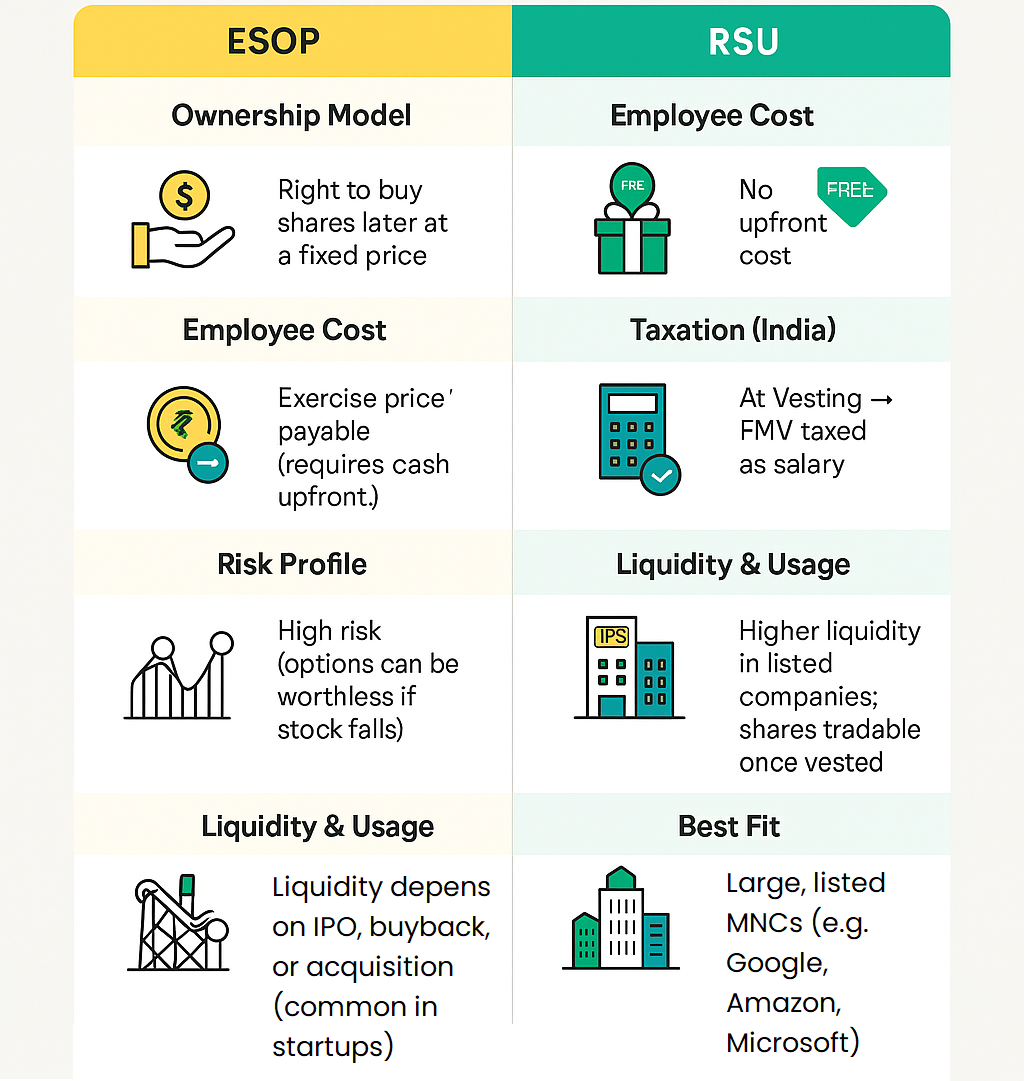
To bring it all together, here is a comparison based on the experiences we've analyzed:
| Feature | Startup Employee (e.g., Swiggy, Udaan) | MNC Employee (e.g., NVIDIA, Google) |
|---|---|---|
| Equity Type | ESOPs (Options to buy) | RSUs (Direct shares) |
| The "Feeling" | A high-stakes bet, a lottery ticket | A reliable, long-term investment |
| The Journey | Years of uncertainty, the "zone of frustration" | Predictable vesting and regular payouts |
| Path to Cash | Uncertain: Wait for an IPO or buyback | Certain: Sell shares on the stock market anytime after vesting |
| Risk Profile | High. Options could be worthless if the company fails. | Low. Shares always have value as long as the stock price is > 0. |
| Potential Outcome | Exponential. Can create life-changing wealth (crores). | Steady. Can create significant wealth through compounding. |
Test your understanding!
Anjali joined a startup 5 years ago, and her ESOPs are fully vested. The company is doing well, but she can't access any of the value.
Rohan joined a large MNC 5 years ago. Every year, he sells some of his vested shares to help pay for his family's vacation.
Based on what we've learned, what is the primary reason Anjali can't access her wealth while Rohan can?
Show answer
The primary reason is the difference in liquidity.
Anjali is at a private startup. Her ESOPs are "illiquid," meaning there is no public market to sell them on. She must wait for a specific "liquidity event," like a company buyback or an IPO, to convert her options into cash.
Rohan is at a publicly-traded MNC. His RSUs are "liquid." As soon as they vest, they become regular shares that he can sell on the stock market at any time, giving him immediate and predictable access to their cash value.
Conclusion
Key Takeaways
- Startup ESOPs offer a path to potentially massive, life-changing wealth, but it's a long, uncertain, and high-risk journey that requires immense patience. The stories from Swiggy and Udaan exemplify this path.
- MNC RSUs offer a lower-risk, more predictable path to wealth. It's a stable component of compensation that provides regular liquidity and grows steadily with the company's stock performance, as seen in the NVIDIA example.
- The choice between them is a personal one, depending on your risk tolerance, financial needs, and career goals. Neither is universally "better"—they are simply two very different philosophies of wealth creation.
Preview of the Next Lesson
We've now completed our high-level comparison of startup and MNC equity. In the next module, we'll start digging into the practical steps. Our next lesson will focus on the first critical action you must take with startup options: explaining what it means to 'exercise' your vested stock options. We'll cover what the process involves and why it's a crucial decision point in your ESOP journey.