Hello! Welcome to the first lesson in our module on exercising your options.
In our last session, we looked at case studies comparing the ESOP journeys of startup and MNC employees. We saw that for startup employees, wealth creation often involves a long, uncertain wait for a "liquidity event" like a buyback or an IPO. Until then, your ESOPs are just "paper wealth."
Today, we're going to zoom in on a critical step you must take to turn that paper wealth into a real asset you own: exercising your options. This is the bridge between having the right to buy shares and actually owning them.
By the end of this lesson, you will be able to explain exactly what it means to 'exercise' your vested stock options.
What Does 'Exercising' Mean?
Think of your vested stock options like a special discount coupon for a product you believe will become very valuable.
- The coupon is your stock option.
- The product is a share of your company.
- The fixed discount price on the coupon is your strike price.
"Exercising" is the act of using your coupon. You go to the company, hand over the coupon (your option), pay the fixed discount price (the strike price), and in return, you receive the product (the actual share).
Once you've done this, you are no longer just an option-holder; you are a shareholder.
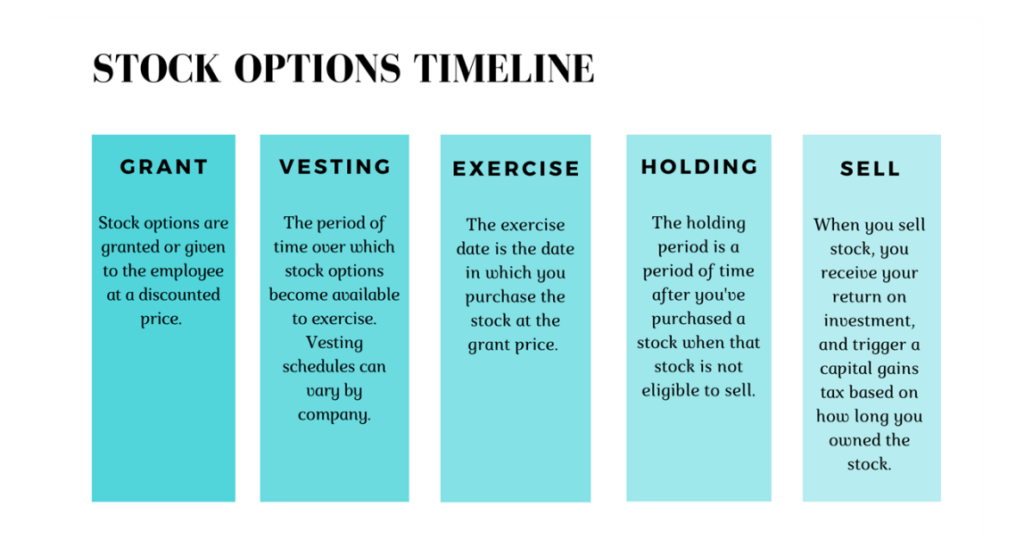
The image below shows where "Exercise" fits into the overall timeline of stock options. It's the step you take after your options have vested, turning them into stock you own.
The Mechanics of Exercising
To understand the core components, let's turn to a guide from Ledgy, a platform that helps companies manage equity.
This guide clearly defines what it means to exercise your options and the key terms involved.
Please read the section titled "Exercising share options". Focus on: The definition of 'exercising' and 'strike price'. The fact that you need to have cash on hand to exercise. The example calculation provided (e.g., 10,000 shares at a £1 strike price).
As the guide explains, exercising is a formal process. You don't just wake up one day as a shareholder. You have to take a specific action.
Based on the guide and standard practice, the process generally looks like this:
- Vesting Occurs: A portion of your options becomes available to you, as per your vesting schedule.
- You Decide to Exercise: You make the choice to buy some or all of your vested options.
- You Submit an Exercise Request: You formally notify your company that you want to exercise your options.
- You Pay the Exercise Price: You transfer the required funds to the company. The total amount is:
- Shares are Allotted: The company issues the shares in your name. You now officially own a piece of the company.
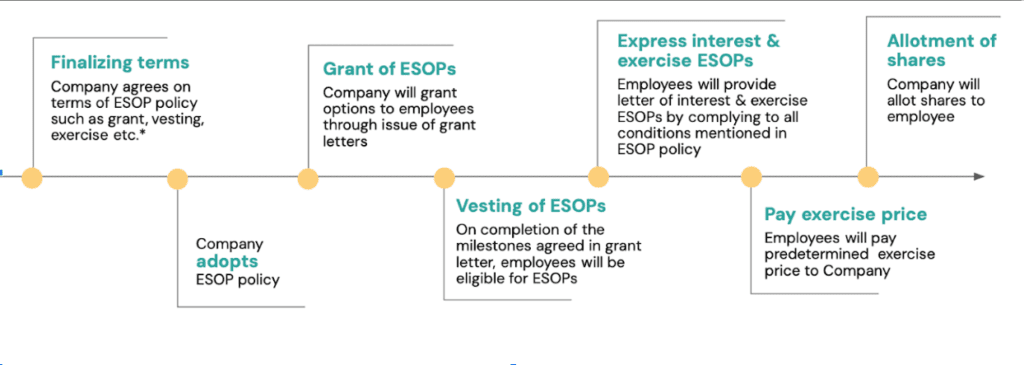
This flow is also nicely illustrated in the chart below from Treelife, an Indian consulting firm. Notice the step "Employee expresses interest & exercise their ESOP".
The Cost of Exercising: It's More Than Just the Strike Price
This is one of the most important and often misunderstood aspects of ESOPs. Exercising your options is not free. There are two main costs you need to be prepared for:
-
The Strike Price Payment: This is the money you pay directly to the company to buy the shares. If your strike price is ₹10 and you exercise 1,000 options, you must pay the company ₹10,000.
-
The Immediate Tax Bill: This is the part that surprises many people. In India, the moment you exercise your options, the government considers it a form of income, and you owe tax on it immediately. This is called a perquisite tax.
Why do you owe tax when you haven't received any cash? Because you received something of value. If your strike price was ₹10 but the share is now worth ₹500, you have a "paper gain" of ₹490 per share. The government taxes this gain as income.
The following video explains this crucial point very clearly.
ESOPs part 3 | Strike Price, Exercise Period, Taxation | Detail Explanation (India)
This video from Dezerv explains why you have to pay tax when you exercise, even though you don't receive any money at that stage. This is a critical concept for anyone with ESOPs in India.
Please watch from 00:30 to 01:05 and then from 03:03 to 04:02. Pay close attention to: The explanation that you must pay the strike price plus taxes. The concept that converting options to stocks is considered income, and why you have to pay tax even though it's just a "paper transfer of ownership."
The key takeaway is that exercising requires a significant cash outlay from your own pocket—first to pay the company, and second to pay the taxman. We'll dive deep into how to calculate this tax in a future lesson, but for now, it's essential to know that this cost exists.
Test your understanding!
Imagine you work for a startup and have 2,000 vested options. Your strike price is ₹50 per option. You decide to exercise all of them.
What is the minimum amount of money you must pay, and who do you pay it to? (For this question, ignore the tax component for a moment).
Show answer
You must pay a minimum of ₹1,00,000 directly to your company.
The calculation is: 2,000 options × ₹50 (strike price per option) = ₹1,00,000.
This payment is what converts your 2,000 options into 2,000 actual shares. Remember, on top of this, you would also have a separate tax liability.
Conclusion
Key Takeaways
- Exercising is the act of purchasing your vested stock options from your company at the pre-agreed strike price.
- This process transforms your options (the right to buy) into actual shares (ownership).
- It is an active choice, not an automatic event. You must formally request to exercise and arrange payment.
- Exercising is not free. It requires you to have enough cash to cover both the strike price payment to the company and the immediate perquisite tax liability to the government.
Preview of the Next Lesson
Now that you know what it means to exercise, the next logical question is when can you do it? Can you exercise anytime you want? What happens if you leave the company?
In our next lesson, we will explore this by identifying the different timeframes you might be able to exercise options, including the all-important "post-termination exercise window."