Hello! Welcome to the next lesson in our module on negotiation and strategy.
In our last session, we explored the critical trade-off between a higher salary and more equity. We established that salary provides immediate security, while equity offers the potential for long-term wealth.
Today, we're going to zoom in on the "equity" side of that equation. The goal of this lesson is to summarize the key advantages (pros) and disadvantages (cons) of ESOPs as a form of compensation. By the end, you'll have a balanced, clear-eyed view of what ESOPs truly represent—both the exciting opportunities and the serious risks. This will be your practical guide for weighing the equity portion of any job offer.
The Two Sides of the ESOP Coin
ESOPs can be life-changing, but they can also be a source of frustration and financial loss. It's crucial to understand both sides of the coin before you place your bets on them.
Let's start with a resource that provides an excellent, structured overview of both the good and the bad.
ESOP for Startups in India: Benefits, Legal Framework, ...
Please read the following sections from the Razorpay article 'ESOP for Startups in India'. It neatly lists the benefits for employees and the potential disadvantages.
First, read the section titled 'Benefits of ESOP for Employees'. Then, read the section 'Disadvantages of ESOPs for Startups', paying close attention to the final point, 'Vesting and Share Value Fluctuations', which directly impacts employees.
Now, let's break down these points in more detail, starting with the exciting part: the advantages.
The "Pros": Why ESOPs Are So Appealing
The primary reason employees get excited about ESOPs is the potential for a massive financial return.
1. Potential for Significant Wealth Creation
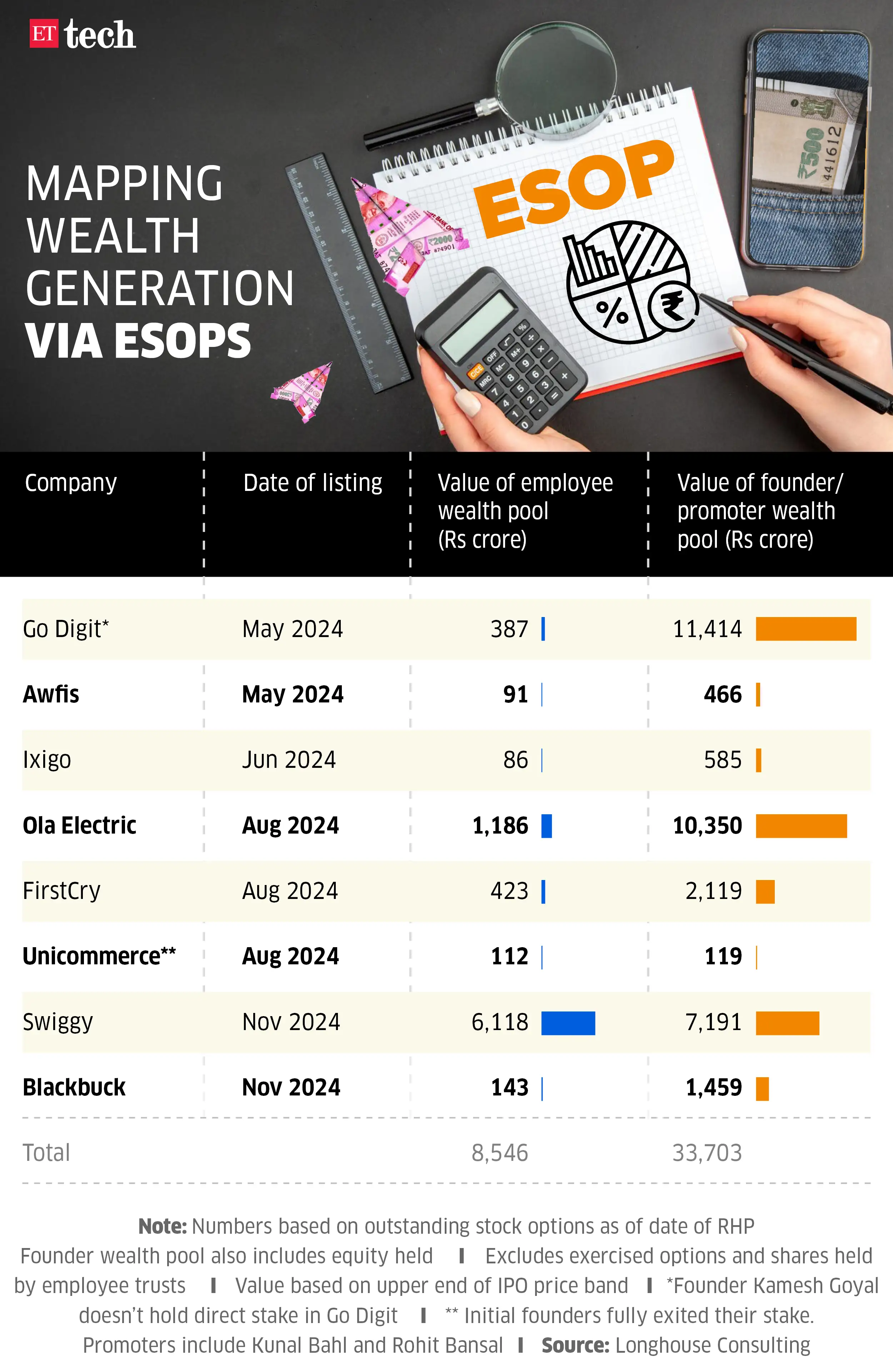
This is the number one advantage. If you join a startup that becomes successful, your ESOPs can become incredibly valuable. The difference between your strike price (the low price at which you can buy the shares) and the market price at a liquidity event (like an IPO or acquisition) can be enormous. This isn't just a bonus; it can be wealth-generating.
To see what this looks like in the real world, look at the wealth created for employees at several Indian companies that recently went public.
2. The "Owner" Mindset and Motivation
Beyond the money, ESOPs change your relationship with your work. As the Razorpay article noted, they provide non-financial benefits as well.
- Sense of Ownership: You're not just an employee working for a salary; you're a part-owner. This fosters a sense of pride and responsibility.
- Alignment of Interests: Your financial success becomes directly tied to the company's success. When the company wins, you win. This motivates you to think long-term and contribute to the company's growth, not just complete your daily tasks.
- Retention: Vesting schedules encourage you to stay with the company for the long haul to realize the full value of your grant. Companies offer ESOPs precisely to retain their best talent.
This "win-win" scenario is the fundamental idea behind ESOPs.
Everything you need to know about ESOPs
Let's watch a short clip that explains why founders are willing to give away precious shares. It perfectly summarizes the motivational power of ESOPs.
Watch the segment from 06:07 to 07:44. Notice how the speaker emphasizes that ESOPs are a way to make employees feel like owners and to retain good talent.
The "Cons": The Risks and Realities of ESOPs
Now for the other side of the coin. For every exciting advantage, there is a corresponding risk or disadvantage you must be aware of.
Let's watch another segment from the same video, which does an excellent job of breaking down the common problems.
Everything you need to know about ESOPs
This next clip outlines the major pitfalls associated with ESOPs. It's a realistic check on the hype.
Watch from 09:36 to 14:30. The speaker uses the pizza analogy to explain several key problems: the risk of shares becoming worthless, vesting, exercise costs, and taxes. Pay close attention to the tax explanation.
Let's summarize these crucial disadvantages, adding insights from our other resources.
1. High Risk of Becoming Worthless
This is the single biggest risk. Most startups fail. If your company shuts down or fails to secure a liquidity event (IPO or acquisition), your vested options are just "paper" with zero actual value. You must always treat ESOPs as a high-risk asset that could easily go to zero.
2. Illiquidity: The "Paper Wealth" Problem
Unlike a salary, you cannot spend your ESOPs. They are illiquid. Your options only turn into real money after a liquidity event. In the Indian startup ecosystem, these events can be rare and take many years to happen, if they happen at all.
Understanding the Benefits and Mechanics of ESOPs in ...
This is a major challenge in India. To understand why, please read the section 'Challenges with ESOPs in India' from the LinkedIn article by CA Mayank W.
Read the entire section. Focus on the points about 'Liquidity issues' and 'Taxation complexities'.
As the article notes, you could be waiting for many years with no way to cash in on your vested shares.
3. The Double Cost of Exercising (In India)
This is a critical point that many people miss. To convert your options into shares, you face two costs:
- Exercise Price: You must pay the company the pre-agreed strike price for every share you want to buy.
- Perquisite Tax: In India, the moment you exercise your options, the "paper gain" (Fair Market Value of the share minus your strike price) is treated as a benefit, or 'perquisite'. This amount is added to your salary income for the year and taxed at your income tax slab rate.
This means you have to pay a significant amount of tax in cash, upfront, even before you have sold the shares or made any actual money. This can be a huge financial burden and stops many employees from exercising their options.
4. Dilution
As we've discussed in previous modules, when a company raises new funding rounds, it issues new shares. This dilutes the ownership percentage of all existing shareholders, including you. Your 0.1% stake might become 0.08%, then 0.06%, and so on.
A Balanced Scorecard: Pros vs. Cons
To make it easy to remember, here is a summary table.
| Advantages (Pros) | Disadvantages (Cons) |
|---|---|
| High Potential for Wealth Creation if the company succeeds. | High Risk of Being Worthless if the company fails. |
| Sense of Ownership and feeling like a partner in the business. | Illiquidity; your shares are just "paper wealth" until a liquidity event. |
| Aligns Your Incentives with the company's long-term success. | Upfront Costs & Taxes; you must pay cash to exercise and pay perquisite tax. |
| Acts as a Retention Tool ("Golden Handcuffs") keeping you committed. | Vesting Schedules mean you can't leave without losing a portion of your grant. |
| Can serve as a significant long-term savings or retirement vehicle. | Dilution from future funding rounds reduces your ownership percentage over time. |
| Can improve job satisfaction and motivation. | Complexity in regulations and tax calculations can be confusing. |
Test your understanding!
An employee joins a startup and is granted 1,000 options with a strike price of ₹10. After four years, all options are vested. The company has done well, and the shares are now valued at ₹1,000 each. The employee decides to exercise all their options but does not sell the shares yet.
What are the two immediate financial costs the employee will face upon exercising?
Show answer
The employee will face two significant costs:
-
The Exercise Cost: They have to pay the company to buy the shares.
Cost = 1,000 shares * ₹10/share = ₹10,000. -
The Perquisite Tax: They have to pay income tax on the "paper gain" they've made.
Paper Gain per share = ₹1,000 (Fair Market Value) - ₹10 (Strike Price) = ₹990.
Total Paper Gain = 1,000 shares * ₹990/share = ₹9,90,000.
This ₹9.9 Lakhs will be added to their taxable income for the year. If they are in the 30% tax bracket, they will have to pay approximately ₹2,97,000 in tax, out of their own pocket, without having sold a single share.
Conclusion
You now have a clear, balanced overview of the pros and cons of ESOPs. They are not a simple bonus; they are a complex financial instrument with a high-risk, high-reward profile.
Key Takeaways:
- Pros: The main advantages are the potential for life-changing wealth and the powerful sense of ownership and motivation that comes from having a stake in your company's future.
- Cons: The main disadvantages are the very real risk of the equity being worthless, the lack of liquidity for many years, and the significant out-of-pocket costs (exercise price + perquisite tax) required to even claim your shares.
- A Double-Edged Sword: ESOPs should be viewed as a "double-edged sword." The potential for a huge reward is always balanced by significant risk and complexity.
What's Next?
In our previous lesson, we analyzed the strategic choice between salary and equity. In this lesson, we've broken down the pros and cons of that equity. Now it's time to see these concepts in action. In our next lesson, we will analyze case studies of successful and unsuccessful ESOP negotiations to learn practical tactics. This will help you apply everything you've learned to a real-world negotiation scenario.