Hello! Welcome to the final lesson in our module on ESOP negotiation and strategy.
In our last session, we dove into the practical tactics of negotiating an ESOP offer. We learned that the terms of a grant are often more important than the raw number of options and that asking the right questions about transparency is key.
Now that you've hypothetically negotiated the best possible deal, what's next? The work doesn't stop once you've signed the offer letter. Managing your equity is an ongoing process. This lesson is about the crucial 'housekeeping' you need to do to protect and understand the value you've earned.
Our learning goal is to describe best practices for documenting, tracking, and periodically reviewing your ESOP grants and vesting status. Think of this as learning good financial hygiene for your equity. By the end of this lesson, you'll have a clear system for keeping your ESOP information organized and up-to-date.
1. Your Equity Paper Trail: The Key Documents
When you are granted ESOPs, you will receive official documents that serve as the legal basis for your ownership. It's essential to get copies of these, read them, and store them safely. There are typically two main documents you need to be aware of.
ESOP Academy 7: Understanding Equity Plan Documentation
This article from Qapita explains the two core documents you'll receive. Understanding their purpose is the first step in managing your equity.
Read the section 'What ESOP documentation will you receive?'. Focus on the difference between the 'Plan Rules' and the 'grant letter'.
To summarize, think of it this way:
- The ESOP Scheme or Plan Rules: This is the "rulebook" for the entire company's ESOP program. It's a detailed legal document that applies to everyone. It covers general rules like eligibility, what happens when an employee leaves, and how major events like an IPO or acquisition are handled. You might not read every word, but you need to have it.
- The Grant Letter: This is your personal contract. It's a much shorter document that specifies the details of your grant. This is the document you'll refer to most often.
The grant letter contains the most critical information for day-to-day tracking. Here are the key terms you'll find, which are the puzzle pieces you need to assemble to see the full picture of your grant.
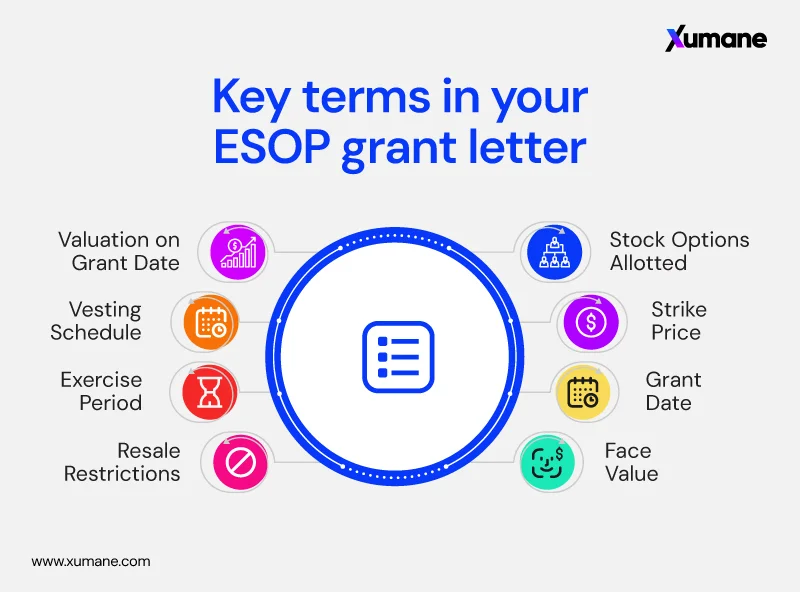
Let's quickly define these terms in simple language:
- Grant Date: The official date your options are granted to you. The vesting clock starts from this date (or a specified vesting start date).
- Stock Options Allotted: The total number of options you have been granted.
- Strike Price (or Exercise Price): The fixed price per share you will pay to buy the shares when you exercise your options.
- Vesting Schedule: The timeline over which you earn the right to your options. We discussed this in detail: it includes the total period (e.g., 4 years), the cliff (e.g., 1 year), and the frequency (e.g., monthly).
- Exercise Period: The window of time you have to exercise your vested options. Pay close attention to the Post-Termination Exercise Period (PTEP), which is the window you have after leaving the company.
- Valuation on Grant Date: The company's valuation at the time you receive your grant. This helps determine the Fair Market Value (FMV) of the shares on that day.
- Face Value: This is a nominal accounting value for a share (e.g., ₹1 or ₹10) and is generally not important for calculating your financial gain. The Market Value (FMV) is what truly matters.
- Resale Restrictions: Any rules that prevent you from selling your shares for a certain period, even after you've exercised them (e.g., a lock-in period after an IPO).
2. How to Read the Fine Print Without a Law Degree
Now you have the documents, but they are often filled with dense legal language. Trying to read the "Plan Rules" from start to finish can be overwhelming. Fortunately, you don't have to.
Since you have a background in development, you know the power of a good search function. We can apply the same logic here. Instead of reading every line, you can search for keywords to find the specific clauses that answer your questions.
ESOP Academy 7: Understanding Equity Plan Documentation
The same article from Qapita offers a brilliant and practical tip: use 'CTRL+F' (or 'Command+F') to find keywords in your ESOP documents. Let's look at the most important keywords to search for.
Scan through the numbered list of keywords starting from '1. 'Option', 'Right', 'Share'...'. You don't need to memorize all of them. Instead, focus on understanding the types of questions these keywords can help you answer. Pay special attention to terms related to vesting, leaving the company, and taxes.
Here is a simplified list of keywords, grouped by the questions they help answer. When you get your ESOP documents, you can use this as a checklist:
- To understand your vesting:
- Search for
Vest,Period,Condition. This will help you find the exact terms of your vesting schedule and any performance conditions attached.
- Search for
- To understand what happens if you leave:
- Search for
Cessation,Termination,Good Leaver,Bad Leaver. This is critical. It will tell you what happens to your vested and unvested options if you resign, are laid off, or are fired.
- Search for
- To understand your deadlines:
- Search for
ExpiryorExpire. This will tell you when your options become worthless if you don't exercise them. This is where you'll find the Post-Termination Exercise Period (PTEP).
- Search for
- To understand the financial implications:
- Search for
Tax,Withhold. This will explain your tax obligations and how the company handles them. (We'll cover Indian taxes in detail in a future module). - Search for
FMVorFair Market Value. This explains how the company determines the market price of the shares.
- Search for
- To understand what happens in an exit:
- Search for
Exit,IPO,Sale,Acquisition,Corporate action. These clauses will describe how your options are treated if the company goes public or is sold. Also look forAccelerateorAccelerationto find any clauses that speed up your vesting in an acquisition.
- Search for
This keyword-based approach empowers you to be your own first line of defense in understanding your equity.
3. Building Your Personal ESOP Tracker
Reading the documents is for understanding the rules. For managing your equity day-to-day, you need a single source of truth. The best way to do this is with a simple spreadsheet. This will be your personal dashboard for tracking what you own, what it's worth, and what you stand to gain.
Here is an example of what a comprehensive ESOP tracking spreadsheet can look like.
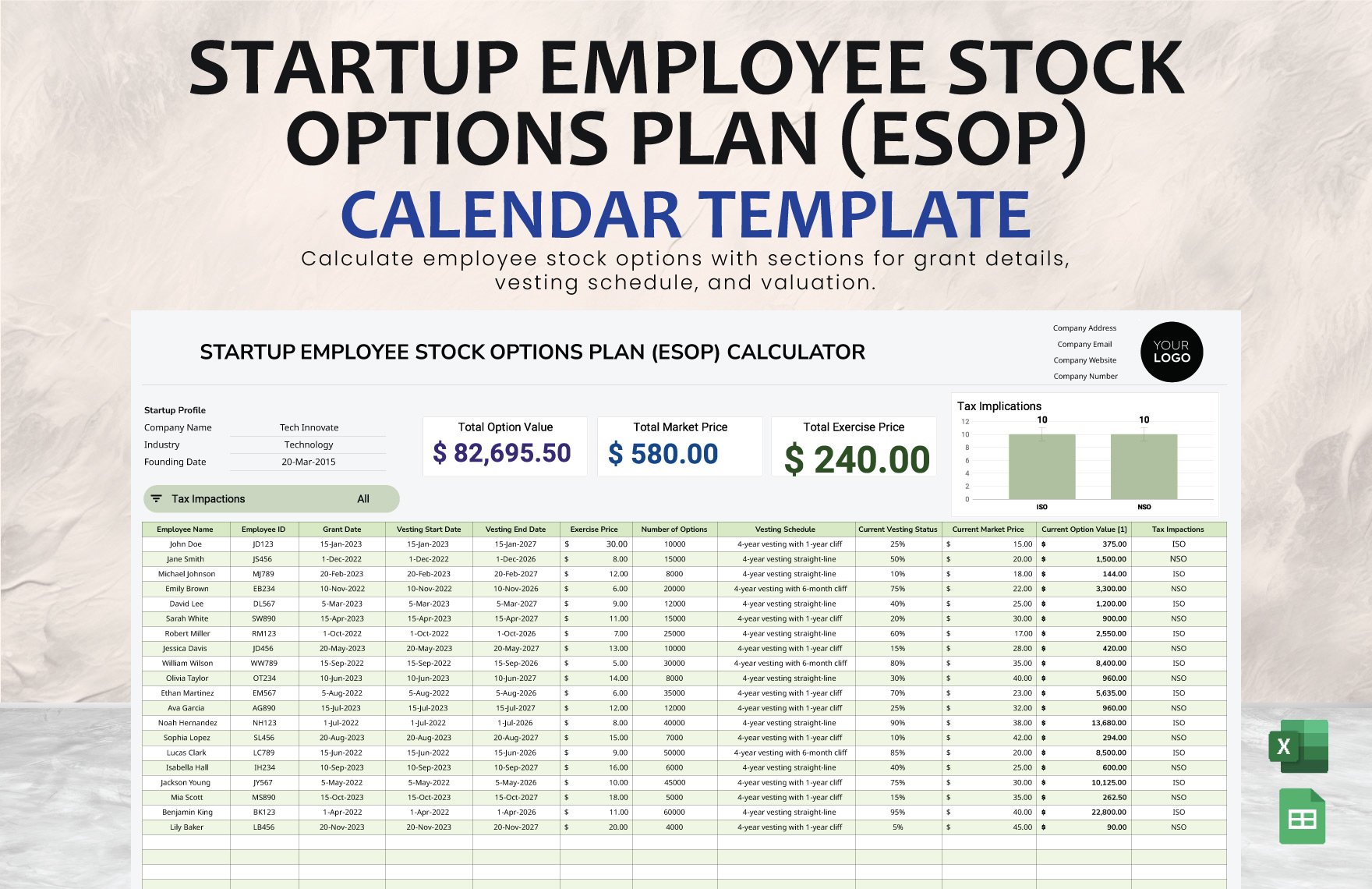
You don't need something this complex to start. You can build your own simple version. Here are the essential columns your tracker should have. You can create this in Google Sheets or Microsoft Excel.
| Grant ID | Grant Date | Total Options | Strike Price | Vesting Start | Cliff Date (1yr) | Vested Options | Unvested Options | Current FMV | Paper Value |
|---|---|---|---|---|---|---|---|---|---|
| Grant 1 | 01-Jan-23 | 4,800 | ₹50 | 01-Jan-23 | 01-Jan-24 | Calculated | Calculated | Update this | Calculated |
| Grant 2 | ... | ... | ... | ... | ... | ... | ... | ... | ... |
How to use this tracker:
- Fill in the Basics: For each grant you receive, create a new row. Fill in the Grant Date, Total Options, Strike Price, and Vesting Start Date directly from your Grant Letter.
- Calculate Key Dates: Your Cliff Date is usually one year after the Vesting Start Date.
- Calculate Your Vested Options: This is the most important calculation.
- If today's date is before the Cliff Date, this number is 0.
- If today's date is after the Cliff Date, you can calculate the number of months passed since the Vesting Start Date. For a standard 4-year (48-month) grant, the formula is:
(Total Options / 48) * (Number of months passed)
- Update Periodically:
- Current FMV: You'll need to get this from your company. It usually changes after a new funding round.
- Paper Value: This is your potential profit. The formula is:
Vested Options * (Current FMV - Strike Price)
This tracker transforms your ESOPs from an abstract number in a letter to a tangible asset that you can monitor.
Test your understanding!
Let's use the first row of our tracker as an example:
- Grant Date: January 1, 2023
- Total Options: 4,800
- Vesting: 4-year schedule with a 1-year cliff, and monthly vesting after the cliff.
It is now July 1, 2024. How many options have vested?
Show answer
- Check the cliff: The cliff date is January 1, 2024. Since it is now July 1, 2024, the cliff has passed.
- Calculate total months vested: From the start date (Jan 1, 2023) to today (July 1, 2024) is exactly 18 months.
- Calculate options per month: Total options (4,800) / total months (48) = 100 options per month.
- Calculate total vested options: 100 options/month * 18 months = 1,800 vested options.
Your tracker would show 1,800 vested options and 3,000 unvested options.
4. The Review Cycle: When and Why to Check In
Your ESOP tracker is not a "set it and forget it" document. You should review it at regular intervals and key moments in your career and the company's lifecycle.
Establish a Regular Review Cadence:
- Quarterly or Annually: Open your spreadsheet. Update the "Vested Options" number based on the current date. It can be motivating to see this number grow!
Review at Key Events:
- After a New Funding Round: This is a major trigger. The company will have a new valuation and a new Fair Market Value (FMV) per share. Ask HR or your manager for the updated FMV. Plug it into your tracker to see how your "Paper Value" has changed.
- When Receiving a New Grant: If you get a promotion or a performance-based "refresher" grant, add a new row to your tracker. Each grant has its own vesting schedule and strike price, so it's crucial to track them separately.
- When Considering Leaving the Company: This is the most critical review. Before you even think about resigning, open your tracker and review:
- How many options are fully vested?
- What is the total cost to exercise them? (
Vested Options * Strike Price) - What is the deadline to exercise them? (Check the PTEP in your Plan Rules!)
Conclusion
Congratulations on completing this module! We've journeyed from high-level strategy to the practical details of managing your equity. Today, you learned the essential "housekeeping" skills that every employee with stock options needs.
Key Takeaways:
- Know Your Documents: Your ownership is defined by the Plan Rules and your Grant Letter. Keep them safe.
- Be a Detective: Use a keyword search (
CTRL+F) to find the most important clauses in your legal documents without getting lost in the jargon. - Build a Tracker: A simple spreadsheet is the most powerful tool for tracking your vesting progress and the potential value of your equity.
- Review Regularly: Treat your ESOPs like any other important financial asset. Review your holdings periodically and especially at critical moments like funding rounds or when planning a career move.
What's Next?
Over the past ten lessons, we have built a solid foundation. We've covered business fundamentals, the mechanics of ESOPs, company growth, liquidity events, taxes, and negotiation.
You now have all the tools. In our final module, The Final Decision: A Personal Framework, we will bring everything together. We'll shift the focus inward and help you connect all this knowledge to your personal financial situation, your career goals, and your tolerance for risk. We will build a framework to help you confidently answer the ultimate question: "Is this ESOP offer right for me?"