In our last lesson, we focused on cultivating the "PMI mindset," emphasizing servant leadership, proactive planning, and tailoring as the intellectual framework for answering the PMP exam's situational questions. This mindset is your guide to choosing the best PMI-approved action in any given scenario.
Today, we will establish the foundational vocabulary that describes how work is structured within an organization according to PMI. Your goal is to differentiate between projects, programs, portfolios, and operations. While your extensive experience in construction has given you a deep, practical understanding of managing "projects," the PMP exam requires you to know and apply PMI's specific definitions and the hierarchical relationship between these concepts. Mastering this terminology is essential, as it forms the basis for understanding project selection, strategic alignment, and the role of the project manager.
The Building Blocks: Projects and Operations
All work performed in an organization can be categorized as either projects or operations. The distinction between these two is a fundamental concept for the PMP exam.
Projects are temporary endeavors undertaken to create a unique product, service, or result. The keywords here are temporary and unique. A project has a definite beginning and end, and its output is something new.
Operations, on the other hand, are the ongoing, repetitive activities that sustain the business. They don't have a defined end date and are focused on maintaining the current state of business.
The following video provides a crisp, exam-focused definition of a project.
Project vs Program vs Portfolio Management | Difference | Definition | PMBOK Guide | PMP | CAPM
This clip from PMbyPM offers the official PMI definition of a project, highlighting its key attributes.
Please watch the brief segment that defines a project, paying close attention to the two keywords emphasized.
Now, let's use a practical example to contrast this with operations.
This article from iZenBridge uses a simple pizza chain example to illustrate the different types of work. We'll start with its definition of operations.
Please read the section titled Operations: The Backbone of Value Delivery. Focus on how the described activities—like hiring staff and procuring ingredients—are continuous and essential for day-to-day business, unlike a project with a clear end goal.
As you can see, building a new restaurant would be a project (temporary, unique result), while the daily baking of pizzas, managing inventory, and staffing that restaurant are operations (ongoing, sustaining).
This table provides a clear visual summary of the key differences between operations, projects, and programs, which we will discuss next.
Grouping Related Work: Programs
When an organization needs to manage a group of related projects in a coordinated way, it creates a program. The goal of a program is to achieve benefits and control that would not be possible by managing the projects individually. The key concept here is synergy.
For example, launching a new line of energy-efficient buildings might be a program. This program could contain several related projects:
- A project to research and select new sustainable materials.
- A project to design the architectural blueprints.
- A project to train the construction crews on new building techniques.
- A project to run the marketing campaign for the new line.
Managing these as a program allows for coordinated scheduling, shared resources, and a unified focus on the strategic benefit of becoming a leader in green construction.
The following video explains the PMI definition of a program and provides an excellent example of a university striving to improve its ranking through a series of related projects.
Projects, Programs, Portfolios & Organizational Strategy | Full PMP Exam Prep Training Videos
This video from Edward Shehab provides a detailed definition of a program with clear, practical examples.
Watch the segment from the beginning until the end of the oil facility example. Pay close attention to how a program groups related projects to achieve a larger benefit (a KPI), which is different from a project's goal of delivering a specific output.
A quick note on a related term: mega-projects. In your field, you've likely encountered massive undertakings like building an airport or a major bridge. While these are huge, they are still considered single (mega) projects if they produce one primary deliverable. They are not automatically programs, although they may be managed using program management techniques due to their complexity.
The Strategic View: Portfolios
At the highest level of this hierarchy is the portfolio. A portfolio is a collection of projects, programs, sub-portfolios, and operations managed as a group to achieve strategic objectives.
The key difference between a program and a portfolio is the word related. The components of a program are related to achieve a common benefit. The components of a portfolio are linked only by their contribution to the organization's strategic goals. They may be otherwise unrelated.
For instance, a construction company's portfolio might include:
- A program to expand into residential construction.
- A standalone project to upgrade its internal IT systems.
- Another standalone project to build a new corporate headquarters.
- The ongoing operations of its commercial building division.
These items are not directly related to each other, but they have all been selected by the organization as the right work to invest in to achieve its strategic objectives (e.g., increase market share, improve efficiency, enhance corporate image). Portfolio management is about doing the right work.
Projects, Programs, Portfolios & Organizational Strategy | Full PMP Exam Prep Training Videos
The same video also provides a clear definition and purpose for portfolios.
First, watch the segment that defines portfolios, using the analogy of a collection of cars or real estate. Then, watch the final segment that details the purpose of portfolios, focusing on how they help an organization invest resources wisely and manage risk at a high level.
The Complete Hierarchy
Understanding how these elements fit together is crucial. Strategy is set at the organizational level. Portfolios are created to align with that strategy by selecting the right programs and projects. Programs group related projects to deliver benefits efficiently. Projects create the unique products, services, or results.
This diagram illustrates the typical hierarchical relationship.
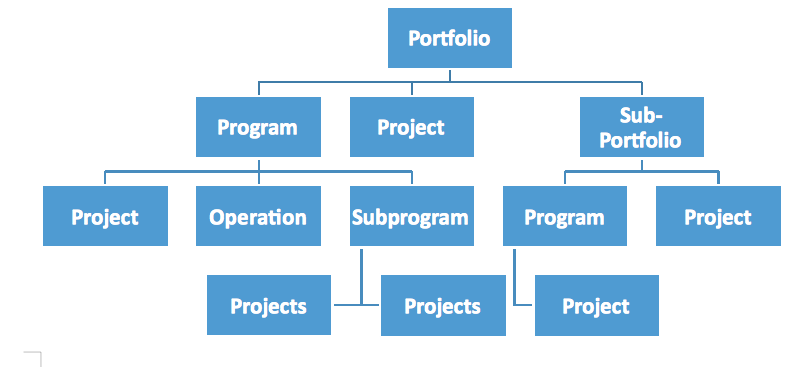
The following video provides an excellent visual explanation of this top-down planning and bottom-up execution flow.
Projects, Programs, Portfolios & Organizational Strategy | Full PMP Exam Prep Training Videos
This segment walks through a diagram very similar to the one above, showing how strategy cascades down and how project execution contributes back up to achieving that strategy.
Please watch the section explaining the structure and hierarchy. This is one of the most important concepts in this lesson, as it connects all the pieces.
To consolidate these concepts, let's use the pizza chain example from the iZenBridge article again, this time reading through the entire narrative.
This reading will tie all the concepts together using a single, coherent example.
Read through the remainder of the article, starting from the section "Portfolio Management". Observe how the company's strategy (diversifying) leads to a portfolio decision, which launches a program (automating orders), which consists of multiple projects (evaluating systems, piloting, training), and how the final result is handed over to operations.
Summary Table
This table summarizes the key differentiators you need to remember for the PMP exam.
| Criterion | Project | Program | Portfolio | Operations |
|---|---|---|---|---|
| Purpose | Deliver a unique product, service, or result. | Realize coordinated benefits from related projects. | Achieve strategic business objectives. | Sustain the business and generate revenue. |
| Scope | Defined, narrow, specific objectives. | Broad, encompassing multiple related projects. | Varies, contains all work aligned with strategy. | Repetitive, ongoing tasks. |
| Duration | Temporary (definite start and end). | Long-term, lasting as long as benefits are generated. | Can be indefinite, changes with strategy. | Ongoing, no end date. |
| Success Metric | Meeting project goals (scope, time, cost, quality). | Realization of planned program benefits. | Value, ROI, and strategic alignment. | Business performance and efficiency. |
| Management Focus | Managing tasks to complete the work. | Coordinating project interdependencies. | Selecting and prioritizing the "right" work. | Managing processes and resources. |
Conclusion
You have now learned the precise PMI definitions that differentiate projects, programs, portfolios, and operations. While these terms might be used more loosely in daily practice, their strict definitions are testable material for the PMP exam.
Here are the key takeaways:
- Projects are temporary and unique, creating change in an organization.
- Operations are ongoing and repetitive, sustaining the organization.
- Programs group related projects to achieve synergistic benefits. Success is measured by these benefits.
- Portfolios group projects, programs, and operations to achieve strategic objectives. Success is measured by overall portfolio performance and value.
- The hierarchy flows from Strategy -> Portfolio -> Program / Project -> Deliverable -> Operations.
In our next lesson, we will zoom in on the central figure in this structure: the project manager. We will define the role, responsibilities, and authority of a project manager according to PMI standards, setting the stage for understanding the specific processes they lead.