Welcome to your fifth lesson. In our previous session, we explored the PMI Code of Ethics, establishing the moral compass that guides a PMP-certified project manager. We focused on how the values of Responsibility, Respect, Fairness, and Honesty are not just abstract ideals but are directly tested through situational questions on the exam.
Today, we will build upon that ethical foundation to define the broader "PMI mindset." Success on the PMP exam hinges less on memorizing every input and output and more on your ability to consistently apply a specific way of thinking and acting. This lesson will distinguish the core principles of this mindset—servant leadership, proactive planning, and tailoring—from other project management approaches you may have encountered in your career. Mastering this mindset is arguably the single most important factor in passing the PMP exam.
Beyond Memorization: The PMP Exam's Focus on Mindset
The PMP exam has evolved significantly. A large majority of the questions are situational, placing you in a scenario and asking for the best course of action. There's often more than one "correct" answer, but only one that reflects the ideal PMI approach.
The following video from PMP expert Andrew Ramdayal provides an excellent introduction to why this mindset is so critical for the modern exam.
2021 PMP Exam, My Best Tip for Situational Questions
This video explains why the PMP exam is dominated by situational questions and how the shift towards Agile has made the servant leadership mindset more important than ever.
Watch the introductory segments where the instructor explains what a situational question is and then discusses the exam's evolution toward Agile and Hybrid approaches, which has elevated the importance of a specific leadership style.
As you just heard, the exam heavily emphasizes principles that originated in Agile but now apply across all project types, including the predictive and hybrid models. Let's break down the key pillars of this mindset.
Pillar 1: Servant Leadership
In your 15 years as an architect and contractor, you have likely experienced various leadership styles, some of which may have been very directive or "command-and-control." While that can be effective in certain construction contexts, the PMP exam champions a different model: servant leadership.
A servant leader's primary focus is not on directing and controlling, but on serving the team. The project manager's job is to empower team members, provide them with the resources they need, and remove any obstacles blocking their progress. You are a facilitator, a coach, and a protector of the team.
2021 PMP Exam, My Best Tip for Situational Questions
The same video provides a clear contrast between traditional and servant leadership and then lists the core principles.
First, watch the brief section contrasting the traditional "dictator" PM with the servant leader. Then, pay close attention as the instructor details the ten principles of servant leadership.
The ten principles of servant leadership are:
- Listening: Actively hearing and understanding the team.
- Empathy: Understanding and sharing the feelings of others.
- Healing: Helping team members overcome past negative experiences.
- Self-Awareness: Knowing your own strengths and weaknesses.
- Persuasion: Influencing without using authority; building consensus.
- Conceptualization: Envisioning the project's long-term goals.
- Foresight: Learning from the past to anticipate the future.
- Stewardship: Taking responsibility for the team and the project.
- Commitment to People Growth: Investing in the team's development.
- Building Community: Fostering a sense of trust and collaboration.
On the exam, when faced with a problem involving your team, always look for the answer that reflects these principles. The option that involves coaching, facilitating, or empowering the team is often the correct one.
The next video offers another perspective and a clear example.
Master the PMP Exam Mindset: 9 Key Principles for Success
This video from PM Aspirant reinforces the servant leadership concept with a practical example.
Watch the segment on servant leadership. Notice the example of how a servant leader would handle a struggling team member—by coaching and providing resources, not by taking over the task.
Pillar 2: The Proactive and Analytical Mindset
The PMI mindset is fundamentally proactive, not reactive. A PMP-certified project manager is expected to anticipate issues, analyze situations before acting, and take ownership of problems.
Assess Before Acting
When a problem arises on the exam, resist the urge to select the answer that represents immediate, decisive action. The PMI-approved approach is to first stop, gather data, analyze the situation, and then formulate a plan.
Be Proactive with Risks
This principle extends to risk management. You are expected to be constantly looking ahead, identifying potential threats and opportunities, and planning responses before they impact the project.
Be Solution-Oriented
When an issue occurs, the project manager owns it. The correct exam answer is rarely to escalate the problem to a manager or blame another department. Instead, it's to work with the team to find a solution.
The PM Aspirant video you just watched has several short segments that perfectly capture these ideas.
Master the PMP Exam Mindset: 9 Key Principles for Success
These clips from the "Master the PMP Exam Mindset" video illustrate the proactive, analytical approach valued by PMI.
Please watch these three short sections: Assess Before Acting: Emphasizes avoiding knee-jerk reactions. Proactive Risk Management: Focuses on prevention over reaction. The construction/weather example is particularly relevant. Solution-Oriented Mindset: Highlights taking ownership of problems rather than escalating.
Pillar 3: Tailoring the Approach
Perhaps one of the most significant shifts in PMI's philosophy is the emphasis on tailoring. There is no single "best" methodology. The project manager must intelligently select and adapt the project management approach, processes, and tools to fit the unique context of the project.
For someone with your background in construction, you're likely most familiar with the Predictive (or Waterfall) approach, where the scope, schedule, and cost are defined upfront. However, the PMP exam requires you to be fluent in Adaptive (Agile) and Hybrid approaches as well.
This first reading will define these core terms.
This resource from PastPaperHero clearly defines the different project management approaches you need to know for the exam.
In the article, please read the section defining the three main approaches: Predictive, Adaptive, and Hybrid.
The key is not just knowing these approaches, but knowing when and how to blend them. This is tailoring. You might use a predictive approach for the structural design and permitting phases of a construction project, but a more adaptive approach for finishing the interior spaces based on evolving client feedback.
This next reading explains the "why" and "how" of tailoring.
This section gets to the heart of the tailoring principle and gives practical examples.
Continue in the same article, reading the sections on Why Tailor, the Tailoring Process and its examples, and the crucial Exam Warning. Note the construction project example and the advice that tailoring should always be considered unless prohibited by contract or law.
The "Exam Warning" you just read is a golden rule for the PMP: always consider tailoring for the best fit. Blindly following a methodology without considering the project's context is a hallmark of an incorrect answer.
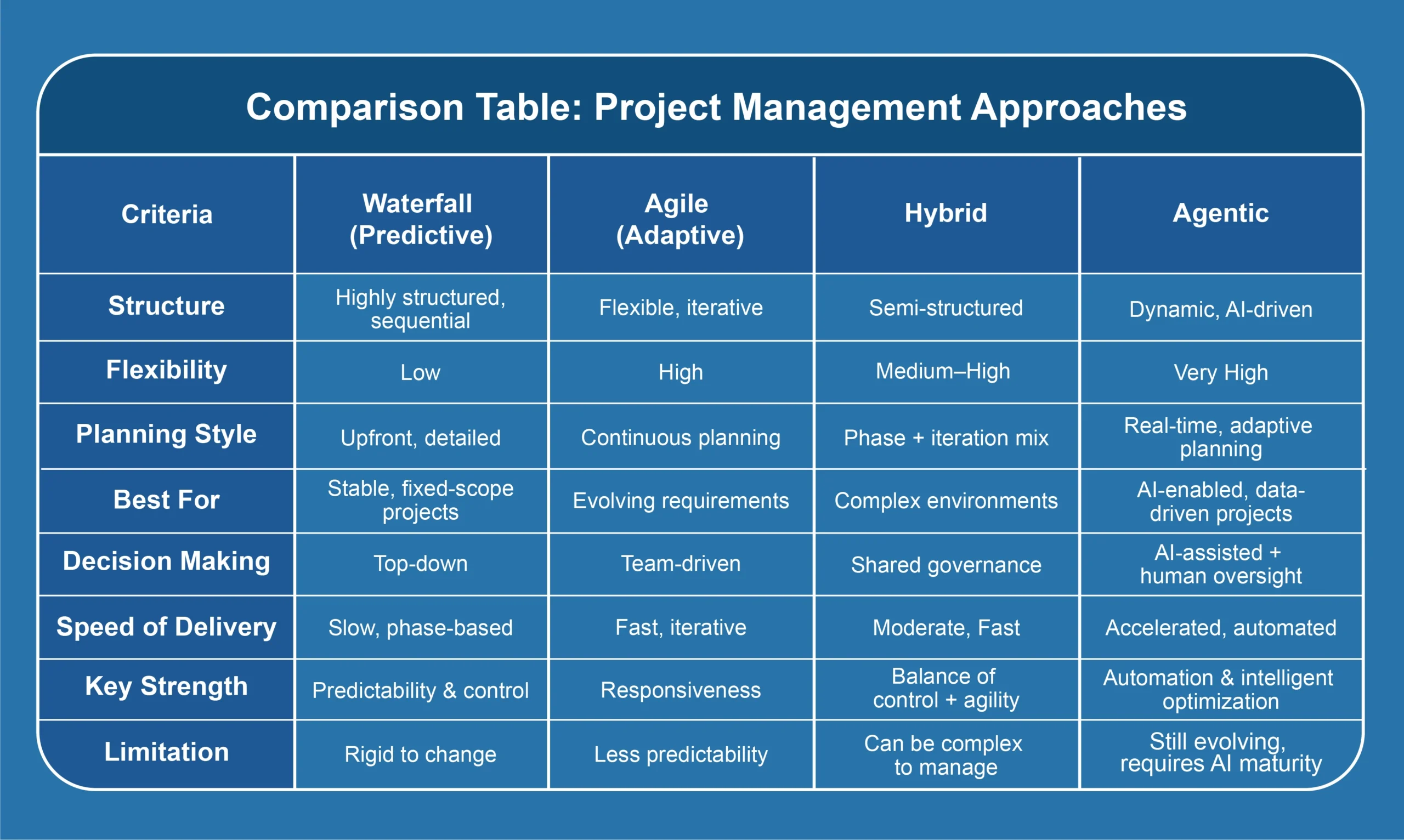
The following table provides a useful summary comparing different project management approaches across several criteria.
Conclusion
You've now covered the essential pillars of the "PMI mindset," the framework for professional judgment that the PMP exam is designed to test. It moves beyond rote memorization to a nuanced application of leadership and strategy. This way of thinking, combined with the Code of Ethics from our last lesson, should guide you as you analyze every situational question on the exam.
Here are the key takeaways:
- The PMI Mindset is Paramount: Your ability to think like a PMI-certified project manager is more important than memorizing facts. The correct exam answers consistently reflect this mindset.
- Embrace Servant Leadership: Your role is to empower, coach, and support your team. Choose options that reflect facilitation and collaboration over command and control.
- Be Proactive and Analytical: Always assess a situation and analyze data before you act. Anticipate risks and take ownership of solving problems within your team. Avoid reactive, hasty decisions or immediate escalation.
- Tailoring is a Core Principle: One size does not fit all. The best approach is one that is consciously adapted to the specific needs of your project, stakeholders, and organization.
In our next lesson, we will step back to define the fundamental components that projects operate within. We'll differentiate projects, programs, portfolios, and operations according to PMI's specific definitions, providing the foundational vocabulary for the rest of the course.