Welcome to your first lesson in calculus! This course is designed to build a strong foundation in single-variable calculus, following the structure of your textbook. We'll begin by exploring the concept that underpins all of calculus: the function.
In this lesson, you will learn to describe the four ways to represent a function: verbally, algebraically, graphically, and numerically. Understanding these four perspectives is fundamental because calculus is the study of change, and functions are the language we use to describe relationships where one quantity depends on another. Being able to move fluently between these representations will be an essential skill for modeling and solving the problems we'll encounter throughout this course.
What is a Function?
At its core, a function is a simple but powerful idea: it's a rule that takes an input and assigns to it exactly one output. In your IT studies, you might think of this like a well-defined algorithm or a script: for any given input, it predictably produces a single, specific result.
The set of all possible inputs is called the domain of the function, and the set of all possible outputs is called the range. We often use to denote the input, calling it the independent variable, and or to denote the output, calling it the dependent variable (since its value depends on ).

To get a more dynamic introduction to this concept, let's watch a segment from a lecture by Professor Leonard.
Calculus 1 Lecture 0.2: Introduction to Functions.
Watch the beginning of this video from Professor Leonard, "Calculus 1 Lecture 0.2: Introduction to Functions."
He provides a clear and intuitive definition of a function, emphasizing the crucial "one input, one output" rule. Please watch from the start until the main definition. Pay close attention to how he explains what makes a relationship a function.
The Four Ways to Represent a Function
Now that we have a working definition, let's explore the four standard ways to represent a functional relationship. Each method gives us a different perspective on the function's behavior. A key skill in calculus is not just understanding each representation, but being able to translate between them.
1.1 Four Ways to Represent a Function
This document provides a concise overview of the four representations.
Please read the section titled "Four Ways To Represent a Function". This will give you a clear framework for the four methods we're about to discuss in detail.
Let's now dive into each of the four methods.
1. Verbal Representation
A verbal representation describes a function using words. This is often how we first encounter a problem in the real world—as a story or a description of a situation.
For example:
"The temperature, , of a cup of coffee is a function of the time, , in minutes, since it was poured."
Here, the input is time () and the output is temperature (). The "rule" is implied by the physics of cooling.
A verbal description is powerful because it provides context, but it's usually not precise enough for mathematical computation. To see how we can move from a verbal description to another form, let's watch a quick example.
Calculus 1.1 Four Ways to Represent a Function
In the video "Calculus 1.1 Four Ways to Represent a Function," the presenter works through a great example of this.
Watch the segment where he translates a verbal description of water temperature into a graph. This is from this example. Notice how the story's details (starting at room temperature, getting hot, then running cold) dictate the shape of the graph.
2. Numerical Representation
A numerical representation uses a table of values to show specific input-output pairs. This is common in science and engineering, where you might collect data from an experiment. Each row or column in the table corresponds to an ordered pair .
For example, consider the cost of a mobile data plan:
| Data Used (GB), | Monthly Cost ($), |
|---|---|
| 1 | 30 |
| 2 | 30 |
| 5 | 45 |
| 10 | 60 |
| 20 | 60 |
From this table, we can see that for an input of 5 GB, the output is $45. We can write this using function notation as . Notice that an output can be repeated (e.g., $30), but each input has only one corresponding output.
1.1: Four Ways to Represent a Function
The Mathematics LibreTexts page on functions provides a more formal look at using tables.
Read the section on representing functions with tables and the later section on evaluating functions from tables. Focus on how to determine if a table represents a function and how to find input/output values from it.
3. Graphical Representation
A graphical representation visualizes a function by plotting its ordered pairs on a Cartesian coordinate plane. The graph provides a powerful, immediate sense of the function's "life history"—where it increases, decreases, its high and low points, and its overall shape.
The key to determining if a graph represents a function is the Vertical Line Test. If any vertical line intersects the graph more than once, then it is not a graph of a function. This is because a vertical line corresponds to a single input value , and if it hits the graph multiple times, that input has multiple outputs.
1.1: Four Ways to Represent a Function
Let's return to the LibreTexts resource to explore graphical representations.
Please read the sections on finding values from a graph and on the Vertical Line Test. The examples clearly illustrate how to read a graph and apply the test.
4. Algebraic Representation
An algebraic representation describes a function using an explicit formula or equation. This is the most concise and powerful representation for computation. For example, the function for the area of a circle is given by the formula , where is the radius.
When using formulas, we rely heavily on function notation, such as . This notation is more than just a substitute for ; it's a way to clearly name functions (e.g., , , ) and to indicate what input value is being used. For instance, is an unambiguous instruction: "evaluate the function at the input value of 3."
Calculus 1 Lecture 0.2: Introduction to Functions.
Let's revisit Professor Leonard's lecture, where he explains the benefits of function notation.
Watch the segment from this point. He explains why we use notation like f(x) instead of just y, and how it helps us keep track of inputs and outputs, which is especially useful when working with multiple functions at once.
All Together Now
The true power comes from seeing these four representations as different views of the same relationship. Let's look at a simple linear function through all four lenses.
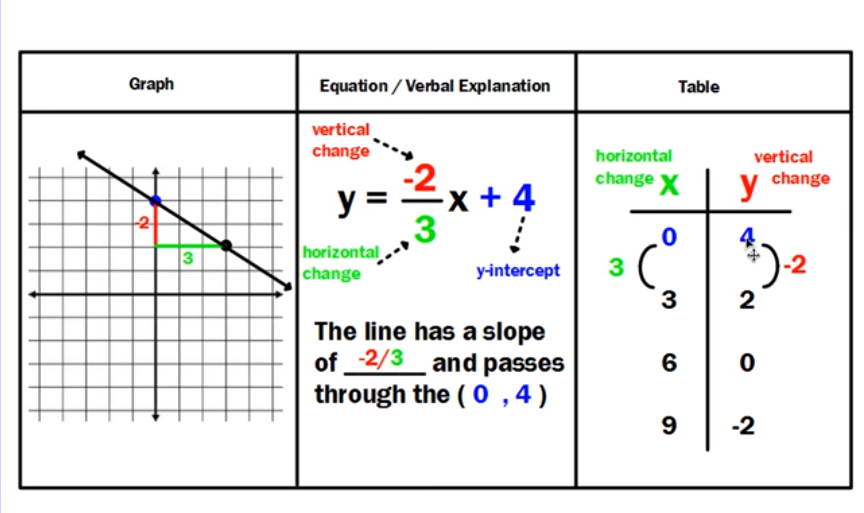
Here we have the function .
- Algebraic: The formula gives us a precise rule for calculating the output for any given input.
- Numerical: The table shows specific coordinate pairs. For example, we can see that when , , and when , .
- Graphical: The graph gives us a visual understanding. We can immediately see it's a straight line that slopes downward, crossing the y-axis at 4. The slope (rise over run) of -2/3 is also visible.
- Verbal: We can describe it as "a line with a slope of -2/3 and a y-intercept of 4."
In your work with networks and systems, you likely encounter similar multi-faceted descriptions: a system's behavior might be described by stakeholder requirements (verbal), defined by a precise algorithm (algebraic), tested with specific input-output cases (numerical), and its performance visualized in a dashboard (graphical). Mastery of these four perspectives is a universally applicable skill.
Conclusion
In this introductory lesson, we have laid the groundwork for our study of calculus.
Key Takeaways:
- A function is a rule that assigns exactly one output to each input.
- The four ways to represent a function are:
- Verbal (a description in words)
- Numerical (a table of values)
- Graphical (a plot on a coordinate plane)
- Algebraic (an explicit formula or equation)
- The Vertical Line Test is a graphical method to determine if a curve represents a function.
- Fluency in all four representations is crucial for modeling and problem-solving.
In our next lesson, we will build upon this foundation. We will learn how to extract key information—such as the real-world meaning of its features—from a function's representation, which corresponds to Section 1.1 of your textbook.