Introduction
In our last session, we mastered the process of calculating the derivative at a single, specific point, , by evaluating the limit of the difference quotient. While powerful, this method is inefficient if we need to know the rate of change at many different points on a function's curve.
Today, we will make a significant conceptual leap. Instead of finding the slope at a fixed point , we will let that point be a variable, . This generalization allows us to derive a new function, , called the derivative function. This function acts as a formula, giving us the slope of the tangent line to the original function at any point . Our goal is to define this new function and, just as importantly, to understand its own domain by identifying where the original function is "differentiable".
From a Point to a Function
The definition of the derivative function is a natural extension of what you've already learned. We simply replace the constant with the variable .
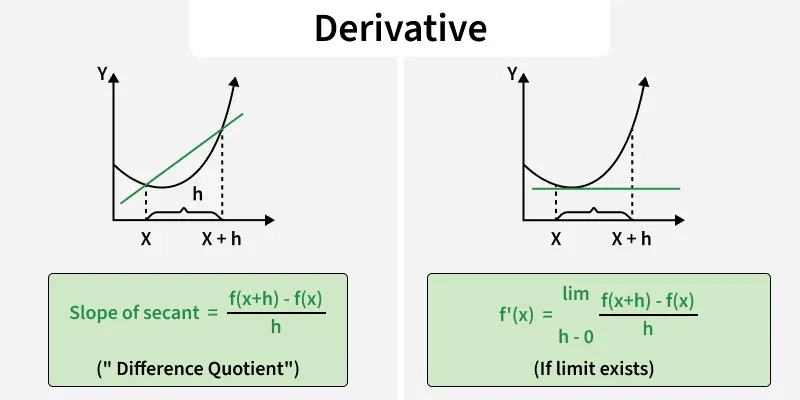
The "algorithm" for finding the derivative remains the same: set up the limit, expand, simplify, and evaluate. The key difference is that your final answer will be a function of , not a single number.
3.2 The Derivative as a Function - Calculus Volume 1 | OpenStax
To formalize this idea, let's turn to the OpenStax textbook, Calculus Volume 1.
Please read the subsection Derivative Functions. This section provides the formal definition of f'(x) and clarifies the terminology of a function being "differentiable."
As you can see, the definition is:
provided the limit exists.
This derivative function, , can be written in several ways. Your textbook and others use different notations, and you should be comfortable with all of them.
Calculus 1 Lecture 2.1: Introduction to the Derivative of a Function
Professor Leonard provides an excellent overview of the common notations for the derivative.
Watch this segment from 1:11:54 to 1:13:20. He explains the meaning of f'(x), y', \frac{dy}{dx}, and \frac{d}{dx}[f(x)]. Recognizing these different forms is crucial as you encounter them in various contexts.
Calculating the Derivative Function
Let's apply the definition to find the derivative function for a couple of examples.
Calculus 2.8 The Derivative as a Function
This video from Asher Roberts provides a clear walkthrough for finding the derivative of a polynomial.
Watch the example beginning at 3:06, where the derivative of f(x) = x^3 - x is calculated. Pay attention to how the algebraic steps—expanding (x+h)^3, canceling terms, and factoring out h—are identical to the process from our last lesson, but now yield a function, 3x^2 - 1.
Now let's consider a function with a radical. This will also give us our first hint about the domain of a derivative.
Calculus 2.8 The Derivative as a Function
The next example in the same video calculates the derivative for a square root function. This is a key example because it demonstrates how the domain of the derivative can differ from the domain of the original function.
Watch the segment from 8:18 to 12:18. The video calculates the derivative of f(x) = \sqrt{x} and then carefully analyzes the domains of both f(x) and f'(x).
As you saw, the derivative of is .
- The domain of the original function, , is , because we can take the square root of 0.
- The domain of the derivative function, , is . We must exclude because it would lead to division by zero.
This raises a critical question: What does it mean geometrically for a function to be defined at a point, but for its derivative not to be? This brings us to the concept of differentiability.
Differentiability: When Does the Derivative Exist?
A function is said to be differentiable at a point if exists. For to exist, the limit in its definition must exist.
There is a fundamental connection between a function being differentiable and it being continuous.
3.2 The Derivative as a Function - Calculus Volume 1 | OpenStax
The OpenStax chapter Derivatives and Continuity explains this relationship clearly.
Read the text from the beginning of the section until the summary points just before Example 3.14. You can start reading at this point. Focus on Theorem 3.1 (Differentiability Implies Continuity) and the examples that show the converse is not true.
The key takeaway is that if a function is differentiable at a point, it must be continuous there. However, the reverse is not true. A function can be continuous at a point but fail to be differentiable. This failure can happen for several reasons, which correspond to "sharp" features in the graph.
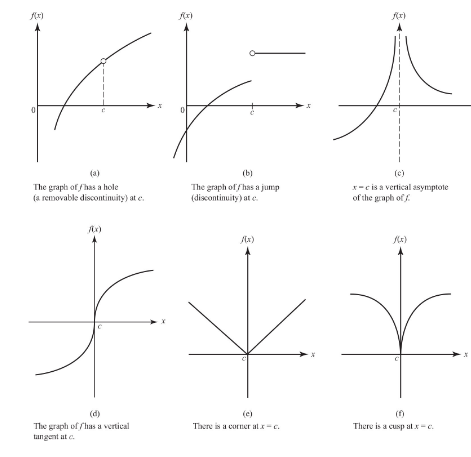
The main types of non-differentiable points for a continuous function are:
- Corners: The classic example is the absolute value function, , at . The slopes from the left (-1) and the right (+1) are different, so the two-sided limit for the derivative does not exist.
- Cusps: A cusp is like an infinitely sharp corner, for example at . Here, the tangent lines approach vertical from opposite directions.
- Vertical Tangent Lines: For a function like at , the slope of the tangent line becomes infinite. Since the derivative must be a finite number, it does not exist at that point. This is precisely what happens with at .
The following video provides an excellent and detailed breakdown of why is not differentiable at , showing how the left- and right-sided limits of the difference quotient do not match.
Calculus 2.8 The Derivative as a Function
Let's return to the Asher Roberts video for a rigorous look at the absolute value function.
Watch the detailed explanation from 16:42 to 24:24. This clip demonstrates why the derivative doesn't exist at a "corner" by computing the limits from the left and right and showing they are unequal.
Therefore, the domain of the derivative function is the set of all points where is both continuous and does not have a corner, cusp, or vertical tangent.
Conclusion
In this lesson, we have generalized the concept of the derivative from a value at a single point to a function in its own right. This derivative function, , encodes the instantaneous rate of change of the original function across its entire domain.
Key Takeaways:
- The derivative function is defined as . It gives a general formula for the slope of the tangent line to at any point .
- A function is differentiable at a point if its derivative exists there.
- Differentiability implies continuity: For a function to have a derivative at a point, it must be continuous at that point.
- Continuity does not imply differentiability: A continuous function can fail to be differentiable at points where its graph has a corner, a cusp, or a vertical tangent line.
- The domain of consists of all points in the domain of except for those where is non-differentiable.
We have begun to see the relationship between the properties of (like its slope) and the properties of (like its value). In our next lesson, we will explore this connection in a purely visual way. You will learn how to look at the graph of a function and sketch the graph of its derivative, a skill that deepens your intuition for how these functions relate.