Welcome to your first lesson. We'll begin our journey into the mathematics for AI and machine learning by building a solid algebraic foundation. You've mentioned that algebraic fractions can be a point of difficulty, so we'll tackle that head-on. Mastering the manipulation of these expressions is fundamental, as they appear constantly in more advanced topics like calculus and optimization algorithms.
Today, we will focus on simplifying complex rational expressions. These are essentially fractions that have other fractions inside their numerator, denominator, or both. By the end of this lesson, you will be able to take a messy, multi-layered fraction and simplify it into a much more manageable form using two powerful and reliable methods.
What is a Complex Rational Expression?
First, let's be precise about what we're working with. A simple rational expression is a fraction where the numerator and denominator are polynomials, like . A complex rational expression is one where the numerator, the denominator, or both contain their own fractions.
For a formal definition and a few examples of what these look like, please read the short introductory section in the following resource from Mathematics LibreTexts.
7.4: Simplify Complex Rational Expressions - Mathematics LibreTexts
This reading will introduce the formal definitions of a complex fraction and a complex rational expression.
Please read the beginning of the text, from the start down to the end of the introduction. Pay attention to the three examples shown to see the different forms these expressions can take.
As you can see, expressions like can look intimidating. Our goal is to develop a systematic way to simplify them. We will explore two primary methods to do this.
Method 1: Simplify and Divide
This first method is very methodical and relies on skills you already have: adding, subtracting, and dividing fractions. The core idea is to treat the main fraction bar as a division symbol.
The steps are as follows:
- Turn the numerator of the complex fraction into a single fraction. This usually involves finding a common denominator for all the terms in the numerator and combining them.
- Do the same for the denominator of the complex fraction, turning it into a single fraction.
- Now that you have one fraction divided by another, rewrite the problem by multiplying the numerator fraction by the reciprocal of the denominator fraction (the "keep-change-flip" rule).
- Simplify the resulting expression by factoring and canceling any common factors.
The image below shows the final step of simplifying a rational expression by factoring and canceling. This is the last thing you'll do in almost every problem.
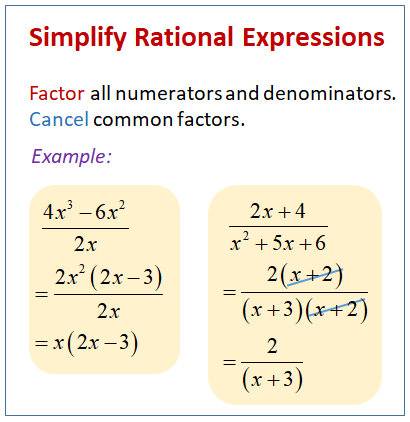
Now, let's see this method applied to a complex expression. The following reading provides a clear, step-by-step example.
7.4: Simplify Complex Rational Expressions - Mathematics LibreTexts
This example will walk you through applying the "Simplify and Divide" method to an expression with variables.
In the article, find "Example \PageIndex{3}". Read through the full solution. Notice how it first combines the terms in the numerator into one fraction and the terms in the denominator into another before performing the division.
This method is reliable and builds on familiar procedures. It breaks a complex problem down into a series of simpler ones.
Method 2: Multiply by the Least Common Denominator (LCD)
The second method is often faster and more direct, especially when the expression is very "complex." It's a clever technique for clearing all the "mini-fractions" in a single step.
The steps are:
- Identify all the individual denominators within the complex rational expression.
- Find the Least Common Denominator (LCD) of all these denominators.
- Multiply both the numerator and the denominator of the main fraction by this LCD. Since you're multiplying by , which is just 1, you are not changing the value of the expression.
- Distribute the LCD to every term in the numerator and denominator. This will cancel out all the smaller denominators.
- Simplify the resulting fraction, factoring and canceling if possible.
The following image illustrates this process clearly.

To see this method in action and compare it with the first one, let's watch a short video.
Simplifying Complex Fractions (2 Methods)
The presenter in this video from Mario's Math Tutoring will demonstrate both methods on the same problem, which is a great way to see how they relate to each other.
First, watch the brief introduction from the beginning. Then, you can skip Method 1 and watch the explanation of Method 2. Pay close attention to how multiplying by the LCD clears all the denominators at once.
Choosing a Method and Seeing it in Action
So, which method is "better"?
- Method 1 (Divide) is great when the numerator and denominator are already simple fractions, like , or when there are few terms to combine.
- Method 2 (LCD) is often more efficient when you have multiple terms being added or subtracted in the numerator and denominator, as it clears all the fractions simultaneously.
With practice, you will develop an intuition for which method is likely to be more straightforward for a given problem.
Now, let's watch a video that works through several examples, primarily using the LCD method. This will help solidify your understanding.
Simplifying Complex Rational Expressions
This video from The Organic Chemistry Tutor provides clear, worked examples that show the power of the LCD method.
Watch the first two examples from the beginning to see the LCD method applied to expressions with variables. Then, to see how these concepts are combined to solve a much more challenging problem, watch the final example from the end. Don't worry if this last example seems complex; the goal is to see how the core skills of finding an LCD, distributing, and factoring all come together.
Conclusion
In this lesson, we established a foundational skill for your journey into higher mathematics. You learned how to systematically simplify complex rational expressions, which will be invaluable as we move forward.
Here are the key takeaways:
- A complex rational expression is a fraction that contains other fractions.
- Method 1 involves simplifying the numerator and denominator into single fractions first, then rewriting the problem as a division.
- Method 2 involves finding the LCD of all inner fractions and multiplying the main numerator and denominator by it to clear the fractions.
- Regardless of the method, the final step is always to factor and simplify the resulting expression as much as possible.
In our next lesson, we will apply these skills to solve equations that contain algebraic fractions. This is a natural progression from simplifying expressions to using them to find unknown values, a central task in algebra.