Introduction
In our last lesson, we confronted a fundamental challenge in GPU programming: thread divergence. We saw how conditional logic can shatter the lockstep execution of a warp, forcing the hardware to serialize different execution paths and leaving valuable computational units idle. You now understand the "what" and the "why" of this performance pitfall.
This lesson transitions from diagnosis to treatment. We will explore concrete strategies for refactoring conditional code to minimize or even eliminate divergence. Your goal is to develop a sense of "mechanical sympathy"—an intuition for writing code that works with the grain of the hardware, not against it. We will cover how the compiler assists you through predication, how to write branchless code yourself, and, most importantly, how to restructure algorithms to prevent divergence from the outset.
The Principle of Mechanical Sympathy
Before diving into specific CUDA techniques, let's establish a guiding principle that is paramount in all high-performance programming, from HFT systems to GPU kernels: mechanical sympathy. This is the practice of designing algorithms that are in harmony with the underlying hardware's strengths. For a GPU's SIMT architecture, this means prioritizing massive parallelism with uniform execution paths.
A linear search, often derided as inefficient in introductory computer science, can be vastly faster than a "more advanced" binary search on modern hardware if it allows for straight-line, branch-free execution over a small, cache-resident dataset. The CppCon talk below, while focused on CPUs, makes this point powerfully.
When Nanoseconds Matter: Ultrafast Trading Systems in C++ - David Gross - CppCon 2024
This clip from a talk on ultra-fast C++ trading systems introduces the concept of "mechanical sympathy" and shows how a simple, branch-free algorithm can outperform a more complex one by aligning with hardware features like caching and prefetching.
Watch the segment from this timestamp. Pay attention to the idea of algorithms being "in harmony with your Hardware" and how a linear search can embody this principle.
As we explore the following techniques, keep this principle in mind. The goal is always to restore the warp's ability to execute a single instruction stream.
Technique 1: Predicated Execution
The most direct hardware mechanism for avoiding branches is predication. Instead of jumping to a different code location, the hardware can execute an instruction but conditionally discard its result.
Consider this simple if statement:
if (threadIdx.x % 2 == 0) {
    // do something
} else {
    // do something else
}
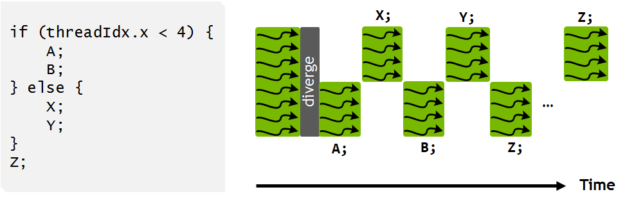
As we saw, this forces the warp to execute the if block and then the else block sequentially.
Now, consider a different case:
if (threadIdx.x % 2 == 0) {
    a = r(t);
} else {
    a = q(t);
}
y = f(a);
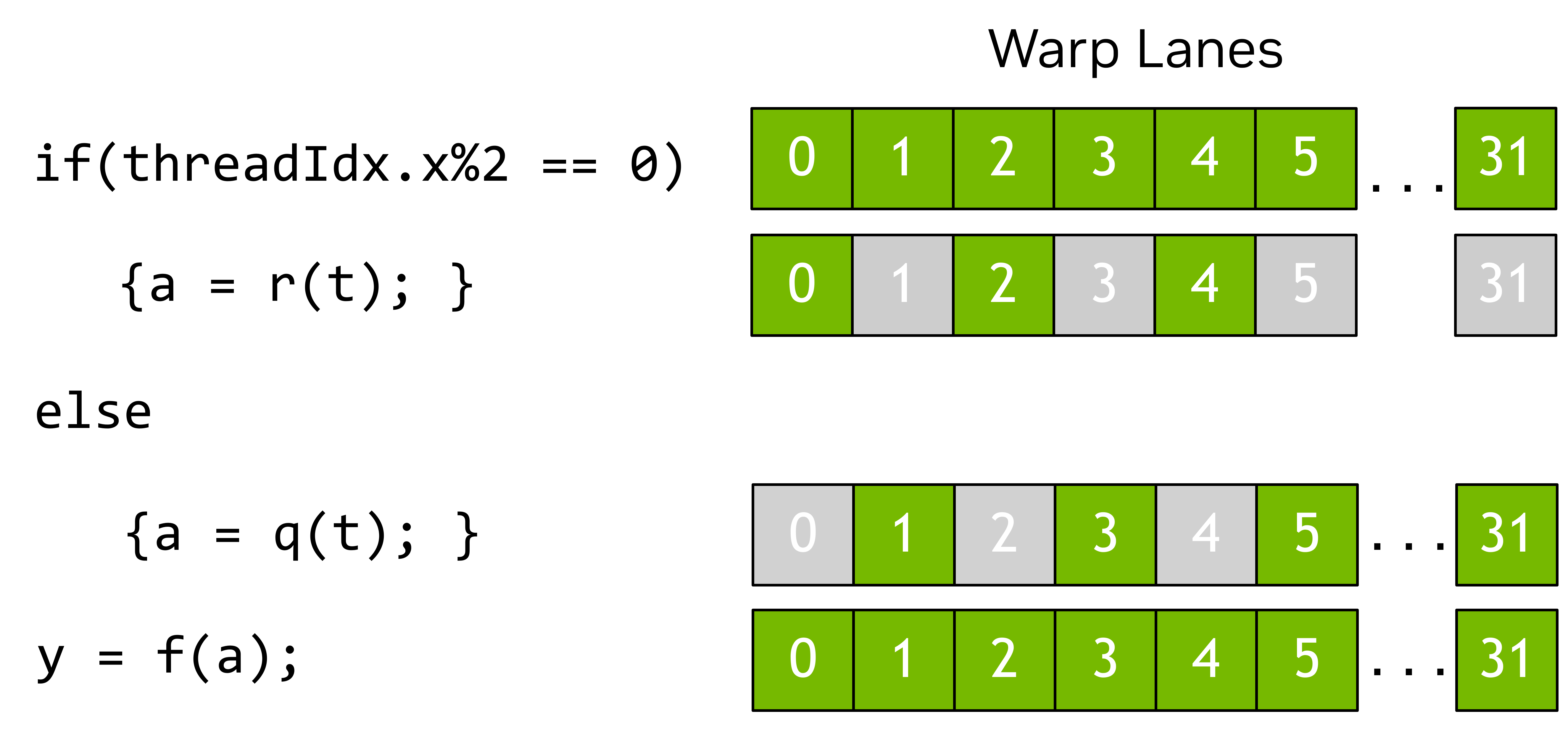
Here, the conditional logic only determines the value of a. The subsequent instruction, y = f(a), is common to all threads. In a scenario like this, the compiler can often perform an optimization called if-conversion. It transforms the branch into a sequence of predicated instructions.
Conceptually, the hardware executes both a = r(t) and a = q(t) for all threads, but for each thread, only the instruction corresponding to its true path is allowed to actually write its result to the register a. This way, there is no branching. The threads remain in lockstep, although some instructions are effectively turned into no-ops for certain threads. After this, all threads can execute y = f(a) together without any serialization.
This image from the NVIDIA documentation illustrates the concept. Even though the if-else block results in different values for a, the threads do not diverge in their control flow. All 32 lanes of the warp remain active and proceed in lockstep.
So, does this hardware feature solve the divergence problem? The answer is nuanced. The compiler will only replace a branch with predicated instructions if the conditional block is short. The trade-off is this:
- Branching: Serializes execution, but only executes the instructions for the paths taken.
- Predication: Avoids serialization, but executes instructions for all paths (some of which are nullified).
If the blocks are long, the cost of executing all instructions from both paths via predication would be higher than the cost of simply serializing the branches. The following forum discussion provides excellent insight into this mechanism.
[Solved] PTX ISA predicated execution and the warp divergence issue
This forum post by an NVIDIA compiler engineer explains how the GPU hardware supports predication to avoid branching for short conditional paths, and discusses the trade-offs the compiler considers.
Read the two replies starting from the first answer and the follow-up. Focus on understanding that predication is a hardware feature that converts control flow hazards into data hazards, and that the compiler uses heuristics to decide when to apply it.
Your key takeaway as a systems programmer is that for very short if blocks, you can often rely on the compiler to generate efficient, branch-free code using predication.
Technique 2: Algorithmic Refactoring
While predication is a powerful tool for small-scale conditionals, it doesn't help with complex logic or divergent loops. For these, a more fundamental change is needed: you must refactor the algorithm itself. A classic example where this is crucial is the parallel reduction.
A reduction algorithm collapses an array of values into a single value using an associative operator like addition or maximum. Let's analyze how different implementations handle divergence.
The following article walks through a 7-step optimization of parallel reduction. We will focus on the first few steps, which are directly related to eliminating divergence.
7 Step Optimization of Parallel Reduction with CUDA - Medium
This article provides an excellent case study in iterative optimization, showing how to transform a naive, divergent kernel into a highly efficient one. We will focus on the early steps that address divergence.
Read the section REDUCE-0. Pay close attention to the for loop and the condition if (tid % (2 * s) == 0). Convince yourself why this causes massive divergence: within a warp, even-indexed threads will follow a different path than odd-indexed threads. Next, read the section REDUCE-1. The code is refactored to remove the % operator and the divergent if. Analyze the new indexing int index = 2 * s * tid;. While this eliminates the original divergence problem, the article notes it introduces a new problem (bank conflicts), which we will cover in a later lesson. This is a common theme in optimization: fixing one bottleneck can expose another.
The refactoring from REDUCE-0 to REDUCE-1 is a direct application of what we're learning. The original code created a "checkerboard" pattern of active threads, causing divergence in every warp. The refactored code groups active threads together, improving warp uniformity.
However, a much better approach is to change the access pattern entirely.
7 Step Optimization of Parallel Reduction with CUDA - Medium
This section introduces a superior access pattern that greatly reduces divergence.
Now, read the section REDUCE-2. The core of the reduction loop is now for(unsigned int s = blockDim.x/2; s > 0; s >>= 1) with the condition if (tid < s). Think about how warps behave with this condition. For s=256 and a block size of 512, warps 0-7 will be fully active, and warps 8-15 will be fully inactive. Divergence only occurs in the single warp that straddles the boundary tid = s. This is a massive improvement.
This sequential addressing pattern is a cornerstone of efficient parallel primitives in CUDA. It concentrates active threads into contiguous blocks, ensuring that most warps are either fully active or fully inactive, thus minimizing divergence.
Technique 3: Eliminating Branches with Loop Unrolling
We can take this refactoring one step further. When the number of active threads (s) in the reduction drops below the warp size (32), something special happens. At this point, the entire reduction can be completed within a single warp.
Since all threads in a warp execute in lockstep, an explicit __syncthreads() is no longer necessary for intra-warp communication. Furthermore, the condition if (tid < s) becomes redundant; either the entire warp is active (if it's the first warp and s is, say, 16) or it's completely inactive. We can therefore "unroll" the last few steps of the loop into a sequence of branch-free instructions.
7 Step Optimization of Parallel Reduction with CUDA - Medium
These sections demonstrate how to eliminate the final conditional checks and synchronization calls by unrolling the loop for the last warp.
Read the sections REDUCE-4 and REDUCE-5. The key idea in REDUCE-4 is to replace the end of the for loop with a call to warpReduce. This warpReduce function is straight-line code with no loops or if statements, completely eliminating both instruction overhead and divergence for the final 32 elements. REDUCE-5 extends this idea to unroll even more of the loop using C++ templates.
This unrolling strategy is a powerful demonstration of mechanical sympathy. By understanding that the last 32 threads will be in the same warp, we can replace a general, conditional loop with a specialized, branch-free sequence of code that is perfectly tailored to the hardware's execution model.
Conclusion
In this lesson, we have moved from identifying the problem of divergence to actively solving it. You have seen that minimizing divergence is not a single trick, but a mindset that influences every level of programming, from small conditional expressions to the high-level structure of your algorithms.
Key Takeaways:
- Mechanical Sympathy: Strive to write code that aligns with the GPU's preference for uniform, parallel execution paths.
- Predication: For short conditional blocks, the compiler can often generate branch-free code by predicating instructions, executing them but only committing the results for threads where the condition is true.
- Algorithmic Refactoring: The most powerful technique is to redesign your algorithm to avoid divergence in the first place. Concentrating active threads, as in sequential addressing for a parallel reduction, ensures most warps are fully utilized.
- Loop Unrolling: For code segments known to operate within a single warp (e.g., the end of a reduction), you can unroll loops and remove conditional checks to create straight-line, highly efficient code.
You are now equipped with the fundamental strategies for managing control flow. In our next lesson, we will address another critical aspect of thread cooperation: how to safely modify shared data when multiple threads need to write to the same memory location, using atomic operations.