Introduction
In our last lesson, we established the "happy path" of GPU execution: the SIMT model, where all 32 threads in a warp execute the same instruction in lockstep. This model is the foundation for the GPU's immense throughput, enabling features like latency hiding and memory coalescing. However, real-world code is rarely a simple, straight line. It's filled with conditional logic—if, else, switch, and complex loops.
This raises a critical question for a systems programmer: what happens to this lockstep model when threads in a warp encounter a branch and need to go down different paths? This lesson confronts that question head-on. We will dissect the phenomenon of thread divergence, exploring how the hardware handles these situations and, crucially, analyzing the severe performance penalties that result. Understanding divergence is not just an academic exercise; it's a vital step toward writing truly high-performance kernels.
What is Thread Divergence?
At its core, thread divergence occurs whenever threads within a single warp follow different control flow paths. The SIMT execution model is built on the premise of a single instruction stream for the entire warp. When a conditional branch introduces multiple possible instruction streams, this premise is broken.
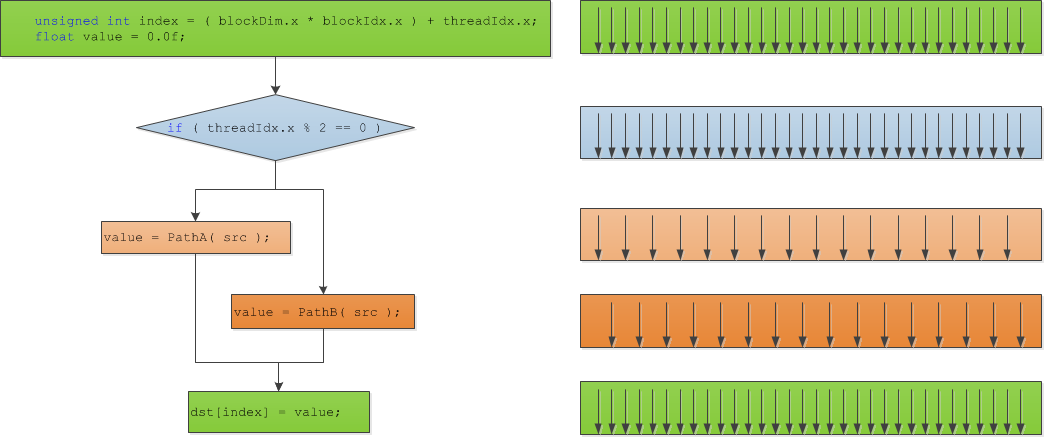
A simple if-else statement where the condition depends on the thread's data or its ID is the most common cause. Consider a check like if (threadIdx.x % 2 == 0). In any given warp, roughly half the threads will evaluate this to true, and the other half to false.
The following image provides a clear visual for this scenario. A simple conditional check splits the threads of a warp into two distinct groups, each needing to execute a different code path.
While if-else statements are a primary cause, divergence can also arise from loops where threads execute a different number of iterations. The following video from Udacity provides a good animated introduction to the concept, showing how threads that finish their work early are forced to sit idle.
Thread Divergence - Intro to Parallel Programming
This short video introduces thread divergence using a loop-based example, visually demonstrating how some threads are forced to wait, leading to a loss of efficiency.
Watch the full video from the beginning. Focus on the visualization of threads becoming idle and the explanation of why this leads to underutilization of the hardware.
In the last lesson, we distinguished between SIMT and the CPU's SIMD model. As it turns out, the ability of threads to diverge is the most significant behavioral difference between them.
03 CUDA Fundamental Optimization Part 1
In this brief clip from a talk on CUDA optimization, the presenter succinctly explains that the key distinction between SIMT and SIMD is how they handle conditional execution, with SIMT allowing threads to diverge.
Watch the Q&A excerpt from this timestamp. This will reinforce the concept of divergence as a defining characteristic of the SIMT model.
The Hardware Mechanism: Masking and Serialization
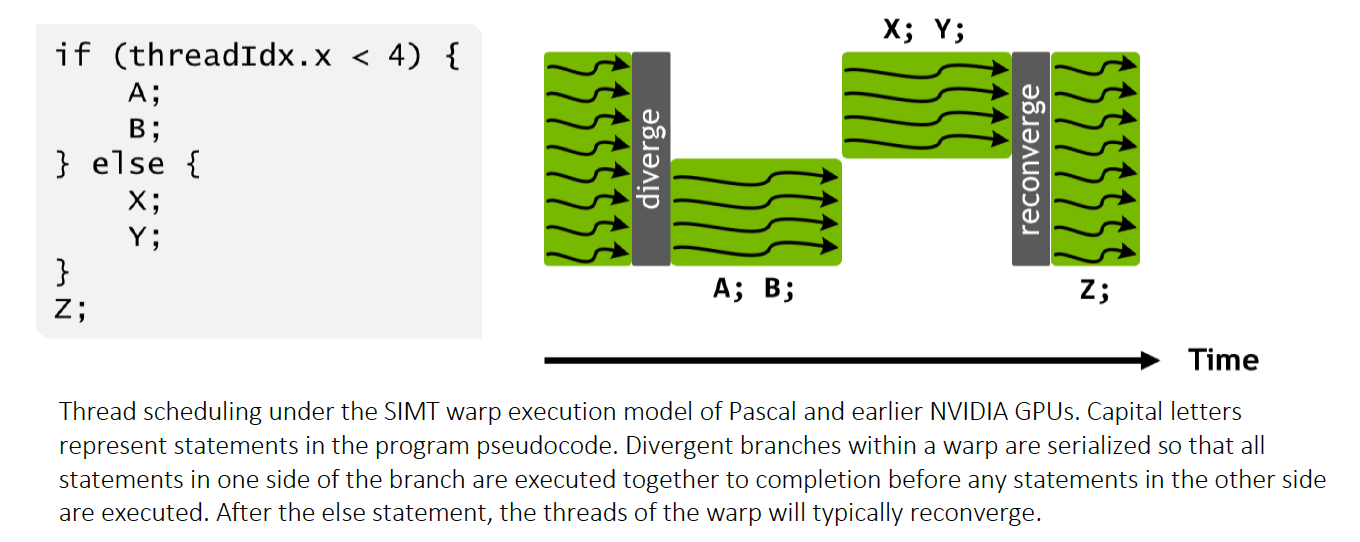
Since a warp scheduler can only issue one instruction at a time for a given warp, it cannot execute both the if and the else paths simultaneously. Instead, the hardware handles divergence through serialization.
- The warp scheduler first picks one path (e.g., the
ifblock). - It executes the instructions in that path. During this time, all threads that should take the
elsepath are masked off—they are temporarily disabled and do no work, but still occupy their hardware lane. - Once the
ifpath is complete, the scheduler reverses the mask. The threads that just executed are now disabled. - It then executes the
elsepath for the remaining threads. - After both paths are complete, the threads reconverge, and all 32 threads resume lockstep execution from the point after the
if-elseblock.
The crucial consequence is that the total time taken to execute the divergent branch is the sum of the time taken for both paths. The parallelism of the warp is temporarily broken.
This image provides an excellent timeline of this serialization process.
The following reading from DigitalOcean provides a concise, technical summary of this process.
CUDA Guide: Workflow for Performance Tuning
This article section explains the practical implications of SIMT, focusing on how divergence forces serialization and masked execution.
Please read the two sections starting with Warp Execution and CUDA Execution Hierarchy. Pay close attention to the terms "serialize execution" and "masked off."
Analyzing the Performance Impact
The performance cost of thread divergence is one of the most significant non-memory-related pitfalls in GPU programming. The impact stems from two primary factors:
-
Execution Unit Underutilization: While one branch of the divergent code is executing, a fraction of the 32 lanes in the SM are idle. If the warp is split 16/16, the hardware is running at only 50% of its potential throughput for that warp's execution time. In the worst case, if only one thread takes a path, 31 lanes are idle, representing a massive waste of computational resources.
-
Increased Total Execution Time: As noted, the warp executes all paths taken by any of its threads. A simple
if-elseblock effectively doubles the instruction count for the warp in that section of code, even though each individual thread only executes one path.
The severity of this penalty can be extreme. In cases of "full divergence," where each of the 32 threads in a warp takes a unique path (possible with switch statements or indexed pointer lookups), the execution becomes almost fully serialized, and the performance can degrade catastrophically.
The following text from ScienceDirect quantifies this impact with some stark numbers from different GPU architectures.
Thread Divergence - an overview | ScienceDirect Topics
These sections provide a formal definition of divergence and analyze its significant performance penalties, providing concrete examples of slowdowns.
First, read the introduction from the topic summary for a clear explanation of the multipass execution mechanism. Then, jump to the section on performance impact and read from the beginning of section 3 to see the quantitative analysis of the slowdown.
The figures mentioned—slowdowns of 4x, 27x, or even over 100x—underscore why managing divergence is critical for any performance-oriented GPU engineer.
A Modern NUANCE: Independent Thread Scheduling
In the last lesson, we touched on how modern GPUs (Volta architecture and newer) introduced Independent Thread Scheduling (ITS) to prevent SIMT deadlocks. This has a subtle implication for divergence.
On older, pre-Volta architectures, the reconvergence point was strict. The hardware used a stack-based mechanism, and the entire warp had to wait at the end of the if-else block until all paths were completed before proceeding.
With ITS, each thread effectively has its own program counter. While the hardware still serializes the divergent paths as described above, a thread that finishes its path can potentially be scheduled to do other independent work if the hardware has other ready warps to switch to.
This is a complex, low-level architectural detail. For your interest in systems programming, the key points are:
- ITS provides more scheduling flexibility and avoids certain deadlocks.
- It does not eliminate the performance penalty of serialization. The divergent paths are still executed one after another for that warp. Throughput is still lost.
You should always program with the goal of minimizing divergence, regardless of the architecture. ITS is a resilience feature, not a performance panacea for divergent code.
Thread Divergence - an overview | ScienceDirect Topics
This section delves deeper into the hardware mechanisms for managing divergence, including a description of Independent Thread Scheduling (ITS) on modern GPUs.
Read the paragraph starting Traditionally. This provides a good contrast between the older, strict reconvergence model and the more flexible ITS model. Note the final sentence, which correctly states that the performance penalty is not eliminated.
Conclusion
This lesson has taken us from the ideal, lockstep world of SIMT to the messy reality of conditional branching. We've seen that thread divergence is a direct violation of the SIMT model's "single instruction" principle, forcing the hardware into a serialized, multi-pass execution that significantly degrades performance.
Key Takeaways:
- Thread Divergence occurs when threads within a warp take different control flow paths, most commonly due to
if-elsestatements or variable-iteration loops. - The hardware handles this by serializing the execution of each path. It executes one path while masking (disabling) threads on other paths, then repeats for all paths taken.
- The performance impact is severe. It leads to underutilization of execution units as threads sit idle, and it increases the total instruction count for the warp, as all branches are executed sequentially.
- Modern architectures with Independent Thread Scheduling offer more flexibility in scheduling and prevent deadlocks, but they do not eliminate the fundamental performance penalty of serialization.
We have now thoroughly diagnosed the problem. You understand what divergence is, how the hardware handles it, and why it's so detrimental to performance. In our next lesson, we will shift from diagnosis to treatment, exploring practical strategies and coding patterns to refactor conditional logic and minimize the costly impact of divergence.