Introduction
In our last lesson, we explored Instruction-Level Parallelism (ILP), focusing on how modern CPUs use pipelining and superscalar execution to run different instructions concurrently. These techniques are about increasing the throughput of a sequence of varied operations. Today, we shift our focus to a different, more explicit form of parallelism that is at the very heart of high-performance computing and AI: data parallelism.
This lesson introduces SIMD (Single Instruction, Multiple Data), a powerful architectural feature that allows a single instruction to operate on multiple pieces of data simultaneously. Your learning objective is to explain what SIMD is and describe its crucial role in modern data-parallel computation. For you, with your goal of mastering high-performance computing, this concept is non-negotiable. It's a foundational principle that scales from a single CPU core to the massively parallel architecture of a GPU.
From Scalar to Vector: A New Paradigm
To understand SIMD, it's helpful to use a classification system for computer architectures called Flynn's Taxonomy. So far, we've implicitly assumed a SISD (Single Instruction, Single Data) model. In SISD, one instruction operates on one or two pieces of data at a time, like a = b + c. This is standard scalar processing.
SIMD introduces a new model where a single instruction triggers an operation on an entire vector of data at once.
Digital Design and Comp. Arch. - Lecture 19: SIMD Architectures (Vector and Array Processors) (S23)
This lecture from Professor Onur Mutlu provides an excellent introduction to Flynn's taxonomy and positions SIMD within it.
Please watch the segment from the taxonomy of computers. This will clarify the fundamental distinction between the SISD model we're used to and the SIMD model we're about to explore.
The core idea is to exploit the fact that many algorithms in scientific computing, graphics, and AI involve applying the same operation to large arrays of data. Instead of writing a loop that processes one element per iteration, SIMD hardware allows us to process a whole chunk of elements in a single clock cycle.
Let's visualize this difference. On the left is a scalar processor executing a single operation. On the right is a SIMD processor executing the same operation on eight data elements in parallel.
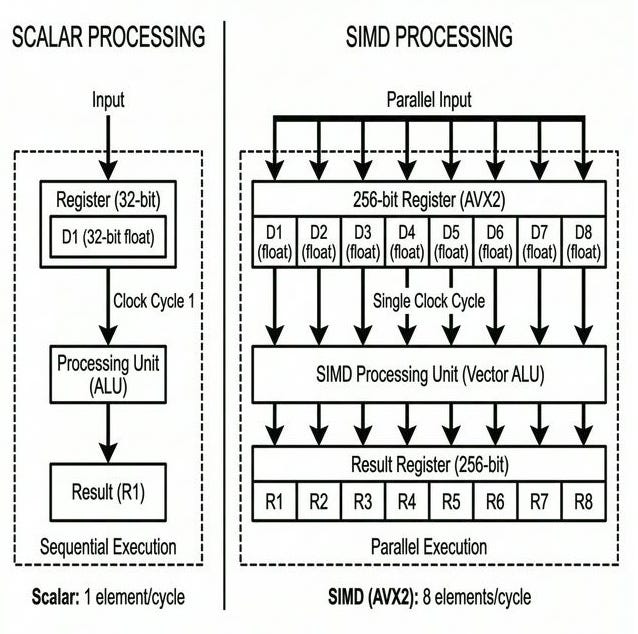
This parallel execution is made possible by specialized hardware within the CPU:
- Wide Registers: Modern CPUs include special vector registers (e.g., 128-bit XMM, 256-bit YMM, 512-bit ZMM registers on x86 architectures) that can hold multiple data elements.
- Vector ALUs: The processing units themselves are designed to perform operations (like addition or multiplication) across the entire width of these registers in parallel.

Structuring Data for SIMD
The transition to SIMD is not just about new instructions; it requires a fundamental shift in how you think about data layout in memory. The hardware is designed to load, process, and store contiguous blocks of similarly-typed data. To enable this, we often need to transform our data structures.
The two common data layouts are:
- Array of Structures (AoS): A standard C/C++ approach where you have an array of objects. For an array of 3D points, the memory might look like this:
XYZ XYZ XYZ XYZ ... - Structure of Arrays (SoA): A SIMD-friendly approach where you have a structure containing arrays of components. For the same 3D points, the memory would look like this:
XXXX... YYYY... ZZZZ...
Why does this matter? A SIMD instruction wants to load, for example, four X-coordinates at once. In the SoA layout, these are already contiguous in memory, allowing for a single, efficient load operation. In the AoS layout, the hardware would have to perform complex and slow "gather" operations to pick out the X-components from different structures.
What is SIMD? Abusing Vector Instructions Across Threads for Ray Tracing
This video provides a very clear, practical explanation of the AoS to SoA transformation.
Watch the first minute of the video, from the beginning, to see a visualization of this crucial data restructuring concept.
This SoA principle is a cornerstone of performance-oriented programming, especially in graphics and AI, where you are almost always working with large batches of similar objects (vertices, particles, vectors).
SIMD in Practice: Auto-Vectorization and Intrinsics
So, how do you actually make the CPU execute SIMD instructions? There are two primary methods.
1. Compiler Auto-Vectorization
Modern compilers are incredibly sophisticated. For simple, well-structured loops where the data dependencies are clear, the compiler can often automatically recognize the opportunity for data parallelism and generate SIMD instructions for you. This is known as auto-vectorization.
SIMD: A Practical Guide - by Caden Parker - Vectorized
This section of the article "SIMD: A Practical Guide" provides a great example of how a compiler can automatically convert a simple C++ loop into a single SIMD instruction.
Read the section titled "Writing programs that use SIMD". Pay close attention to the C++ code and the corresponding assembly, noting the difference between addss (scalar) and addps (packed/SIMD).
2. SIMD Intrinsics
Auto-vectorization is powerful, but it has limits. For more complex algorithms, or when you need explicit control over the generated code for maximum performance, you must use intrinsics. Intrinsics are special functions provided by the compiler (e.g., in <immintrin.h> for Intel/AMD) that map directly to a single assembly instruction.
Writing with intrinsics feels like a hybrid of C++ and assembly programming. You're still in a high-level language, but you are dictating the exact instructions the CPU will execute. This is a critical skill for kernel engineers.
Let's look at a snippet from a SIMD implementation of cosine similarity, a core operation in AI for comparing vector embeddings. The goal is to compute the dot product of two vectors, a and b. A dot product involves multiplying corresponding elements and summing the results.
A SIMD implementation for an x86 CPU with AVX2 support (256-bit registers) might involve a loop with the following core instruction:
// This is a conceptual C++ snippet using intrinsics.
// __m256 is a data type representing a 256-bit register holding 8 floats.
// ab_vec, a_vec, b_vec are __m256 variables.

// Fused-Multiply-Add: ab_vec += a_vec * b_vec
ab_vec = _mm256_fmadd_ps(a_vec, b_vec, ab_vec);
The _mm256_fmadd_ps intrinsic maps to a single CPU instruction that performs eight multiplications and eight additions in one go. After the loop processes the entire vectors in 8-element chunks, a final step is needed.
The ab_vec register holds eight partial sums. To get the final dot product, these partial sums must be added together. This is a common SIMD pattern called a horizontal accumulation or reduction. It's typically done after the main loop to avoid performance penalties.
Understanding SIMD: Infinite Complexity of Trivial Problems - Modular
This detailed article from Modular shows how to build a high-performance SIMD kernel from scratch. We will focus on the core loop logic and the reduction step.
First, read the section Baseline implementation to understand the setup. Then, focus on the C code for the fused multiply-add instruction and its explanation. Finally, read the section "Reducing horizontal accumulation" to understand how the partial sums in the vector register are combined into a final scalar result.
Control Flow: The Challenge of if Statements
A major conceptual hurdle in SIMD is handling conditional logic. A SIMD unit executes one instruction at a time. It can't have one lane of the vector ALU execute the if block while another executes the else block. This is a fundamental constraint.
The solution is masking or predicated execution.
- A SIMD comparison (e.g.,
A > B) doesn't return a singletrueorfalse. Instead, it returns a mask register where each element is either all ones (if the condition was true for that lane) or all zeros (if false). - This mask can then be used in two ways:
- As a bitmask to perform logical operations (
AND,OR) that selectively zero out results from lanes where the condition was false. - With special
blendinstructions that select elements from one of two source registers based on the mask.
- As a bitmask to perform logical operations (
This effectively allows for conditional outcomes without actual branching, keeping all processing lanes active.
SIMD: A Practical Guide - by Caden Parker - Vectorized
This part of the guide explains conditional logic in SIMD clearly, from the comparison mask to the ConditionalMove helper function.
Please read the section titled "Conditional Moves". This is a critical concept that distinguishes SIMD programming from scalar programming and will be highly relevant when we discuss thread divergence on GPUs.
Conclusion
We have now seen two distinct forms of on-chip parallelism. ILP, from our last lesson, is about the processor finding and executing different independent instructions in parallel. SIMD is a more explicit form of data parallelism where a programmer structures their data and uses special instructions to execute the same operation on multiple data elements at once.
Key Takeaways:
- SIMD (Single Instruction, Multiple Data) is a class of parallel computer architecture that executes the same instruction on multiple data points simultaneously.
- It is the fundamental hardware mechanism for exploiting data parallelism in algorithms common to AI, graphics, and scientific computing.
- SIMD relies on wide vector registers to hold multiple data elements and parallel ALUs to process them in a single cycle.
- Effective SIMD programming requires careful data layout, often preferring a Structure of Arrays (SoA) over an Array of Structures (AoS).
- SIMD instructions can be generated automatically by a compiler (auto-vectorization) or programmed explicitly using intrinsics.
- Conditional logic in SIMD is handled not by branching, but by masking and predicated execution, which selectively combines results based on a comparison mask.
We've seen how parallelism can provide significant speedups. But what are the theoretical limits? Even if we have infinite processors or infinitely wide SIMD registers, can we make any program infinitely fast? The answer is no, and our next lesson will introduce Amdahl's Law, a simple but profound formula that explains why the serial portion of a program ultimately limits its potential for parallel speedup.