Introduction
In our last lesson, we took a crucial step in optimizing our matrix multiplication kernel by implementing shared memory tiling. We saw how this dramatically reduced traffic to slow global memory, resulting in a significant performance boost. The analysis of arithmetic intensity proved that this gain came from reusing data within the fast, on-chip shared memory.
We are now going to descend one final, critical level in the GPU's memory hierarchy. This lesson focuses on the path from shared memory to the even faster register file, where the actual computations happen. Our goal is to implement register-level tiling, a technique that maximizes data reuse from the fastest memory available to a thread. By assigning more work to each thread, we can hold frequently accessed data directly in registers, bypassing shared memory for much of the inner compute loop.
This technique is also known as thread coarsening. It represents a classic trade-off in high-performance computing: we will deliberately reduce the total number of active threads (making them "coarser") in exchange for making each thread's work significantly more efficient. Mastering this concept is essential for pushing kernels towards their peak theoretical performance.
From Shared Memory to Registers: The Core Idea
In our previous tiled kernel, each thread was responsible for calculating a single element of the output matrix tile. To do this, it had to repeatedly load elements from the tiles of A and B stored in shared memory. While much faster than global memory, these are still memory instructions. What if we could load an element once and use it many times without any further memory operations? This is the promise of the register file.
The video below gives an excellent high-level overview of this strategy.
Mini Project: How to program a GPU? | CUDA C/C++
The video "Mini Project: How to program a GPU?" by Tushar Gautam provides a clear, visual explanation of how to restructure the computation to leverage registers.
Please watch two key segments: First, watch the section on basic register tiling. The presenter explains the strategy of using one thread to compute multiple output elements. Notice how an element of matrix A or B, once loaded into a register, is reused for multiple calculations, avoiding repeated access to shared memory. Next, watch the segment on extending register reuse. This section shows how the idea can be scaled up, with each thread computing an entire 2x2 grid of output elements, further increasing the amount of work done per element loaded.
As the video illustrates, by making a single thread responsible for a 1xN or MxN tile of the output matrix, we create opportunities for extreme data reuse.
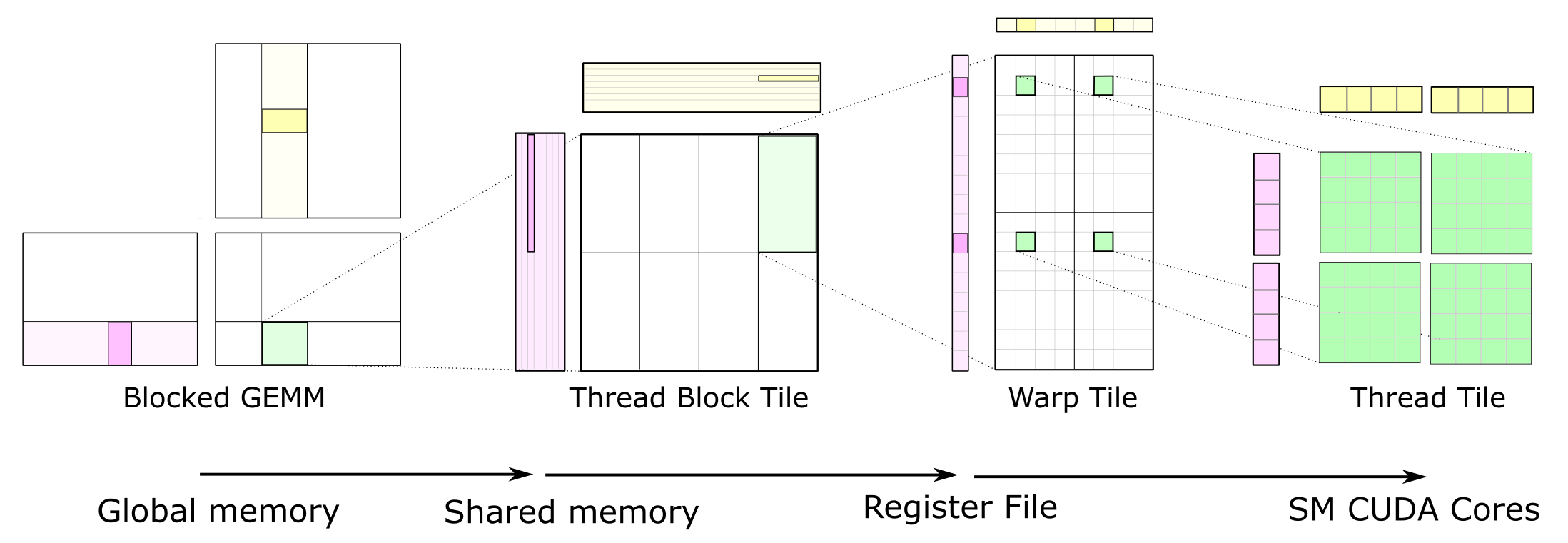
In our previous lesson, we optimized the "Global memory -> Shared memory" data path. Now, we are focusing on the "Shared memory -> Register File" path, aiming to keep "Warp Tile" and "Thread Tile" data in registers for as long as possible.
Designing the Register Tiling Strategy
To implement this, we must decide what data to store in registers and how to organize the threads. Let's consider the computation for a single output tile .
If one thread is responsible for computing an entire row of , it will need to access its corresponding row from over and over again while it iterates through all the columns of . This makes the row of a perfect candidate for caching in registers.
Conversely, each column of is needed by every thread, as each thread computes a different output row. Therefore, the tile of B, B_sub, is best kept in shared memory where all threads in the block can access it.
This leads to our core strategy:
- Thread Coarsening: Each thread will compute a
1xTSZ_COLSstrip of the output tile, whereTSZ_COLSis a small number like 4, 8, or 16. - Data Placement:
- The
Btile is loaded from global to shared memory. - Each thread loads the elements of the
Arow it needs into its private registers. - Each thread accumulates its
1xTSZ_COLSresults in private registers.
- The
- Computation: The inner loop performs a dot product by multiplying the
Aelements in its registers with theBelements fetched from shared memory.
This approach introduces a new constraint: register pressure. Registers are a finite resource. A thread can only hold so many values from matrix A and the partial results for matrix C. The size of the register tile (TSZ_COLS) is therefore limited by the available register file size per thread.
This blog post provides a great discussion of these design considerations.
Efficient Matrix Multiplication in CUDA: SMEM and Register Tiling
This article from Abhimanyu Talwar's blog dives into the practical details of designing a register-tiled kernel.
Please read the following two sections: Joint SMEM and Register Tiling: This section introduces the concept of "Thread Coarsening" and explains the trade-off you are making. Register Pressure and Input/Output Tile Shapes: This part details the exact strategy we just discussed—coarsening along the column dimension, storing A in registers, B in shared memory, and the impact of register pressure.
Implementing the Register-Tiled Kernel
Now let's translate this design into a CUDA kernel. The key change is that inside our main tile loop, each thread will have its own private arrays declared for the A data and the partial C results. These will be mapped to registers by the compiler.
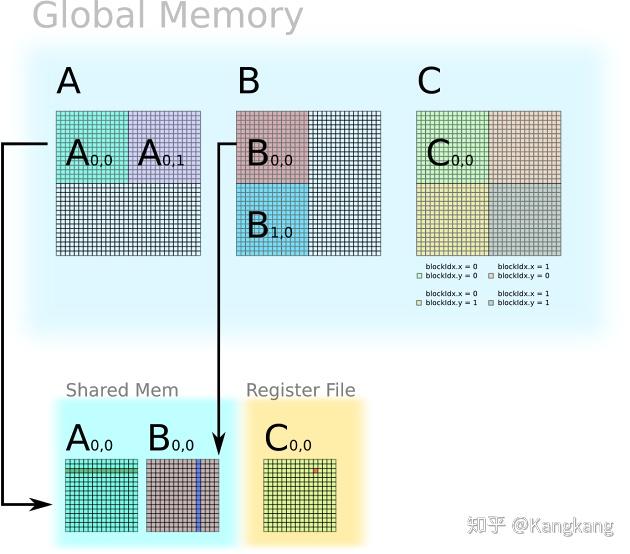
Visualizing our strategy: The A and B tiles are first loaded into shared memory (as before). But now, for the computation of the C tile, a thread will load a row of A into its private registers and reuse it, while accessing the columns of B from shared memory.
The following reading contains a complete, well-commented kernel that implements this exact strategy.
Efficient Matrix Multiplication in CUDA: SMEM and Register Tiling
This final section of the blog post provides the full CUDA C++ implementation.
Study the code in the section Kernel 4. Pay close attention to these three lines, which are the heart of the implementation: __shared__ float bdata_smem[TSZ_STRIPS][TSZ_COLS]; This declares the tile for matrix B in shared memory, accessible by all threads in the block. float adata_regs[TSZ_COLS]; This declares a private array for each thread to hold its required elements from matrix A. The compiler will place this in registers. float result_regs[TSZ_COLS] = {0.0f}; This declares a private array for each thread to accumulate the results for the portion of the output tile it's responsible for. This also lives in registers. Trace the logic of the nested loops inside the main for (int k = ...) loop. You will see how adata_regs is reused repeatedly as the code iterates through bdata_smem to compute the values in result_regs. Compare this to our previous tiled kernel, where every multiplication required two loads from shared memory. Here, one of those loads is replaced by a much faster register access.
The code might look complex, but it directly follows the logic we've built up: load a B tile into shared memory, load the necessary A data into registers, compute using the registers and shared memory, and repeat for all tiles.
Conclusion
In this lesson, you have implemented one of the most powerful optimization techniques for compute-bound kernels. By understanding the memory hierarchy down to the register level, you've taken control of data movement to ensure the GPU's arithmetic units are constantly fed.
Key Takeaways:
- Register Tiling (Thread Coarsening): This technique assigns multiple output elements to a single thread, reducing the total number of threads but making each thread's work more efficient.
- Maximizing Data Reuse: By storing frequently needed, thread-private data in registers (
Aelements andCresults), we minimize accesses to the slower shared memory, reducing bandwidth pressure and latency. - Strategic Data Placement: The key is to distinguish between data that needs to be shared among threads in a block (the
Btile in shared memory) and data that is private to a thread's computation (theAstrip in registers). - Register Pressure: This is a key hardware constraint that limits how much work a single thread can do. The size of your register tile is a tunable parameter that must be balanced against the GPU's available register file.
We have now dramatically improved the efficiency of the computation within a tile. However, we are still loading data from global memory using single-element loads. Our next step is to optimize the initial data loading phase itself.
In the next lesson, we will explore vectorized memory loads. We will learn how to use data types like float4 to instruct the GPU to load four floating-point numbers at once with a single instruction, effectively quadrupling our memory bandwidth from global memory and further closing the gap to a professionally optimized GEMM kernel.