Introduction
In our last lesson, you built a naive matrix multiplication kernel and diagnosed its fatal flaw: a massive number of redundant reads from slow global memory. Each thread made its own independent trip to the "pantry," making our kernel severely memory-bound. This lesson introduces the solution—our performance "hero"—that will defeat this bottleneck.
Today, we will refactor our GEMM kernel to use a powerful algorithmic technique called tiling, enabled by a key feature of the GPU architecture: shared memory. By having threads within a block cooperate to load data into this fast, on-chip memory, we can drastically reduce global memory traffic and unlock significant performance gains. This is a fundamental pattern in high-performance CUDA programming and a critical step in your journey to becoming a kernel engineer.
Our goal is to implement a tiled matrix multiplication kernel that leverages shared memory, understanding both the algorithm and its mapping to the GPU's hardware.
The Memory Hierarchy and Our Optimization Strategy
Before diving into the algorithm, let's quickly refresh our understanding of the GPU memory hierarchy. The performance difference between memory types is the entire motivation for tiling.
Give Me 30 min, I'll Make CUDA Click Forever
This segment from "Give Me 30 min, I'll Make CUDA Click Forever" by Zachary Huang provides a concise and effective overview of the GPU's memory hierarchy.
Watch the section from this timestamp. Pay close attention to the table comparing global memory, shared memory, and registers. The staggering difference in latency (400-800 cycles for global vs. 20-30 for shared) is the core problem we are about to solve. The "three-step plan" introduced at the end is exactly what we will implement today.
The Tiling Algorithm: Work Smarter, Not Harder
The central idea of tiling is to break a large problem into smaller, manageable chunks that can fit into a fast, local cache. Instead of each thread in a block fetching the entire row of matrix A and column of B it needs for its dot product, the threads will work together as a team.
The team (a thread block) will:
- Load a small sub-matrix, or tile, of A from global memory into shared memory.
- Load a corresponding tile of B from global memory into shared memory.
- Perform a partial matrix multiplication using only the data in fast shared memory.
- Repeat this process, accumulating the partial results, until the full dot product is complete.
This "cooperative fetching" strategy is a pure algorithmic optimization. The following resources explain the logic behind it.
Give Me 30 min, I'll Make CUDA Click Forever
The same video continues with an excellent kitchen analogy and a Python-based walkthrough to help you understand the logic of tiling before we touch any CUDA code.
Watch the section from the tiled approach. The key concept is breaking the dot product into "phases." Understanding how the partial sums from each phase combine to form the final result is crucial.
For a more visual, step-by-step breakdown of how the tiles are loaded and used to compute partial results, the following article is an excellent supplement.
CUDA Matmul (Part 2): Understanding Tiled Matrix Multiplication
This article from andreasholt.com provides a clear textual and visual explanation of the tiling process.
Read the section from the beginning of the example. The diagrams illustrating the two phases of computation for a 4x4 matrix are particularly helpful for visualizing how the full dot product for C[0,0] is constructed from partial results.
This animated diagram beautifully visualizes the core loop of the tiled algorithm. For each phase, tiles from A and B are loaded into shared memory, where threads use them to compute a partial result for the output tile in C.
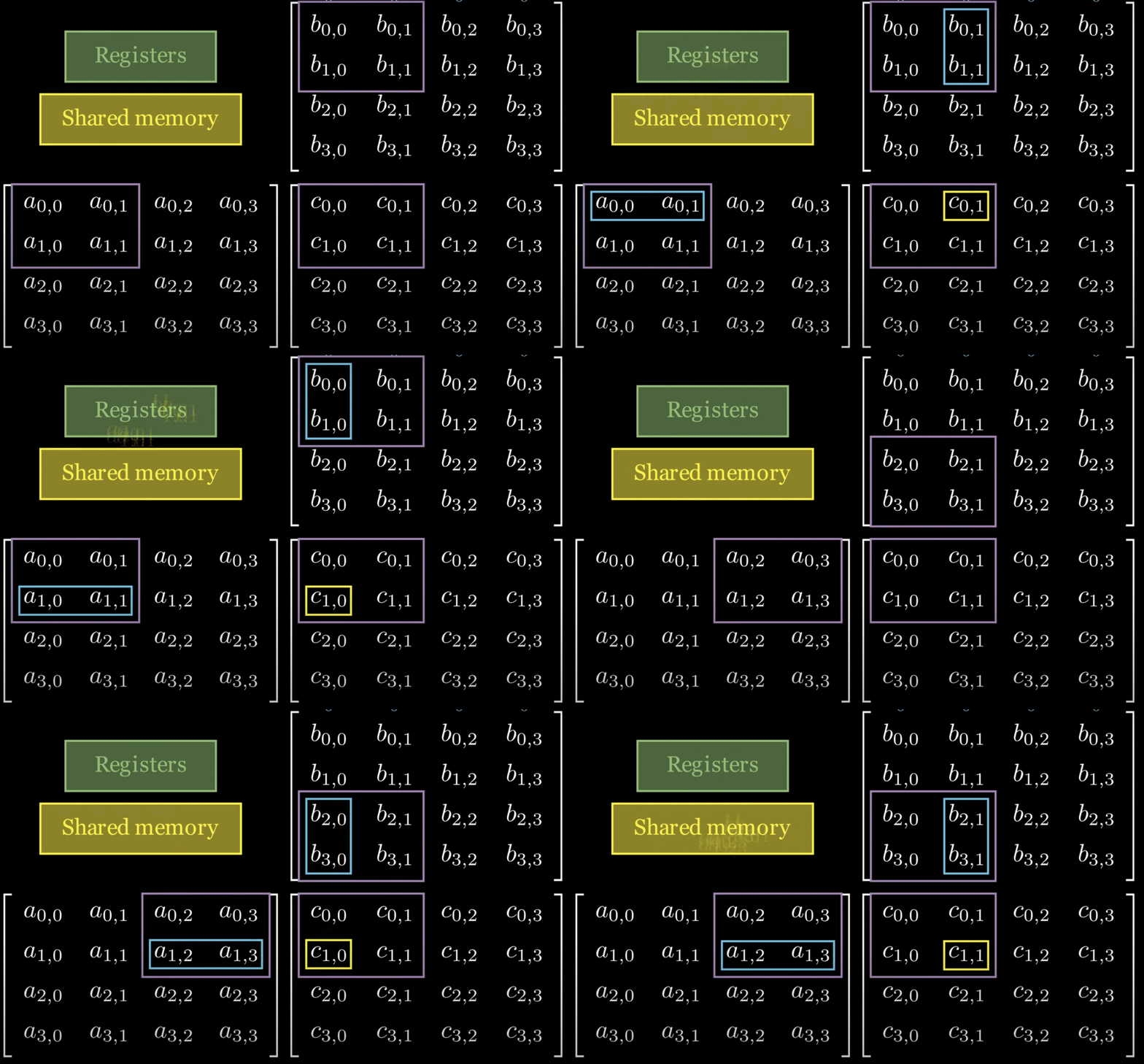
Implementing the Tiled Kernel in CUDA
Now we'll translate this algorithm into a CUDA kernel. The core of the implementation is the load -> synchronize -> compute pattern executed in a loop.
Here is what the overall structure of our tiled kernel will look like. We will break it down piece by piece.
template<int TILE_SIZE>
__global__ void tiled_matmul_kernel(const float* A, const float* B, float* C, int M, int N, int K) {
    // 1. Declare shared memory tiles
    __shared__ float shared_A[TILE_SIZE][TILE_SIZE];
    __shared__ float shared_B[TILE_SIZE][TILE_SIZE];

    // 2. Identify thread's position (global and local)
    int row = blockIdx.y * blockDim.y + threadIdx.y;
    int col = blockIdx.x * blockDim.x + threadIdx.x;
    int tx = threadIdx.x;
    int ty = threadIdx.y;

    float sum = 0.0f;

    // 3. Loop over tiles in the K dimension
    for (int tile = 0; tile < (K + TILE_SIZE - 1) / TILE_SIZE; tile++) {
        // 4. Load a tile of A and B from global to shared memory
        // ... loading logic ...

        // 5. Synchronize to ensure all data is loaded
        __syncthreads();

        // 6. Compute partial dot product from shared memory
        for (int k = 0; k < TILE_SIZE; k++) {
            sum += shared_A[ty][k] * shared_B[k][tx];
        }

        // 7. Synchronize again before loading the next tile
        __syncthreads();
    }

    // 8. Write final result to global memory
    if (row < M && col < N) {
        C[row * N + col] = sum;
    }
}
Let's dissect the most critical parts of this implementation. The following video and article provide detailed walkthroughs of the code.
Give Me 30 min, I'll Make CUDA Click Forever
Zachary Huang's video now presents the "hero" kernel, explaining the code that achieves the 100x speedup.
Focus on the breakdown of the main for loop from this section. It clearly explains the three-step pattern: load, synchronize, compute.
Step 1: Cooperative Loading
This is the most complex part of the kernel. Each thread in the block is responsible for fetching one element of A and one element of B from global memory and placing them into the correct position in the shared_A and shared_B tiles.

The indexing to load the correct global memory element can be tricky. The key is to combine the tile loop index with the thread's local index (tx, ty).
- For
shared_A, a thread at(ty, tx)within the block loads the elementA[row][tile * TILE_SIZE + tx]. All threads in the same row of the block (tyis constant) load elements from the same row of matrixA. - For
shared_B, the same thread loads elementB[tile * TILE_SIZE + ty][col]. All threads in the same column of the block (txis constant) load elements from the same column of matrixB.
The following resource provides a complete, well-explained implementation.
CUDA Matmul (Part 2): Understanding Tiled Matrix Multiplication
This article provides the full kernel code and then dissects each component. It's an excellent reference for the complete implementation details.
First, carefully study the full kernel code. Don't worry about understanding every line perfectly yet. Next, read the breakdown that follows, paying close attention to these sections: The explanation of the outer tile loop. The code and explanation for collaborative loading. The if statements here are boundary checks, which we will cover in a later lesson. For now, focus on the indexing logic inside the if block: a_col = tile * TILE_SIZE + tx. The crucial role of __syncthreads(). The explanation of the inner computation loop, which is the payoff step. Finally, look at the host function to see how the kernel is launched with a TILE_SIZE of 16, meaning each block will be 16x16 threads.
Step 2: Synchronization with __syncthreads()
As the resources emphasize, __syncthreads() is not optional. It acts as a barrier, forcing all threads in a block to wait at that line of code until every single thread in the block has arrived.
- The first
__syncthreads()is essential to prevent a race condition. Without it, a fast thread might start computing fromshared_Abefore a slower thread has finished writing its value intoshared_A. The result would be incorrect. It ensures the "workbench is fully stocked before anyone starts cooking." - The second
__syncthreads()is also important. It ensures that all threads have finished their computations with the current tile before any thread races ahead to the nextforloop iteration and starts overwriting the shared memory tiles with new data.
The Performance Payoff (A Preview)
By implementing this tiled approach, we dramatically reduce the number of slow global memory reads. Instead of each thread performing K reads from A and K reads from B (all from global memory), each thread now performs (K / TILE_SIZE) reads from A and (K / TILE_SIZE) reads from B. The rest of the K multiplications happen using ultra-fast shared memory.
Give Me 30 min, I'll Make CUDA Click Forever
This short clip quantifies the reduction in memory traffic, giving you a concrete sense of the optimization's power.
Watch from this timestamp. For a 1024x1024 matrix, the reduction from 2.1 billion global reads to 134 million is a staggering 16x improvement in memory efficiency.
Conclusion
In this lesson, you have learned and implemented one of the most important optimization techniques in CUDA programming. By replacing the naive, brute-force memory access pattern with a cooperative tiling strategy, you have taken a massive leap from a functionally correct kernel to a genuinely high-performance one.
Key Takeaways:
- Tiling is an algorithmic technique that improves performance by increasing data locality, breaking a large problem into smaller chunks that fit into fast cache memory.
- Shared memory is the fast, on-chip GPU memory that enables efficient tiling. It is accessible to all threads within a block.
- The fundamental pattern for tiled algorithms in CUDA is a loop that repeatedly executes a load-synchronize-compute sequence.
__syncthreads()is essential for correctness. It synchronizes all threads in a block, preventing race conditions where threads might access data before it's ready or overwrite data that's still in use.- This approach drastically reduces traffic to slow global memory, shifting the workload from waiting for memory to performing actual computation.
You have now built the "hero" kernel. In our next lesson, we will put it to the test. You will learn how to use the NVIDIA Nsight Compute profiler to scientifically measure the performance improvement, analyze the reduction in global memory traffic, and see just how much faster our new kernel is.